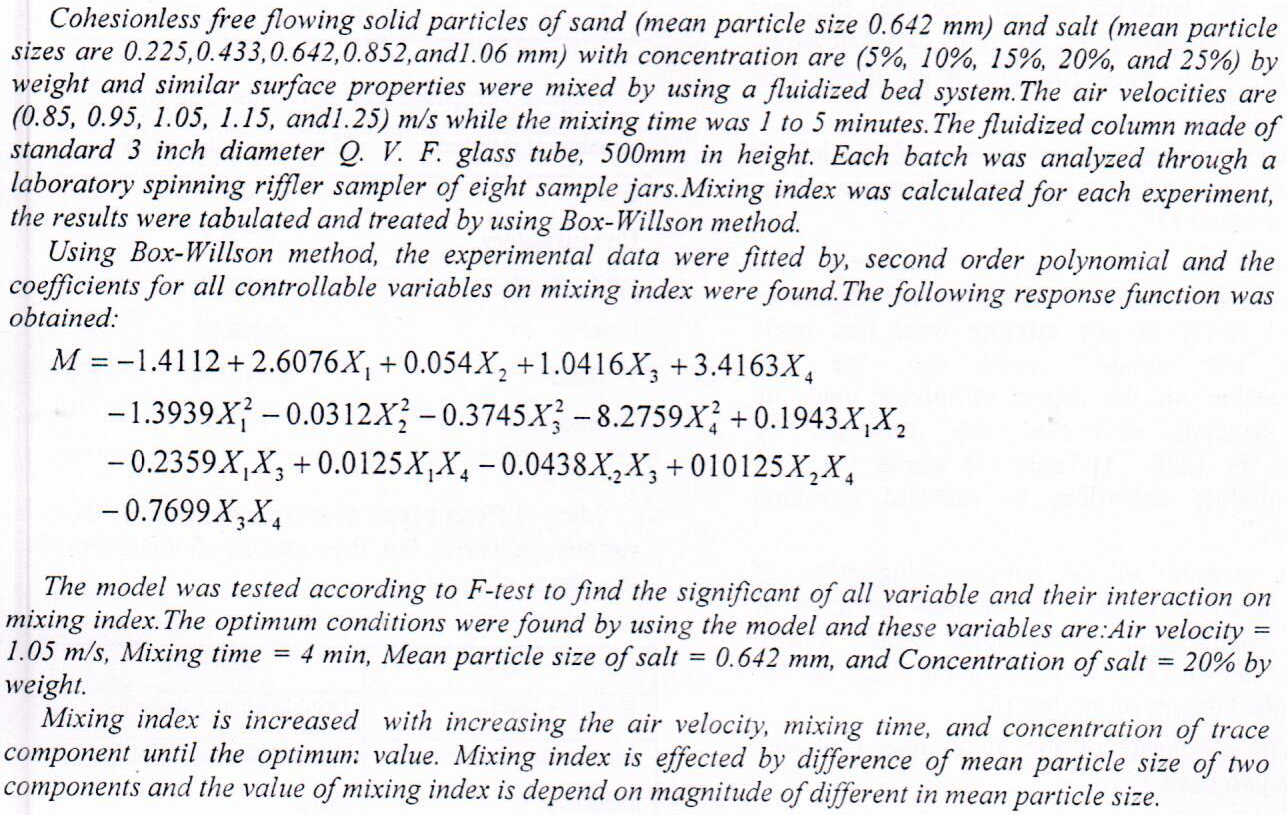
Performance of Mixing Granules Solid Materials by Fluidization

This work aims to analyze and study the bit performance in directional oil wells which leads to get experience about the drilled area by monitoring bit performance and analyzing its work. This study is concerned with Rumaila Oil Field by studying directional hole of one oil well with different angles of inclination. Drilling program was used in order to compare with used parameters (WOB, RPM and FR).in those holes. The effect of the drilling hydraulic system on the bit performance was studied as well as the hydraulic calculation can be done by using Excel program. This study suggests method which is used to predict the value of penetration rate by studying different formation type to choose the best drilling parameters t
... Show MoreThis study investigates self-perception and self-branding on Instagram among young Arab women in the UAE, focusing on how they curate, negotiate and perform their digital identities and whether their digital self-presentation in any way compromises their sense of authenticity. The study is based on 11 interviews with young women in the UAE, between the ages of 20 and 30, in addition to online observation to follow the participants’ activities on Instagram. The study demonstrates that while social and digital media platforms may play a role in “empowering” Arab women, women tend to set their boundaries of authenticity shaped according to their audience’s expectations and their in-groups. This confirms the r
... Show More (3)
(3)

Aim: To evaluate the effect of ultrasonic agitation for retrograde biodceramic root repair, MTA and biodentine filling materials on push-out bond strength to dentine walls. Materials and Methods: Ninety extracted human teeth with single straight roots were selected randomly. After disinfection and cleaning, the coronal portions were sectioned to standardize the root canal length at 15mm. following root canal shaping, obturation and apical roots resection, retrograde cavities were prepared. Teeth were categorized depending on the filling material used into three groups, 30 teeth each. Group A filled with bioceramic root repair material, B with MTA and C with Biodentine material. These groups were divided in to three subgroup (n= 10). Subgrou
... Show More (1)
(1)

Objectives: This study aimed to evaluate and compare the effect of plasma treatment versus conventional treatment on the micro shear bond strength (μSBS), surface roughness, and wettability of three different CAD/CAM materials. Materials and methods: Sixty cylindrical specimens (5 mm diameter ×3 mm height) were prepared from three different CAD/CAM materials: Group A: Zirconia, Group B: Lithium disilicate, and Group C: Resin nano-ceramic. Each group was subdivided into two subgroups according to surface treatment used: Subgroup I: Conventional treatment, zirconia was sandblasted with Al2O3, while lithium disilicate and resin nano-ceramic were etched with hydrofluoric acid. Subgroup II: Plasma treatment, the surface of each material was tr
... Show More
(20)
(15)

The research aimed at identifying the relationship between motivation and self–confidence on the performing routines in the parallel bar. The researchers used the descriptive method on (480) thirds year college of physical education and sport sciences/ university of Baghdad students. The data was collected and treated using proper statistical operations to conclude that there is a high correlation relationship between motivation and self-confidence with routine performance on parallel bars. In addition to that, the researchers concluded that third-year students have high motivation and self – confidence and there is a positive relationship between motivation, self-confidence, and routine performance on parallel bars.
(2)
The current work is concerned with preparing cobalt manganese ferrite (Co1-xMnxFe2O4) with different concentrations of cobalt and manganese (x=0.2, 0.4, and 0.6) and decorating it with polyaniline (PAni) for use in supercapacitive applications. The results of the X-ray diffraction (XRD) manifested a broad peak of PAni and a cubic structure of cobalt manganese ferrite having crystal size between 60 nm and 138 nm, which decreases with increasing concentration of Mn. The field emission scanning electron microscopy (FESEM) images evidenced that the PAni has nanofiber (NF) structures, according to the method of preparation, where the hydrothermal method was used. The magnetic properties of the prepared ferrite, as well as the prepared PAni/Co1-x
... Show MoreZinc-air fuel cells (ZAFCs) are a promising energy source that could compete with lithium-ion batteries and perhaps proton-exchange membrane fuel cells (PEMFCs) for next-generation electrified transportation and energy storage applications. In the present work, a flow-type ZAFC with mechanical rechargeable was adopted, combined with an auxiliary cell (electrolyzer) for zinc renewal and electrolyte recharge to the main cell. In this work a practical study was performed to calculate the cell capacity (Ah), as well as study the electrolysis cell efficiency by current efficiency, and study the effective parameters that have an influence on cell performance such as space velocity and current density. The best parameters were selected to
... Show More
In this research, an analysis for the standard Hueckel edge detection algorithm behaviour by using three dimensional representations for the edge goodness criterion is presents after applying it on a real high texture satellite image, where the edge goodness criterion is analysis statistically. The Hueckel edge detection algorithm showed a forward exponential relationship between the execution time with the used disk radius. Hueckel restrictions that mentioned in his papers are adopted in this research. A discussion for the resultant edge shape and malformation is presented, since this is the first practical study of applying Hueckel edge detection algorithm on a real high texture image containing ramp edges (satellite image).
(1)
(1)