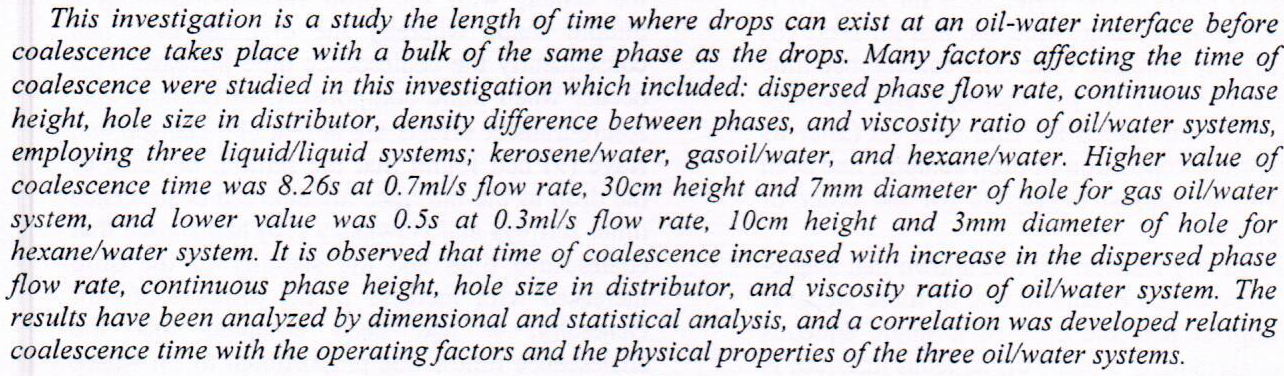
Drop Interface Coalescence in Liquid-Liquid System

In-situ gelation is a process of gel formation at the site of application, in which a drug product formulation that exists as a liquid has been transformed into a gel upon contact with body fluids. As a drug delivery agent, the in-situ gel has an advantage of providing sustained release of the drug agent. In-situ gelling liquid suppositories using poloxamer 188 (26-30% W/W) as a suppository base with 10% W/W naproxen were prepared, the gelation temperature of these preparations were measured and they were all above the physiological temperature. Additives such as polyvinylpyrrolidin "PVP" ,hydroxylpropylmethylcellulose "HPMC", sodium alginate and sodium chloride were used in concentration ranging from (0.25-1
... Show More (1)
(1)

The characterization and design of this study of new liquid crystals with a V shape compounds containing thiazolidine-2,4-dione and 1,3-phenylene as a core unite with mesophase properties were reported. Preparation and characterization of chloroacetic acid, water, and thiourea to produce thiazolidine-2,4-dione [I] in the presence of strong hydrochloric acid. The 4-hydreoxybenzaldehyde and n-alkyl bromide were reacted with potassium hydroxide to create the n-alkoxy benzaldehyde., then the compound [I] reacted with [II]n in presence of piperidine to produce compounds [III]n. Also, converted resorcinol to a corresponding compound [IV] by refl
... Show More
(1)
Discotic liquid crystal compounds were synthesized and characterized. Liquid crystalline texture of these compounds was investigated by polarized optical microscopy (POM). The Hartree-Fock approximation (HF) was used to calculate theoretical molecular parameters for synthesized compounds such as optimization, hardness, EHOMO, ELUMO, and energy gap using the Gaussian 09W program.
 (7)
(3)
(7)
(3)


Selective recovery of atropine from Datura innoxia seeds was studied. Applying pertraction in a rotating film contactor (RFC) the alkaloid was successfully recovered from native aqueous extracts obtained from the plant seeds. Decane as a liquid membrane and sulfuric acid as a stripping agent were used. Pertraction from native liquid extracts provided also a good atropine refinement, since the most of co-extracted from the plant species remained in the feed or membrane solution. Solid–liquid extraction of atropine from Datura innoxia seeds was coupled with RF-pertraction in order to purify simultaneously the extract obtained from the plant. Applying the integrated process, proposed in this study, a product containing 92.6% atropine was
... Show MoreIn the present work studies were carried out to extract a cationic dye (Methylene Blue MB) from an aqueous solution using emulsion liquid membrane process (ELM). The organic phase (membrane phase) consists of Span 80 as emulsifier, sulfuric acid solution as stripping agent and hexane as diluent.
In this study, important factors influencing the extraction of methylene blue dye were studied. These factors include H2SO4 concentration in the stripping phase, agitation speed in the dye permeation stage, Initial dye concentration and diluent type.
More than (98%) of Methylene blue dye was extracted at the following conditions: H2SO4 concentration (1.25) M, agitation
... Show More
(18)
Ag nanoparticles were prepared using Nd:YAG laser from Ag matel in distilled water using different energies laser (100 and 600) mJ using 200 pulses, and study the effect of the preparation conditions on the structural characteristics of and then study the effect of nanoparticles on the rate of killing the two types of bacteria particles (Staph and E.coli). The goal is to prepare the nanoparticle effectively used to kill bacteria.
(3)
(12)
(12)
In this study, (50–110 nm) magnetic iron oxide (α-Fe2O3) nanoparticles were synthesized by pulsed laser ablation of iron target in dimethylformamide (DMF) and sodium dodecyl sulfate (SDS) solutions. The structural properties of the synthesized nanoparticles were investigated by using Fourier Transform Infrared (FT-IR) spectroscopy, UV–VIS absorption, scanning electron microscopy (SEM), atomic force microscopy (AFM), and X-ray diffraction (XRD). The effect of laser fluence on the characteristics of these nanoparticles was studied. Antibacterial activities of iron oxide nanoparticles were tested against Gram-positive; Staphylococcus aureus and Gram-negative; Escherichia coli, Pseudomonas aeruginosa and Serratia marcescens. The results sh
... Show More
(232)
(226)