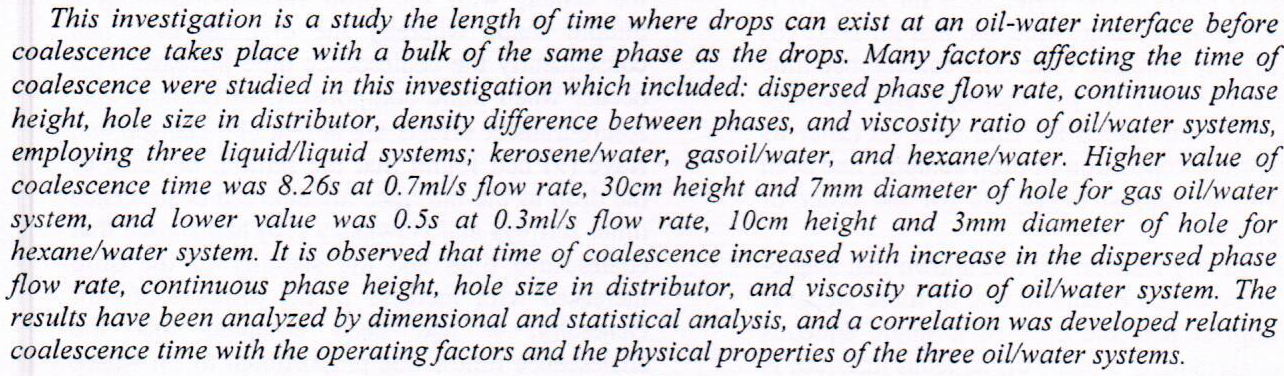
Drop Interface Coalescence in Liquid-Liquid System

Abstract Background: The emptied sheep’s ovarian follicles recently used as a container for spermatozoa during cryopreservation, it was found a proper carrier to cryopreserving spermatozoa in vapor-dependent cryopreservation. The aim of this study was to evaluate the effect of two periods of exposure to liquid nitrogen (LN2)vapor on the parameter of spermatozoa during cryopreservation in this technique. Method: The study was conducted on 30 semen samples from patients with oligozoospermia diagnosed by semen analysis according to the standard criteria of World Health Orgnization (WHO) 2010. Sheep’s ovarian follicles obtained from local slaughterhouse and prepared by slicing the ovaries and evacuating the follicular fluid and oocyt
... Show More
The new compounds synthesized by sequence reactions starting from a reaction of 4-hydroxybenzaldehyde with 1,5-dibromo pentane to produce dialdehyde)I( .Then compound )I( reacted with different aromatic amines to give schiff bases )IIIV(,thereafter added acetyl chloride to schiff bases to yield N-acyl derivatives)VVII(.While1,3-diazetine derivatives)VIII-X( were synthesized from the reaction of N-acyl derivatives with sodium azide.The reaction of thiourea with N-acyl compounds led to formation of thiourea derivatives (XI-XIII).Finally, the pyrimidine compounds )XIV-XVI( were synthesized by ring closure reaction of compounds(XIXIII) with diethyl malonate.The synthesized compounds were characterized by measurements of melting points,FTIR,1H-N
... Show More (1)
(1)
 (1)
(1)


Excess molar volumes of five ternary mixtures of 2- methoxy ethanol(1) +butyl acetate(2)+benzene(3), +toluene(3), +chlorobenzene(3), +bromobenzene(3), and +nitrobenzene(3) have been measured at 303.15K. The excess molar volume exhibited positive deviation over the entire range of composition in the systems 2-methoxy ethanol(1)+ butyl acetate(2)+ benzene(3),+toluene(3) and sigmoid behavior in the case of the remaining systems. Flory's statistical theory have been extended to predict the excess molar volumes of the five ternary mixtures at 303.15 k over a wide range of composition . An excellent agreement has been found between the experimental and theoretical excess molar volumes , both in magnitude and sign .
(13)
(15)
(23)
(22)
In this study, condensation polymerization was used to synthesize a number of novel liquid crystal polymers with 1,3,4-oxadiazole rings based on melamine. The new synthesized polymers were characterized by Fourier transform infrared (FTIR) and proton nuclear magnetic resonance (1HNMR) spectroscopy. Differential scanning calorimetry (DSC) and optical polarization microscopy (OPM) were used to investigate their liquid crystalline properties. The results demonstrated that throughout a wide temperature range, most of the polymers exhibited columnar (CohX) and nematic (N) liquid crystalline phases.
(1)
(1)
(56)
(49)
Three series of monomers, polymers and thioester cyclic compounds containing 4H-1,2,4-triazol-3-thiol moiety were synthesized and examined for their liquid crystalline properties. All monomers, polymers and thioester compounds were characterized by elemental analysis and FTIR, 1 H-NMR and mass spectroscopy. The phase transition and mesomorphic properties were investigated by polarized optical microscope (POM) and differential scanning calorimetry (DSC). The monomer with terminal phenyl substituent display dimorphism nematic and smectic A (SmA) mesophases. The corresponding polymers derived from acrylic and phenyl acrylic acid monomers show nematic mesophase. The only thioester cyclic compound derived from terephtaloyl chloride show nemati
... Show More
(15)
Gel polymer electrolytes (GPEs) have attracted considerable attention for rechargeable battery applications because of their high ionic conductivity, mechanical flexibility, and enhanced safety. In the present work, copper-ion-conducting PVA/HPMC gel polymer electrolytes were successfully prepared by the solution casting method using a 50:50 PVA/HPMC blend. Different CuSO₄ concentrations (10, 20, and 30 wt%) were incorporated into the polymer matrix, followed by the addition of 3 mL PANI/[BMIM][BF₄] polyionic liquid. The prepared electrolytes were characterized using scanning electron microscopy (SEM), differential scanning calorimetry (DSC), thermogravimetric analysis (TGA), and electrochemical impedance spectroscopy (EIS). SEM analysi
... Show More