Drop Interface Coalescence in Liquid-Liquid System
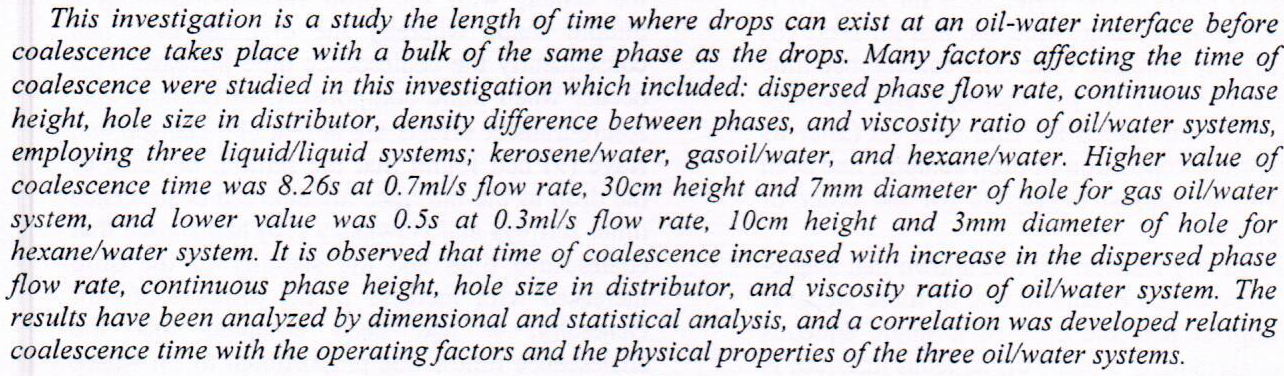

 (2)
(2)
 (1)
(1)

 (17)
(12)
(17)
(12)

Polyaniline (PANI) was prepared by polymerization via the chemical oxidation of aniline monomer with ammonium persulfate as the initiator. The interfacial polymerization method was used to prepare PANI/1-butyl-3-methylimidazolium tetrafluoroborate [BMIM][BF4] polyionic liquid (PIL). The obtained PANI/ [BMIM][BF4] PIL was investigated by the XRD, EDX, SEM, FTIR, and UV-Visible characterizations. X-ray diffractogram of PANI showed five prominent characteristic peaks at 27.1°, 24o, 21.8°, 19.8°, and 18.2°. This demonstrates the semi-crystalline character of the polyaniline produced through the interfacial polymerization process. Incorporation of [BMIM][BF4] into PANI reduced the crystalline phase and enhanced amorphicity. From the
... Show More
(5)
(6)
The increasing population growth resulting in the tremendous increase in consumption of fuels, energy, and petrochemical products and coupled with the depletion in conventional crude oil reserves and production make it imperative for Nigeria to explore her bitumen reserves so as to meet her energy and petrochemicals needs. Samples of Agbabu bitumen were subjected to thermal cracking in a tubular steel reactor operated at 10 bar pressure to investigate the effect of temperature on the cracking reaction. The gas produced was analyzed in a Gas Chromatograph while the liquid products were subjected to Gas Chromatography-Mass Spectrometry (GC-MS) analysis. Heptane was the dominant gas produced in bitumen cracking at all temperatures and the r
... Show More
Collapse of the vapor bubble condensing in an immiscible is investigated for n-pentane and n-hexane vapors condensing in cold water and n-pentane in two different compositions of glycerin- water mixture. The rise velocity and the drag coefficient of the two-phase bubble are measured.
This paper presents an experimental and theoretical analysis to investigate the two-phase flow boiling heat transfer coefficient and pressure drop of the refrigerant R-134a in the evaporator test section of the refrigeration system under different operating conditions. The test conditions considered are, for heat flux (13.7-36.6) kW/m2, mass flux (52-105) kg/m2.s, vapor quality (0.2-1) and saturation temperature (-15 to -3.7) ˚C. Experiments were carried out using a test rig for a 310W capacity refrigeration system, which is designed and constructed in the current work. Investigating of the experimental results has revealed that, the enhancement in local heat trans
... Show More
(3)
A simple, precise, rapid, and accurate reversed – phase high performance liquid chromatographic method has been developed for the determination of guaifenesin in pure from pharmaceutical formulations.andindustrial effluent. Chromatography was carried out on supelco L7 reversed- phase column (25cm × 4.6mm), 5 microns, using a mixture of methanol –acetonitrile-water: (80: 10 :10 v/v/v) as a mobile phase at a flow rate of 1.0 ml.min-1. Detection was performed at 254nm at ambient temperature. The retention time for guaifenesin was found 2.4 minutes. The calibration curve was linear (r= 0.9998) over a concentration range from 0.08 to 0.8mg/ml. Limit of detection (LOD) and limit of quantification ( LOQ) were found 6µg/ml and 18µg/ml res
... Show More
The aim of present work is to study the removal of phenol present in aqueous feed solution by the emulsion liquid membrane technique using kerosene as a diluent, sodium hydroxide as a stripping agent, and sorbitan monooleate (Span 80) as a surfactant. The parameters studied were: surfactant concentration, volume ratio of membrane phase to internal phase, and stirring speed. It was found that more than 98% of phenol can be removed at the conditions were surfactant concentration 2% (v/v), volume ratio of membrane phase to internal phase 5:1 and stirring speed 400 rpm. Maximum phenol extraction efficiency at 7 minutes of process time was observed. It was found that there was a good agreement between the standard kerosene an
... Show More
(5)
(3)
Pyrolysis of high density polyethylene (HDPE) was carried out in a 750 cm3 stainless steel autoclave reactor, with temperature ranging from 470 to 495° C and reaction times up to 90 minute. The influence of the operating conditions on the component yields was studied. It was found that the optimum cracking condition for HDPE that maximized the oil yield to 70 wt. % was 480°C and 20 minutes. The results show that for higher cracking temperature, and longer reaction times there was higher production of gas and coke. Furthermore, higher temperature increases the aromatics and produce lighter oil with lower viscosity.