Control of Calcium Scale and Corrosion of Medical City Cooling Water System using Sulfuric Acid
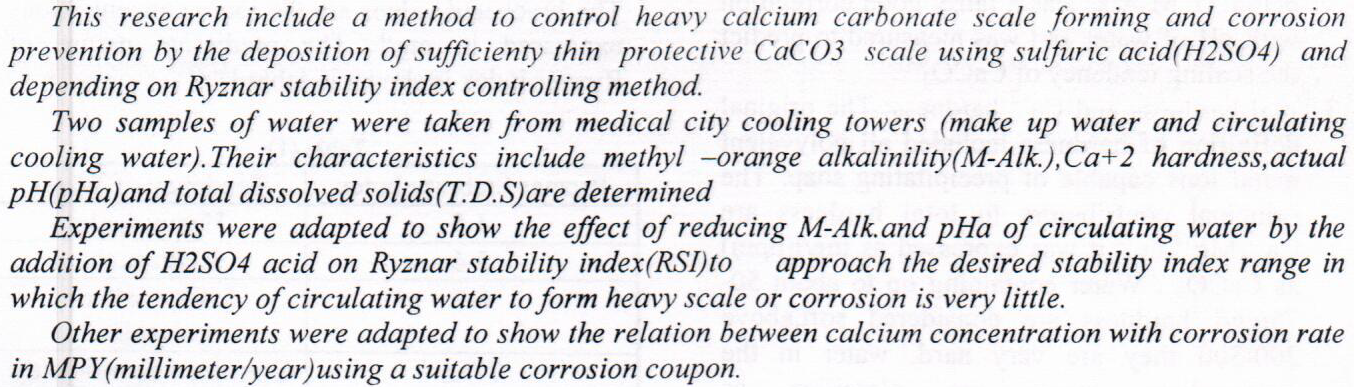

ENGLISH
 (4)
(4)

Groundwater quality deterioration due to anthropogenic natural activities and its immense utilization in various sectors is considered a great concern. The aim of this study is to determine the groundwater quality parameters at various sources in and around Dhaka city and compare them with Bangladesh drinking water standards. In this study, six groundwater quality parameters (pH, DO, COD, TS, TDS, and arsenic) and ten groundwater samples are analyzed to determine the water quality. The collected samples have maximum and minimum pH values of 6.9 and 6.4, respectively. Maximum and minimum DO values are 0.3 and 0.1 mg/L, respectively. The arsenic concentration is 0 mg/L for all collected groundwater samples. The maximum and minimum COD
... Show More (23)
(17)
(23)
(17)


This paper presents a fuzzy logic controller for a two-tank level control system, which is a process with a dead time. The fuzzy controller is a proportional-integral (PI-like) fuzzy controller which is suitable for steady state behavior of the system. Transient behavior of the system was improved without the need for a derivative action by suitable change in the rule base of the controller. Simulation results showed the step response of the two-tank level control system when this controller was used to control this plant and the effect of the dead time on the response of the system.
The present study investigates the effect of the de-sanding (recycling system) on the bearing capacity of the bored piles. Full-scale models were conducted on two groups of piles, the first group was implemented without using this system, and the second group was implemented using the recycling system. All piles were tested by static load test, considering the time factor for which the piles were implemented. The test results indicated a significant and clear difference in the bearing capacity of the piles when using this system. The use of the recycling system led to a significant increase in the bearing capacity of the piles by 50% or more. Thus it was possible to reduce the pile length by (15 % or more) thus, and implementation c
... Show More
The present study investigates the effect of the de-sanding (recycling system) on the bearing capacity of the bored piles. Full-scale models were conducted on two groups of piles, the first group was implemented without using this system, and the second group was implemented using the recycling system. All piles were tested by static load test, considering the time factor for which the piles were implemented. The test results indicated a significant and clear difference in the bearing capacity of the piles when using this system. The use of the recycling system led to a significant increase in the bearing capacity of the piles by 50% or more. Thus it was possible to reduce the pile length by (15 % or more) thus, and implementation costs
... Show More
(1)
In solar-thermal adsorption/desorption processes, it is not always possible to preserve equal operating times for the adsorption/desorption modes due to the fluctuating supply nature of the source which largely affects the system’s operating conditions. This paper seeks to examine the impact of adopting unequal adsorption/desorption times on the entire cooling performance of solar adsorption systems. A cooling system with silica gel–water as adsorbent-adsorbate pair has been built and tested under the climatic condition of Iraq. A mathematical model has been established to predict the system performance, and the results are successfully validated via the experimental findings. The results show that, the system can be operational
... Show More
(13)
(13)
This research has presented a solution to the problem faced by alloys: the corrosion problem, by reducing corrosion and enhancing protection by using an inhibitor (Schiff base). The inhibitor (Schiff base) was synthesized by reacting of the substrates materials (4-dimethylaminobenzaldehyde and 4-aminoantipyrine). It was diagnosed by infrared technology IR, where the IR spectrum and through the visible beams proved that the Schiff base was well formed and with high purity. The corrosion behavior of carbon steel and stainless steel in a saline medium (artificial seawater 3.5%NaCl) before and after using the inhibitor at four temperatures: 20, 30, 40, and 50 C° was studied by using thr
... Show MoreThis research has presented a solution to the problem faced by alloys: the corrosion problem, by reducing corrosion and enhancing protection by using an inhibitor (Schiff base). The inhibitor (Schiff base) was synthesized by reacting of the substrates materials (4-dimethylaminobenzaldehyde and 4-aminoantipyrine). It was diagnosed by infrared technology IR, where the IR spectrum and through the visible beams proved that the Schiff base was well formed and with high purity. The corrosion behavior of carbon steel and stainless steel in a saline medium (artificial seawater 3.5%NaCl) before and after using the inhibitor at four temperatures: 20, 30, 40, and 50 C° was studied by using three electrodes potentiostat. The corrosion behavior
... Show More
(19)
(6)
This research has presented a solution to the problem faced by alloys: the corrosion problem, by reducing corrosion and enhancing protection by using an inhibitor (Schiff base). The inhibitor (Schiff base) was synthesized by reacting of the substrates materials (4-dimethylaminobenzaldehyde and 4-aminoantipyrine). It was diagnosed by infrared technology IR, where the IR spectrum and through the visible beams proved that the Schiff base was well formed and with high purity. The corrosion behavior of carbon steel and stainless steel in a saline medium (artificial seawater 3.5%NaCl) before and after using the inhibitor at four temperatures: 20, 30, 40, and 50 C° was studied by using three electrodes potentiostat. The corrosion behavior was
... Show More
(19)
(6)
