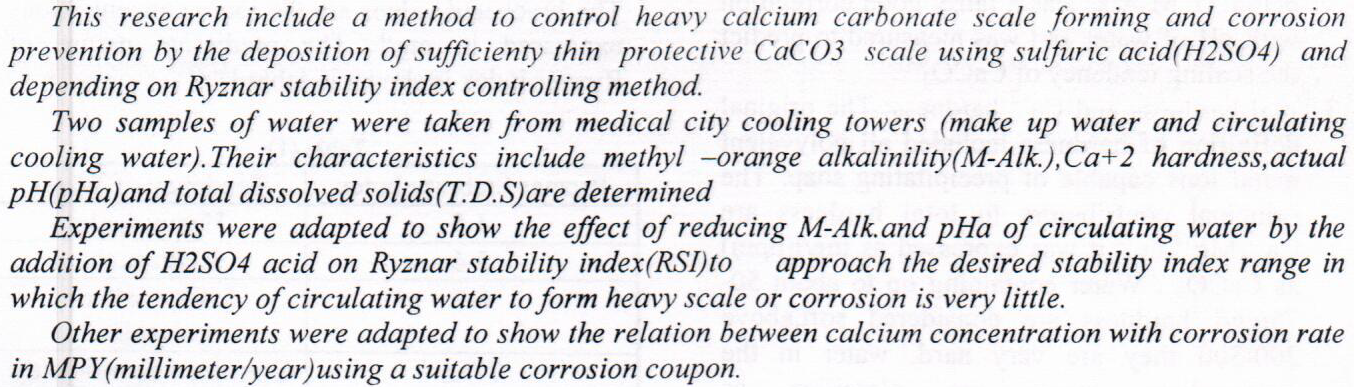
Control of Calcium Scale and Corrosion of Medical City Cooling Water System using Sulfuric Acid

 (14)
(14)

This study is considered to be the first on this sector of Tigris River after 2003, to evaluate the effect of Tharthar Arm on the composition and diversity of Copepoda in Tigris River. Six sampling sites were selected; two on the Tharthar Arm and four sites along the Tigris River, one before the confluence as a control site and the others downstream the confluence; thirty-five copepod taxa were recorded, 34 taxa in the Tigris River and 25 taxa in the Tharthar Arm.
The highest density of Copepoda was in site 2 at Tharthar Arm was 265584.2 Ind./m3 lead to an increasing in Copepoda density in Tigris River from 63878.2 Ind./m3 in site 1 before the confluence to 127198.3 Ind./m3 in site 4 immediately downstream the confluence. Also, the me
(15)
 (3)
(3)

ENGLISH
(1)
The present work presents design and implementation of an automated two-axis solar tracking system using local materials with minimum cost, light weight and reliable structure. The tracking system consists of two parts, mechanical units (fixed and moving parts) and control units (four LDR sensors and Arduino UNO microcontroller to control two DC servomotors). The tracking system was fitted and assembled together with a parabolic trough solar concentrator (PTSC) system to move it according to information come from the sensors so as to keep the PTSC always perpendicular to sun rays. The experimental tests have been done on the PTSC system to investigate its thermal performance in two cases, with tracking system (case 1) and without trackin
... Show More
(4)
This study aims to evaluate drinking water quality at the Al Wahda plant (WTP) in Baghdad city. A conventional water treatment plant with an average flow rate of 72.82 MLD. Water samples were taken from the influent and effluent of the treatment plant and analyzed for some physicochemical and biological parameters during the period from June to November 2020. The results of the evaluation indicate that treated water has almost the same characteristics as raw water; in other terms, the plant units do not remove pollutants as efficiently as intended. Based on this, the station appears to be nothing more than a series of water passage units. However, apart from Total dissolved solids, the mean values of all parameters in the study were
... Show More
(1)
This study aims to evaluate drinking water quality at the Al Wahda plant (WTP) in Baghdad city. A conventional water treatment plant with an average flow rate of 72.82 MLD. Water samples were taken from the influent and effluent of the treatment plant and analyzed for some physicochemical and biological parameters during the period from June to November 2020. The results of the evaluation indicate that treated water has almost the same characteristics as raw water; in other terms, the plant units do not remove pollutants as efficiently as intended. Based on this, the station appears to be nothing more than a series of water passage units. However, apart from Total dissolved solids, the mean values of all parameters in th
... Show More
(1)
By using the deacetylation method, chitin is converted into bioproduct chitosan. Deacetylation can be accomplished using chemical or biological mechanisms. Due to its biocompatibility, nontoxicity, biodegradability, natural origin, and resemblance to human macromolecules, it is useful in medicine. Chitosan may have antibacterial and antioxidant properties. Additionally, it could be used in biotechnology, agriculture, gene therapy, food technology, medication delivery, cancer therapy, and other fields. The objective of the current review was to list the most significant applications of Chitosan in the biomedical field.
Objective (s): To assess the QoL of children age from (8- lessthan13) years with acute lymphocytic leukemia undergoing chemotherapy and to find out the relationship between the QoL of children with acute lymphocytic leukemia and their illness history.
Methodology: A descriptive study included (40) children with acute lymphocytic leukemia who were ranged between (8 - less than 13 years) at the Hematology Center in Medical City for the period from 4th March 2021 to 1st September 2021. The sample was non-probability (purposive) sample of children (male and female). A questionnaire designed with 2 main parts was used. The first part focused on sociodemographic characterist
... Show More