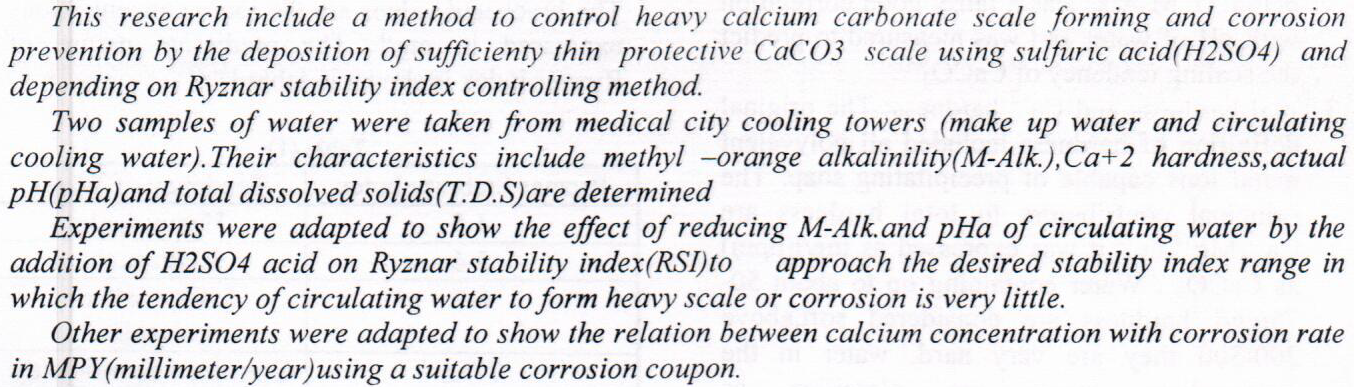
Control of Calcium Scale and Corrosion of Medical City Cooling Water System using Sulfuric Acid

 (24)
(24)
 (26)
(26)



Background: Bone augmentation techniques are commonly employed in medical fields. This biomaterial system must be readily available, easily applicable by minimally-invasive technique and able to release an osteoinductive growth factor. Such a system will be able to engineer new bone formation locally at the site of injection. Hyaluronic acid has osteogenic potential that can be exploited not only for repairing bone defects but also for providing transplantable bone for the reconstruction of a variety of bone defects. The aims of this study were to evaluate the effects of Hyaluronic acid gel on bone healing by immunohistochemical estimation of transforming growth factor -beta 3 in experimental and control groups. Materials and methods: Thirt
... Show MoreThe manganese doped zinc sulfide nanoparticles were synthesized by simple aqueous chemical reaction of manganese chloride, zinc acetate and thioacitamide in aqueous solution. Thioglycolic acid is used as capping agent for controlling the nanoparticle size. The main advantage of the ZnS:Mn nanoparticles of diameter ~ 2.73 nm is that the sample is prepared by using non-toxic precursors in a cost effective and eco-friendly way. The structural, morphological and chemical composition of the nanoparticles have been investigated by X-ray diffraction (XRD), Scanning Electron Microscopy (SEM) with energy dispersion spectroscopy (EDS) and Fourier transform infrared (FTIR) spectroscopy. The nanosize of the prepared nanoparticles was elucidated by Scan
... Show MoreThis study describe the effect of temperature on the optical
properties of nickel(ii) phthalocyanine tetrasulfonic acid tetrasodium
salt (NiPcTs) organic thin films which are prepared by spin coating
on indium tin oxide (ITO-glass). The optical absorption spectra of
these thin films are measured. Present studies reveal that the optical
band gap energies of NiPcTs thin films are dependent on the
annealing temperatures. The optical band gap decreases with increase
in annealing temperature, then increased when the temperature rising
to 473K. To enhance the results of Uv-Vis measurements and get
more accurate values of optical energy gaps; the Photoluminescence
spectra of as-deposited and annealed NiPcTs thin fi
(1)
(6)
(14)
This article presents the simultaneous adsorption of bimetal Cu2+ and Zn2+ from an aqueous solution using activated carbon synthesized from a plum seed precursor by sulfuric acid and microwave activation: plum seeds chemically activated by 45% (w/w) sulfuric acid with 2:1 ratio for 4 h, then carbonized for 2 h at 700 °C and the product obtained activated in a microwave oven for 20 min at 700 W for final of activation. Plum seeds and activated carbon produced were characterized in terms of their physical and chemical composition using Brunauer–Emmett–Teller measurements, field emission scanning electr
... Show More
(2)
(1)
Pharmaceuticals have been widely remaining contaminants in wastewater, and diclofenac is the most common pharmaceutical pollutant. Therefore, the removal of diclofenac from aqueous solutions using activated carbon produced by pyrocarbonic acid and microwaves was investigated in this research. Apricot seed powder and pyrophosphoric acid (45 wt%) were selected as raw material and activator respectively, and microwave irradiation technique was used to prepare the activated carbon. The raw material was impregnated in pyrophosphoric acid at 80◦C with an impregnation ratio of 1: 3 (apricot seeds to phosphoric acid), the impregnation time was 4 h, whereas the power of the microwave was 700 watts with a radiation time of 20 min. A series o
... Show More
(16)
The flexible joint robot manipulators provide various benefits, but also present many control challenges such as nonlinearities, strong coupling, vibration, etc. This paper proposes optimal second order integral sliding mode control (OSOISMC) for a single link flexible joint manipulator to achieve robust and smooth performance. Firstly, the integral sliding mode control is designed, which consists of a linear quadratic regulator (LQR) as a nominal control, and switching control. This control guarantees the system robustness for the entire process. Then, a nonsingularterminal sliding surface is added to give a second order integral sliding mode control (SOISMC), which reduces chartering effect and gives the finite time convergence as well. S
... Show More
(14)
(9)
(4)
(2)
(27)
(21)