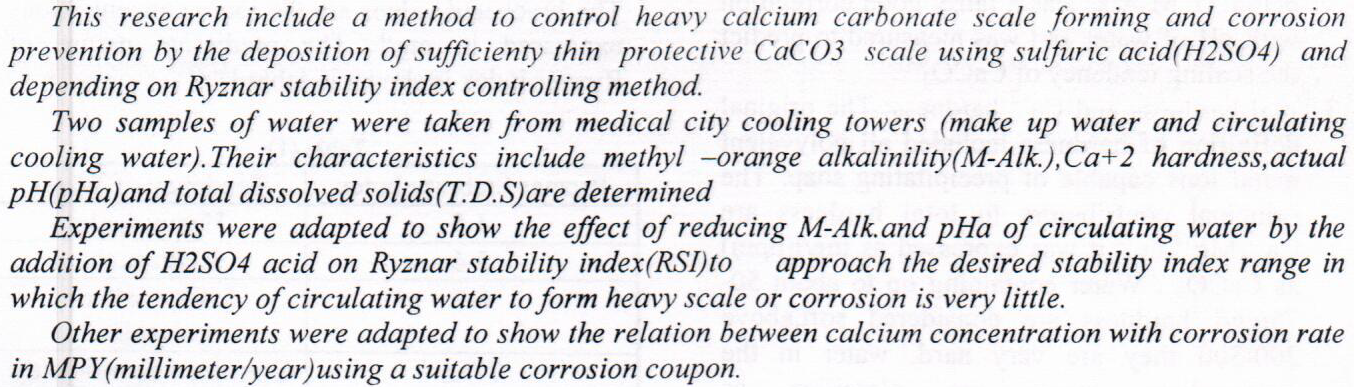
Control of Calcium Scale and Corrosion of Medical City Cooling Water System using Sulfuric Acid

Abstract
The removal of water turbidity by using crumb rubber filter was investigated .The present study was conducted to evaluate the effect of variation of influent water turbidity (10, 25 and 50 NTU), media size (0.6and 1.14mm), filtration rate (25, 45 and 65 l/hr) and bed depth (30 and 60 cm) on the performance of mono crumb rubber filter in response to the effluent filtered water turbidity and head loss development, and compare it with that of conventional sand filter.Results revealed that 25 l/hr flow rate and 25 NTU influent turbidity were the best operating conditions. smaller media size and higher bed depth gave the best removal efficiency while higher media size and small bed depth gave lower head
... Show MoreThis research was aimed to study the efficiency of microfiltration membranes for the treatment of oily wastewater and the factors affecting the performance of the microfiltration membranes experimental work were includes operating the microfiltration process using polypropylene membrane (1 micron) and ceramic membrane (0.5 micron) constructed as candle; two methods of operation were examined: dead end and cross flow. The oil emulsion was prepared using two types of oils: vegetable oil and motor oil (classic oil 20W-50). The operating parameters studied are: feed oil concentration 50 – 800 mg/l, feed flow rate 10 – 40 l/h, and temperature 30 – 50 oC, for dead end and cross flow microfiltration.
It was found that water flux decrea
In this research the specifications of Iraqi drinking bottled water brands are investigated throughout the comparison between local brands, Saudi Arabia and the World Health Organization (WHO) for bottled water standard specifications. These specifications were also compared to that of Iraqi Tap Water standards. To reveal variations in the specifications for Iraqi bottled water, and above mentioned standards some quality control tools are conducted for more than 33% of different bottled water brands (of different origins such as spring, purified,..etc) in Iraq by investigating the selected quality parameters registered on their marketing labels. Results employing Minitab software (ver. 16) to generate X bar,
... Show MoreCoupling reaction of 2-amino benzoic acid with the 8-hydroxy quinoline gave the azo ligand (H2L): 5-(2-benzoic acid azo )-8-hydroxy quinoline.Treatment of this ligand with some metal ions (CoII, NiII and CuII ) in ethanolic medium with a (1:2) (M:L) ratio yielded a series of neutral complexes with general Formula[M(HL)2],where: M=Co(II), Ni(II) and Cu(II), HL=anion azo ligand (-1).The prepared complexes were characterized using flame atomic absorption,FT-IR and UV-Vis spectroscopic methods as well as magnetic susceptibility and conductivity measurements.
Many studied were conducted to evaluate the antihepatotoxic and antioxidant activities of Silybum marianum and proved these actions. The Naturally grown seed in Iraqi-Kurdistan Region also were studied for its chemical contents and biological activities. Vegetable oils occur in various plant parts mainly concentrated in the seeds.
In this study comparison was made between the fatty acid patterns of two plant seeds, Silybum marianum and Nigella sativa. Seed sample of Silybum marianum and Nigella sativa were exposed for extraction and isolation of the fatty acid contents using two different solvents (petroleum ether and n-hexane) at 60-80oC using soxhlet apparatus and the oily extract
... Show More (2)
(2)

Inflammatory bowel disease (IBD) is a common chronic inflammatory disease of the gastrointestinal tract, including ulcerative colitis and Crohn's disease. ulcerative colitis (UC) disease is characterized by chronic, persistent, recurrent, and nonspecific intestinal ulcers and mucosal inflammation. This study investigated the protective effects of cinnamic acid on dextran sodium sulfate (DSS) induced ulcerative colitis in mice. Forty adult male mice were collected and randomly divided into five groups, group Ӏ received a suspension of distill water and poloxamer, and group ӀӀ received 3% DSS in drinking water for 7 consecutive days. Two treatment groups received an oral suspension of cinnamic acid 50 and 25 mg/kg respectively an
... Show More (10)
(7)
(10)
(7)

This study was conducted to test the effectiveness of Agaricus bisporus inoculums (spawn) in the ratio of (0.25, 0.5 and 1%) v/v to control Pythium aphanidermatum fungus the causal agent of damping- off disease of cucumber plant. results showed the ability of A. bisporus fungus to protect the seedlings from incidence by P. aphanidermatum . all treatments of edible fungus inoculums were significantly different from pathogen treatment after 15 day of planting and there was no significant difference found from control treatment (without pathogen) . the successful of A. bisporus was continued to protect the seedlings after 30 and 45 day after planting. The numbers of seedlings were (8, 7.25 & 7.25) respectively compared to 5.5 seedlings in con
... Show More
Objectives: the study aims to findout the effectiveness of educational program concerning infection control guideline on nurses, and to find out the relationship between effectiveness of program and types of hospital unit, age, level of education, and years of experience of nurses. Methodology: A quasi-experimental design study was carried out in Baghdad teaching hospital in the wards, for the period of December, 20th 2013 to September, 30th of July 2014, The study samples is composed of (60) nurses who have been actually working in the medical ward, blood disease, psychiatric ward, and neurological war
Rates of zinc consumption during cathodic protection of a copper pipeline carrying saline water were measured by the loss in weight technique. The study of sacrificial anode cathodic protection of short copper tube using zinc strip extended axially in the pipe revealed that : (i) The increase of zinc consumption with time of exposure (1-3 h's) at different flow rates (turbulent flow) (300-600 l/hr) while the temperature , solution concentration and the pH were fixed at 20ºC, 3.5%wt NaCl, and pH=8 respectively in absence and presence of bacteria.(ii)Increase of zinc consumption with flow rates (300-600 l/hr) at different temperatures (10-40ºC) while solution concentration and time of exposure were fixed at 3.5 %wt NaCl and 3hr's respective
... Show MoreRates of zinc consumption during cathodic protection of a copper pipeline carrying saline water were measured by the loss in weight technique. The study of sacrificial anode cathodic protection of short copper tube using zinc strip extended axially in the pipe revealed that : (i) The increase of zinc consumption with time of exposure (1-3 h's) at different flow rates (turbulent flow) (300-600 l/hr) while the temperature , solution concentration and the pH were fixed at 20ºC, 3.5%wt NaCl, and pH=8 respectively in absence and presence of bacteria.(ii)Increase of zinc consumption with flow rates (300-600 l/hr) at different temperatures (10-40ºC) while solution concentration and time of exposure were fixed at 3.5 %wt NaCl and 3hr's respect
... Show More