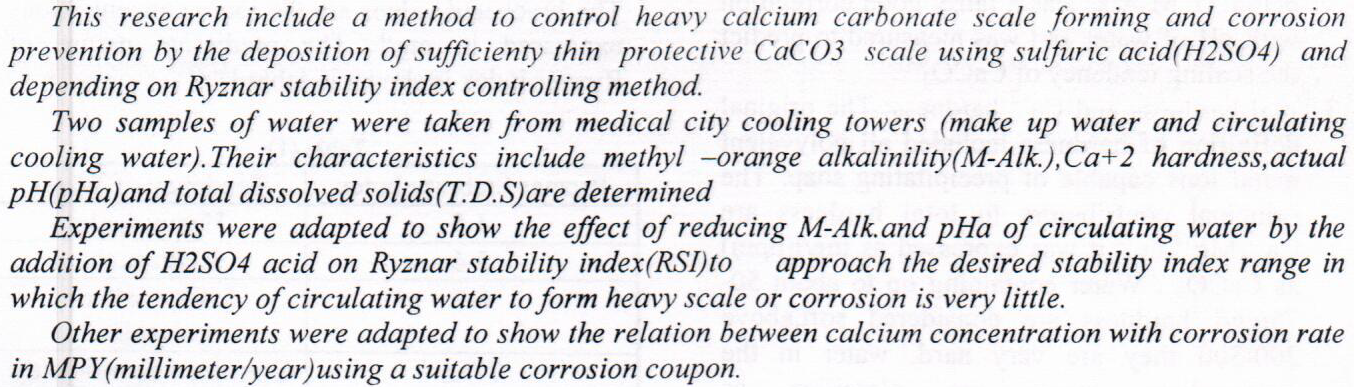
Control of Calcium Scale and Corrosion of Medical City Cooling Water System using Sulfuric Acid

An aromatic ester containing two azo groups namely p-nitro phenyl azo-β-naphthyl-(4'-azobenzoic acid)-4-benzoate was synthesized by esterfiaction of 4,4'-azo dibenzoic acid with p-nitro phenyl azo-β-naphthol. Synthesized ester was characterized by CHN-Elemental analysis, FTIR, 1H NMR and 13C NMR. A modified PVA polymer was obtained by grafting 10 g of PVA-polymer via partial esterification with (2, 3, 4 g) p-nitro phenyl azo-1-naphthyl-4-azobenzoic acid)-4-azo benzoate. Grafting PVA-polymer behaviours was studied, by physical measurements (solubility, swelling), thermal properties (DSC) and tensile.
A new ligand 3-hydroxy-2-(3-(4-nitrobenzoyl) thiouriedo) propanoic acid (NTP) where synthesized by reaction of 4-nitro benzoyl isothiocyanate with serine amino acid. The ligand was characterized by FT-IR, NMR spectra and the elemental analysis. The transition metal complexes of this ligand where synthesize and characterized by UV-Visible spectra, FT-IR, magnetic suscpility, conductively measurement, The general formula [M (NTP) 2] where M+2= (Mn, Co, Ni, Cu, Zn, Cd, Hg,), the form of molecular for these complexes as tetrahedral except Cu has square planer.
New Schiff bases derivatives [IV]a-e is prepared via condensation of Derythroascorbic acid with p-substituted aldehydes in dry benzene. To obtain these derivatives, the 5,6-O-isopropylidene-L-ascorbic acid[I] was chosen as starting material, compound prepared from the reaction of L-ascorbic acid as starting material. Compound[I] was prepared from the reaction of L-ascorbic acid with dry acetone in the presence of hydrogen chloride. The esterification of hydroxyl groups at C-2 and C-3 positions with excess ofethyl α –chloroacetate in the presence of sodium acetate produce acorresebonding ester [II] , which was condensed with hydrazine hydrate to give new hydrazide [III] . The new Schiff bases [IV]a-e were synthesized by reaction of acid h
... Show MoreTow simple, rapid and sensitive spectrophotometric methods for the determination of mesalazine in pharmaceutical preparations have been carried out. The proposed methods depend on oxidative coupling reaction of mesalazine with m-aminophenol in the existence of N-bromosuccinamide in alkaline medium (method A) and 2,6-dihydroxybenzoic acid in the existence of sodium metaperiodate in basic medium (method B) to produce colored products , show highest absorptions at 640 (nm) and 515 (nm), alternately. Beer’s law was consistent in concentrations extent of 1.25-30 and 0.5-12.5 (µg.mL-1) with molar absorptivity of 0.36×10⁴ and 0.77×10⁴ L.mol-1.cm<
... Show More (7)
(7)
 (6)
(6)



New azo ligand 2-((4-formyl-3-hydroxynaphthalen-2-yl) diazenyl) benzoic acid (H2L) was synthesized from the reaction of 2-aminobenzoic acid and2-hydroxy-1-naphthaldehyde. Monomeric complexes of this ligand, of general formulae [MII(L)(H2O)] with (MII = Mn, Co, Ni, Cu, Zn, Pd, Cd and Hg ) were reported. The compounds were isolated and characterized in solid state by using 1H-NMR, FT-IR, UV–Vis and mass spectral studies, elemental microanalysis, metal content, magnetic moment measurements, molar conductance and chloride containing. These studies revealed tetrahedral geometries for all complexes except PdII complex is Square planar. The study of complexes formation via molar ratio of (M:L) as (1:1). Theoretical treatments of compounds in gas
... Show More
(1)
The removal of SO2 from simulated gas stream (SO2 + air) in a fixed bed reactor using Modified Activated Carbon (MAC) catalysts was investigated. All the experiments were conducted at atmospheric pressure, initial SO2 concentration of 2500 ppm and bed temperature of 90oC. MAC was prepared by loading a series of nickel and copper oxides 1, 3, 5, 7, and 10 w
... Show MoreThe study involved the removal of acidity from free fatty acid via the esterification reaction of oleic acid with ethanol. The reaction was done in a batch reactor using commercial 13X zeolite as a catalyst. The effects of temperatures (40 to 70 °C) and reaction time (up to 120 minutes) were studied using 6:1 mole ratio of pure ethanol to oleic acid and 5 wt. % of the catalyst. The results showed that acid removed increased with increasing temperature and reaction time. Also, the acidity removal rises sharply during the first reaction period and then changes slightly afterward. The highest acidity removal value was 67 % recorded at 110 minutes and 70 °C. An apparent homogeneous reversible reaction kinetic model has been proposed a
... Show More
(2)
(3)
(3)