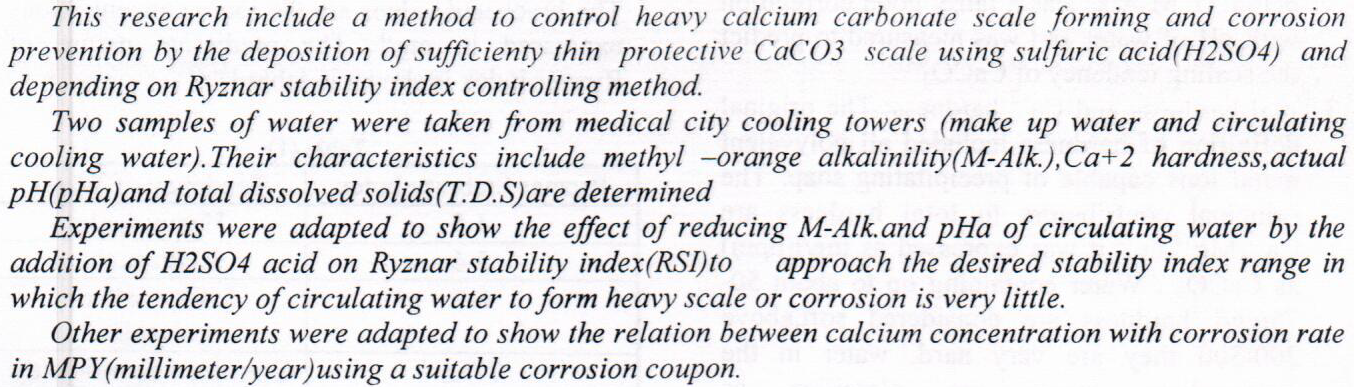
Control of Calcium Scale and Corrosion of Medical City Cooling Water System using Sulfuric Acid

 (38)
(38)
 (22)
(22)


 (6)
(2)
(6)
(2)
Background: The miswak is a teeth cleaning twig made from a twig of the Salvadora persica tree (known as arak in Arabic).A traditional alternative to the modern toothbrush, it has a long, well-documented history and is reputed for its medicinal benefits. It also features prominently in Islamic hygienical jurisprudence. Materials and methods: Twenty maxillary first premolars were treated with the selected solutions which included siwak water extract (5%, 10%) and sodium fluoride 0.05% for 2minutes once daily for 20 days interval, deionized water was used as control negative. Then the concentration of the dissolved calcium ion in the etching solution of 2N HCL was measured. Results: The least amount of the dissolved calcium ion was registere
... Show MoreIn this study, the electro-hydraulic servo system for speed control of fixed displacement hydraulic motor using proportional valve and (PID) controller is investigated theoretically ,experimentally and simulation . The theoretical part includes the derivation of the nonlinear mathematical model equation of (valve – motor ) combination system and the derivation of the transfer function for the complete hydraulic system , the stability test of the system during the operation through the transfer function using MATLAB package
V7.1 have been done. An experimental part includes design and built hydraulic test rig and simple PID controller .The best PID gains have been calculated experimentally and simulation, speed control performance te
(7)
(4)
(3)
(4)
(3)
(2)
Objective(s): assessment of the health follow up and weight control for women with osteoporosis and find out the relationship between their health follow up and weight control and their socio-demographic characteristics.
Methodology: A descriptive study was conducted on women with osteoporosis for the period of September, 26th 2020 to Jun, 20th 2021. Non- probability (convenient) sample of (70) women with osteoporosis selected from (5) Private Clinics for Joints and Fractures in Baqubah City. A questionnaire was designed though extensive review of literatures and it consists of three parts: the first part includes women’s socio demographic characteristics, the second part inclu
... Show More
(1)
(1)
The Child is the first sedum for the human society performing, and we deal in our
research to explain the nature of the mutual relations in between the form and the medicine
social caring foundation. So the motherhood and the childhood nowadays become the most
dedicated in the researchers works, whom interesting in the social affairs, and that whom
work in the medicine field as scientists.
So the child is the future man and must be in wright body construction that need to great
care and interest to make him wright mind through capability of performing anything support
to him.
In our research we deal with the main factors in which lead to infect the child by the
creative malfunction, like the environmental and m