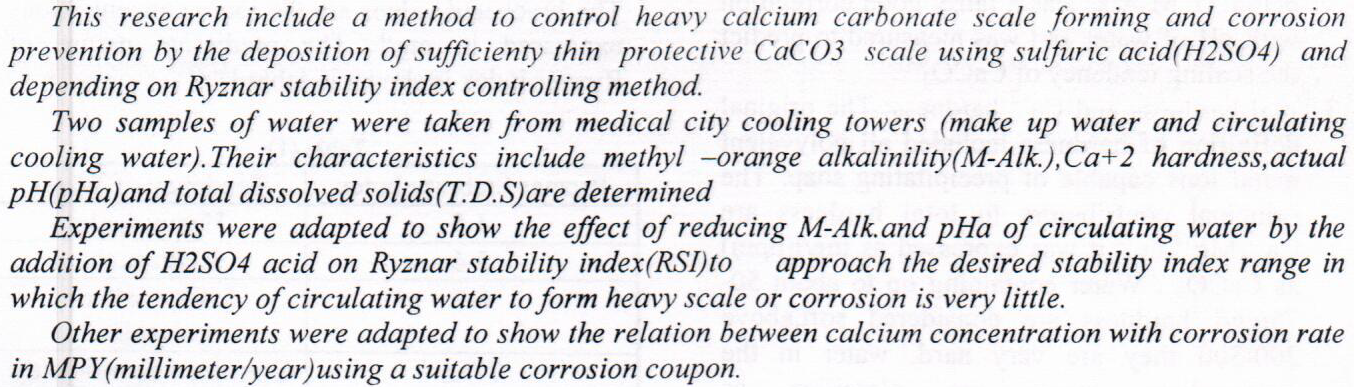
Control of Calcium Scale and Corrosion of Medical City Cooling Water System using Sulfuric Acid

 (2)
(2)
 (1)
(1)

 (9)
(9)
Fresh water resources in terms of water quality is a crucial issue worldwide. In Egypt, the Nile River is the main source of fresh water in the country and monitoring its water quality is a major task on governments and research levels. In the present case study, the physical, chemical and algal distribution in Nile River was monitored over two seasons (winter and summer) in 2019. The aims of the study were to check the seasonal variation among the different water parameters and also to check the correlations between those parameters. Water samples were collected from the Nile in Cairo governorate in EGYPT. The different physiochemical and microbiological properties in water samples were assessed. The studied parameters were included: te
... Show More
(16)
(5)

A theoretical and protection study was conducted of the corrosion behavior of carbon steel surface with different concentrations of the derivative (Quinolin-2-one), namely 7-Ethyl-4-methyl-1-[(4-nitro-benzylidene)-amino]-1H-quinolin-2-one (EMNQ2O). Theoretically, Density Functional Theory (DFT) of B3LYP/ 6-311++G/ 2d, 2p level was carried out to calculate the geometrical structure, physical properties and chemical inhibition chemical parameters, with the local reactivity in order to predict both the reactive centers and to know the possible sites of nucleophilic and electrophilic attacks, in vacuum and two solvents (DMSO and H2O), all at the equilibrium geometry. Experimentally, the inhibition efficiencies (%IE) in (3.5% NaCl)
... Show More
(15)
(5)
The control of prostheses and their complexities is one of the greatest challenges limiting wide amputees’ use of upper limb prostheses. The main challenges include the difficulty of extracting signals for controlling the prostheses, limited number of degrees of freedom (DoF), and cost-prohibitive for complex controlling systems. In this study, a real-time hybrid control system, based on electromyography (EMG) and voice commands (VC) is designed to render the prosthesis more dexterous with the ability to accomplish amputee’s daily activities proficiently. The voice and EMG systems were combined in three proposed hybrid strategies, each strategy had different number of movements depending on the combination protocol between voic
... Show More
(5)
(6)
(37)
(32)
Metal complexes of Cu (II), Fe (III) and Mn (II) with Quinaldic acid (L1) and 1, 10-Phenathroline (L2) are synthesized and characterized by standaral physic- chemical procedures (element analysis, metal analysis, FTIR, Uv-Vis, magnetic moment and conductometeric measurements). On the base of these studies, mononuclear and six coordinated octahedral geometry and nonelectrolyte of these complexes have been proposed. The standard heat of formation (?Hºf) and binding energy (?Eb) for the free ligands and their complexes are calculated by using the PM3 method at 273K of Hyperchem.-8 program. The complexes are more stable than their ligands. Moreover, the electrostatic potential of free ligands are measured to investigate the reactive site of th
... Show More
(2)
Some metal ions (Mn+2, Co+2, Ni+2, Cu+2, Zn+2, Cd+2 and Hg+2) complexes of quinaldic acid (QuinH) and α-picoline (α-Pic) have been synthesized and characterized on the basis of their , FTIR, (U.V-Vis) spectroscopy, conductivity measurements, magnetic susceptibility and atomic absorption. From the results obtained the following general formula has suggested for the prepared complexes [M(Quin)2( α-Pic)2].XH2O where M+2 = (Mn, Co, Ni, Cu, Zn, Cd and Hg), X = 2, X = zero for (Co+2 and Hg+2) complexes, (Quin-) = quinaldate ion, (α-Pic) = α-picoline. The results showed that the deprotonated ligand (QuinH) by using (KOH) coordinated to metal ions as bidentate ligand through the oxygen atom of the carboxylate group (-COO-) and the nitrogen ato
... Show MoreSorghum seeds suffer from a low germination ratio, so a factorial experiment was carried out in the Seed Technology Laboratory, Department of Field Crops, College of Agricultural Engineering Sciences, University of Baghdad during 2022 according to a Completely Randomized Design with four replications to study the effect of stimulating seeds with aqueous extract of banana peels with a concentration of (0, 15, 25 and 35%) and citric acid at concentrations (0, 50, 100 and 200 mg L-1) on viability and vigour of seed properties. Seeds that soaked with banana peel extract at a concentration of 25% outperformed in first count (79.8%), final count (85.0%), radicle length (13.2 cm), plumule length (11.6 cm), and seedling vigour index (2109), noting
... Show More
(6)
(3)