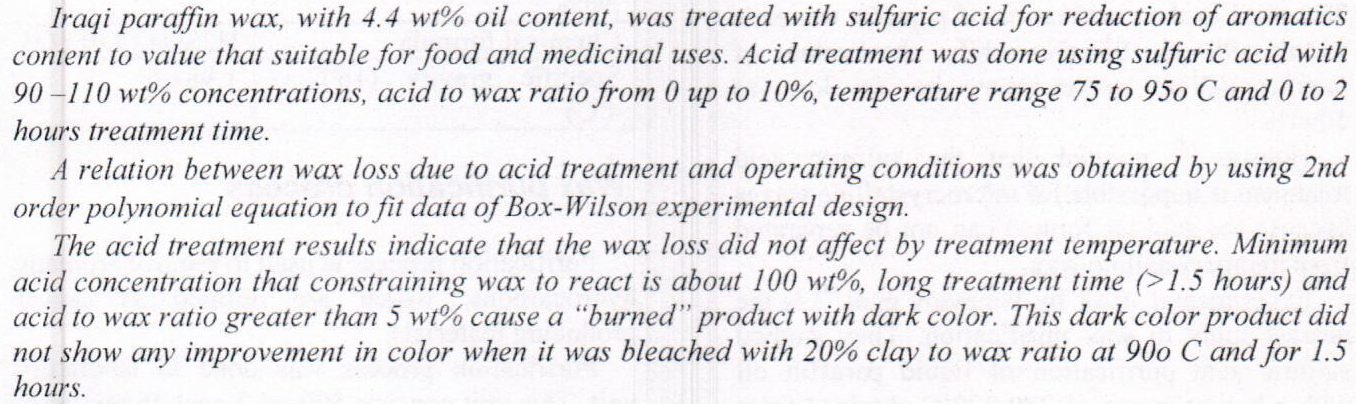
Acid Treatment of Iraqi Paraffin Wax

In this study, nano TiO2 was prepared with titanium isopropoxide (TTIP) as a resource to titanium oxide. The catalyst was synthesized using phosphotungstic acid (PTA) and, stearyl trimethyl ammonium bromide (STAB) was used as the structure-directing material. Characterization of the product was done by the X-ray diffraction (XRD), X-ray fluorescent spectroscopy (XRF), nitrogen adsorption/desorption measurements, Atomic Force Microscope (AFM) and Fourier transform infrared (FTIR) spectra, were used to characterize the calcined TiO2 nanoparticles by STAB and PWA. The TiO2 nanomaterials were prepared in three crystalline forms (amorphous, anatase, anatase-rutile). The results showed that the nanoparticles of anatase TiO2 have good cata
... Show More (10)
(10)

KE Sharquie, AA Noaimi, S Adnan, AM Al-Niddawi, WK Aljanabi, American Journal of Dermatology and Venereology, 2020 - Cited by 2
This search include the synthesis of some new 1,3-oxazepine derivatives have been prepared, starting from reaction of L-ascorbic acid with dry acetone in presence of dry hydrogen chloride afforded the acetal (I). Treatment of the latter with p-nitrobenzoyl chloride in pyridine yielded the ester (II) which was dissolved in (65%) acetic acid in absolute ethanol yielded the glycol (III). The reaction of the glycol (III) with sodium periodate in distilled water at room temperature produced the aldehyde (IV). The compound (V) [4-(1,3-dioxoisoindolin-2-yl)benzoic acid] was synthesized by reaction p-aminobenzoic acid and phthalic anhydride in presence of (gla. CH3COOH). Reaction of compound (V) with thionyl chloride produced [4-(1,3-dioxoisoindoli
... Show MoreMefenamic acid belongs to non-steroidal anti-inflammatory drugs that are used widely for the treatment of analgesia. Our aim from this study is to establish a new assay for the quantitative determination of mefenamic acid (MFA) in the pharmaceutical sample by two sensitive and rapid flow injection-fluorometric methods. A homemade fluorometer was used in fluorescence measurements, which using solid-state laser diode 405 and 532 nm as a source, combined with a continuous flow injection technique. The first method depends on the effect of MFA on calcein blue (CLB) fluorescence at 405 nm. Another method is a study of rhodamine-6G (Rh-6G) fluorescence after adding MFA, and recording at 532 nm. Optimum parameters as fluorescent dye concen
... Show More (8)
(5)
(8)
(5)

Poly urea formaldehyde –Bentonite (PUF-Bentonite) composite was tested as new adsorbent
for removal of mefenamic acid (MA) from simulated wastewater in batch adsorption
procedure. Developed a method for preparing poly urea formaldehyde gel in basic media by
using condensation polymerization. Adsorption experiments were carried out as a function of
water pH, temperature, contact time, adsorbent dose and initial MA concentration .Effect of
sharing surface with other analgesic pharmaceuticals at different pH also studied. The
adsorption of MA was found to be strongly dependent to pH. The Freundlich isotherm model
showed a good fit to the equilibrium adsorption data. From Dubinin–Radushkevich model the
mean free
Indole acetic acid (IAA) produced from F. oxysporum (F2) was purified by several steps included extraction by cold ethyl acetate ; Column chromatography using silica gel and TLC chromatography . The pure indole acetic acid (IAA) which produce by F. oxysporum (IAA) was tested by ultraviolet spectra at (200-300)nm ; and appear that the maximum absorbance at 229nm , the high performance liquid chromatography (HPLC) used to test the purity of the indole acetic acid and the results showed one peak at appearance time 3.822 min
In this study, nano TiO2 was prepared with titanium isopropoxide (TTIP) as a resource to titanium oxide. The catalyst was synthesized using phosphotungstic acid (PTA) and, stearyl trimethyl ammonium bromide (STAB) was used as the structure-directing material. Characterization of the product was done by the X-ray diffraction (XRD), X-ray fluorescent spectroscopy (XRF), nitrogen adsorption/desorption measurements, Atomic Force Microscope (AFM) and Fourier transform infrared (FTIR) spectra, were used to characterize the calcined TiO2 nanoparticles by STAB and PWA. The TiO2 nanomaterials were prepared in three crystalline forms (amorphous, anatase, anatase-rutile). The results showed that the
... Show More
(10)
(153)
(141)
 (22)
(19)
(7)
(3)
(22)
(19)
(7)
(3)