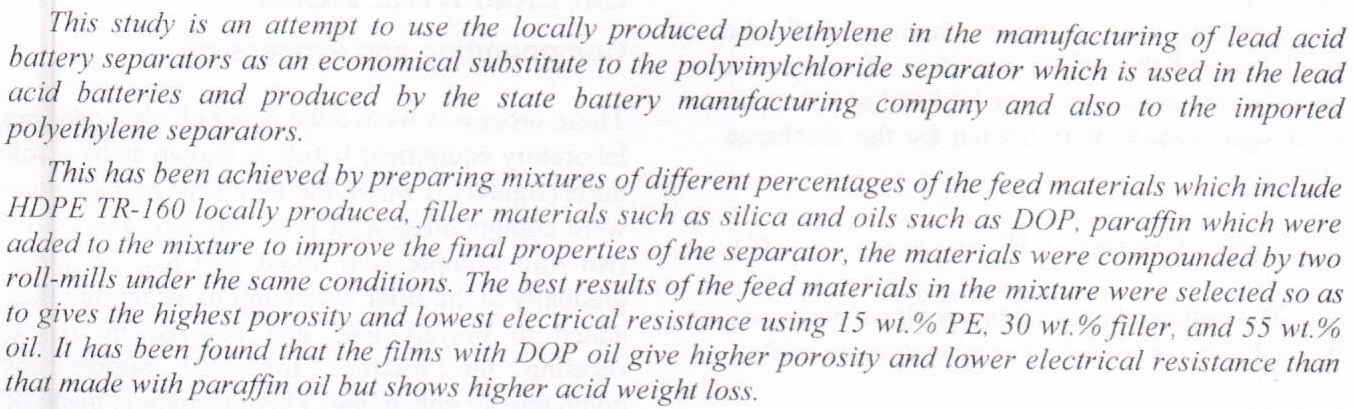
The Manufacture of Lead Acid Battery Separators using Locally Produced Polyethylene

The loose sand is subject to large settlement when it is exposed to high stresses. This settlement is due to the nature of the high drainage of sand, which displays foundations and constructions to a large danger. The densification of loose sandy soils is required to provide sufficient bearing capacity for the structures. Thus soil stabilization is used to avoid failure in the facilities. Traditional methods of stabilized sandy soil such as fly ash, bituminous, and cement often require an extended curing period. The use of polymers to stabilize sandy soils is more extensive nowadays because it does not require a long curing time in addition to being chemically stable. In this study, the effect of adding different percent
... Show More (3)
(3)
 (3)
(3)
200 samples collected Adrar of patients with urinary tract infection were investigating the types of bacteria most local isolates showed high resistance to antibiotics penicillin c ??????? Amoxicillin Beracelin
In this study some generic commercial products of Atorvastatin tablets were evaluated by dissolution test in acid medium by comparing with that of parent drug Lipitor of Pfizer Company. Some of solubilizing agents were studied in formulation of Atorvastatin tablet including; surface active agent and PEG 6000 .The most effective factor was the use of PEG6000 in formulation of Atorvastatin tablet which improved the dissolution and the results of dissolution profile of formulated tablet in this work was bioequivalent to that of Lipitor .The quantitative analysis of this work was performed by using reversed phase liquid chromatography and a proper mixture of  
... Show More
This paper focuses firstly on the production of monomers bis (2-hydroxyethyl) terephthalate (BHET) and oligomers by using two different form of MgO light active and Nano Magnesium oxide with different weight ratio (0.15, 0.25 and 0.5) by using chemical recycling glass condenser at 190 ˚C. The second purpose is to study the effect of catalyst ratio, time of reaction and yield of products of the product. Elemental analysis for Carbon –Hydrogen and Nitrogen (CHN), differential scanning calorimetry (DSC), infrared spectroscopy (FTIR) and thermogravimetric analysis (TGA) have been investigated. Results indicated the catalytic activity was found to correlate with surface area; however, LA MgO has shown an exceptional activity, still it is h
... Show More
(8)
This research was conduct to evaluate the cytotoxic effect of exotoxin A (ETA) produced by Pseudomonas aeruginosa on mice in comparison with (phosphate buffer saline (PBS) as a negative control. The effect of the toxin was measured by employing the cytogenetic analysis which included (the mitotic index (MI), chromosomal aberrations (CAs), micronucleus (MN) and sperm abnormalities) parameters. In order to specify the cytotoxic effect of the toxin, three doses of ETA (125, 250 and 500 ng/ml) were used. Results showed that ETA was found to cause a significant decrease in mitotic index (MI) percentage, while significant increase in micronucleus (MN), chromosomal aberrations (CAs) and sperm abnormalities parameters in compression with control wa
... Show MoreThe dental amalgam of radioactive materials in the restoration of teeth because of its readily adaptable to existing materials in the oral cavity in addition to mechanical properties such as hardness mechanical resistance Alndgat and others in this study were prepared Almlagm used Guy dental restoration of silver alloy tin plus some elements to improve the characteristicsmechanical such as copper, zinc or indium in addition to mercury
In the present work, a kinetic study was performed to the extraction of phosphate from Iraqi Akashat phosphate ore using organic acid. Leaching was studied using lactic acid for the separation of calcareous materials (mainly calcite). Reaction conditions were 2% by weight acid concentration and 5ml/gm of acid volume to ore weight ratio. Reaction time was taken in the range 2 to 30 minutes (step 2 minutes) to determine the reaction rate constant k based on the change in calcite concentration. To determine value of activation energy when reaction temperature is varied from 25 to 65 , another investigation was accomplished. Through the kinetic data, it was found that selective leaching was controlled by surface chemical reactio
... Show More
(1)
In the present work, a kinetic study was performed to the extraction of phosphate from Iraqi Akashat phosphate ore using organic acid. Leaching was studied using lactic acid for the separation of calcareous materials (mainly calcite). Reaction conditions were 2% by weight acid concentration and 5ml/gm of acid volume to ore weight ratio. Reaction time was taken in the range 2 to 30 minutes (step 2 minutes) to determine the reaction rate constant k based on the change in calcite concentration. To determine value of activation energy when reaction temperature is varied from 25 to 65 , another investigation was accomplished. Through the kinetic data, it was found that selective leaching was controlled by
... Show More
(1)