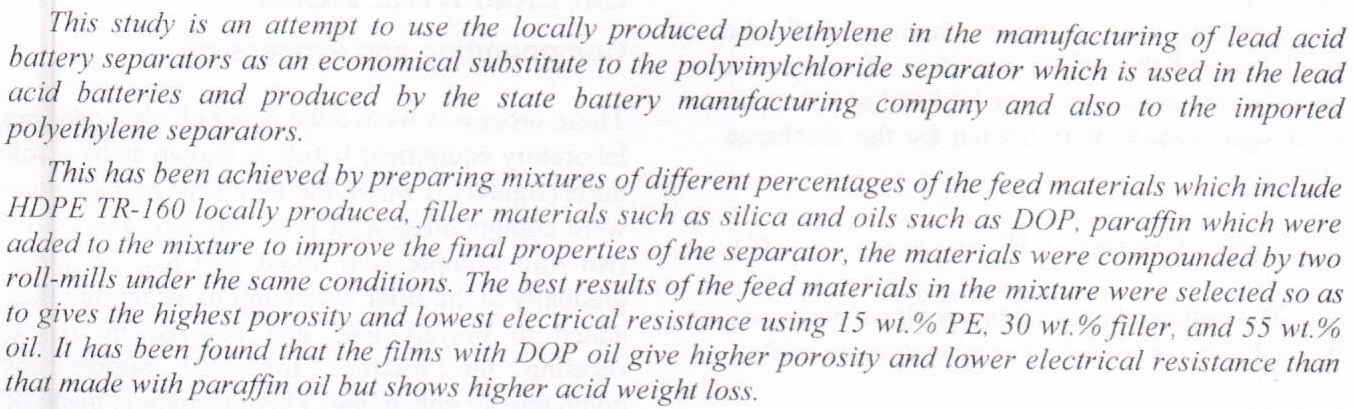
The Manufacture of Lead Acid Battery Separators using Locally Produced Polyethylene

A novel metal-organic framework (MOF) sorbent based on tannic acid/copper (TA/Cu) was synthesized and characterized for the application of the anticancer drug imatinib (IMA) from biological samples. The TA/Cu MOF was prepared via a facile coordination reaction and thoroughly characterized by SEM, XRD, and FTIR techniques. Critical parameters influencing the extraction efficiency of imatinib mesylate (IMAM), including pH, ionic strength, desorption solvent, and adsorption-desorption time were optimized. With acetonitrile as the desorption solvent, the method demonstrated a broad linear range of 0.55-300 μg L-1 under ideal conditions. Limits of detection and quantification were found to be 0.16 μg L-1 and 0.55 μg L-1, respectively.
... Show More (5)
(5)



A novel metal-organic framework (MOF) sorbent based on tannic acid/copper (TA/Cu) was synthesized and characterized for the application of the anticancer drug imatinib (IMA) from biological samples. The TA/Cu MOF was prepared via a facile coordination reaction and thoroughly characterized by SEM, XRD, and FTIR techniques. Critical parameters influencing the extraction efficiency of imatinib mesylate (IMAM), including pH, ionic strength, desorption solvent, and adsorption-desorption time were optimized. With acetonitrile as the desorption solvent, the method demonstrated a broad linear range of 0.55-300 μg L-1 under ideal conditions. Limits of detection and quantification were found to be 0.16 μg L-1 and 0.55 μg L-1, respectively.
... Show More
(5)
(5)
The aim of this study is to evaluate in-vitro activity of Cefamandol (Cfm) and Ceftazidime (Cfz), in combination with Clavulanic acid (CA) against ten complicated multiresistant uropathogenic E.coli .One hundred clinical strains were isolated from patients with chronic urinary tract infections (UTIs), these isolates were identified by the Api identification systems. The antimicrobial susceptibility tests were determined by Kirby-Bauer method, all of them were sensitive to Imipenem (Imp). Ten strains were chosen for the present study, they were resistant to Ampicillin (Amp), Amoxicillin (Amo), Carbenicillin (Cb), Ticarcillin (Tic), Azlocillin (Azl), Amoxicillin\ Potassium Clavulanate {Augmentin(Amc)}, (Amo\CA), Ticarcillin\ Potas
... Show More
The study aimed to purification of acid phosphatase (ACP) from sera of obesetype 2 diabetes mellitus patients, this study included from thirty T2DM patients and thirty control, purification process was done with several steps included precipitation with inorganic salt (NH4 ) 2SO4 30%-80%, dialysis, ion exchange chromatography by DEAE sepharose anion column and size exclusion chromatography by Sepharose 6B.ACP, BMI, FBS, HbA1c, Lipid profile, Urea, Creatinie, Insuline, Homa-IR were determined. Results showed the precipitate and concentrated protein appeared four peaks in ion exchange column. ACP located in the first and second peak with purification fold (21.1), (37.2) yield of enzyme and specific activity (173.3) IU/ml, which obtained a si
... Show More
The relationship of hyperuricemia to kidney disease, diabetes, hypertension and the risk of cardiovascular diseases remain controversial. The aim of this study is to evaluate the use of uric acid (UA) levels to find the higher risk of cardiovascular disease (CVD) in patients with end stage renal disease that have diabetic nephropathy (DN), nephropathy with hypertension (NH) and patients with both diabetic nephropathy with hypertension (DNH). This study deals with 115 patients with end-stage renal disease under hemodialysis sub-grouped into 35 patients with (DN), 40 patients with (NH), and 40 patients with (DNH). Some biochemical parameters were determined in the serum of all participants such as HbA1c, fasting blood glucose (FBG), UA, urea,
... Show More
(1)
One of the most common procedures in oral surgery is the removal of impacted mandibular third molars, often followed by pain, swelling, alveolitis, and trismus. Purpose. To compare the outcomes of the intrasocket application of 1% hyaluronic acid oral gel (HA) and advanced platelet-rich fibrin (A-PRF) on the expected postoperative complications, pain, swelling, and trismus follow the surgical extraction of the impacted mandibular third molar. Material and Methods. A randomized controlled trial was conducted at the Oral and Maxillofacial Surgery Unit, Dental Teaching Hospital. Healthy patients who required surgical removal of the impacted mandibular third molar were divided randomly into three groups. The extraction site of the group
... Show More
(10)
 (6)
(6)
The experiment was carried out to study the effect of variety and gibberellic acid in concentration (0 and 50)mg.lat-1 and BL in five concentration (0, 0.50 ,1 ,2 and 3)mg.ltr-1 and their interaction in some chemical Characteristics and total chlorophyll for Dill plant . the experiment designed according Randomized Complete Block Design (RCBD) and three replicates per treatment, compared to the average using less significant difference at the level of probability (0.05) , the results showed the following:- The effect of brassinolide with it,s concentrations led to obtain a significant increase in all the studied characteristics, so the superiority of the concentration of 2 mg.L-1 of brassinolide in each of Ca, Mg,Fe, and total chlorophyll T
... Show More
(14)
(1)