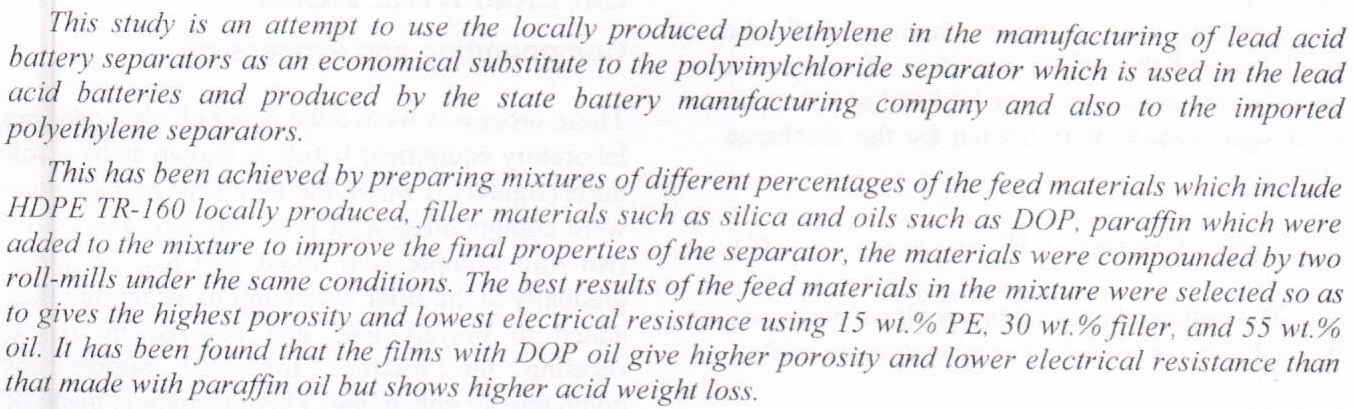
The Manufacture of Lead Acid Battery Separators using Locally Produced Polyethylene

Extraction and Description of Urease Enzyme Produced from Staphylococcus saprophyticus and study of its effect on kidney and bladder of white mice
 (5)
(5)

The study focused on the treatment of real oilfield produced water from the East Baghdad field affiliated to the Midland Oil Company (Iraq) using an oil skimming process followed by a coagulation/flocculation process for zero liquid discharge system applications. Belt type oil skimmer was utilized for evaluating the process efficiency with various operating conditions such as temperature (17-40 °C) and time (0.5-2.5 hr.). Polyaluminum chloride (PAC) coagulant and polyacrylamide (PAM) flocculant was used to investigate the performance of the coagulation/flocculation process with PAC dosage (5-90 ppm) and pH (5-10) as operating conditions. In the skimming process, the oil content, COD, turbidity, and TSS decreased with an increase in tempera
... Show MoreEnglish is spoken by its native speakers in two different forms. Reduced form which marks the colloquial and rapid speech so that it is easily produced and a citation or unreduced form which is a characteristic of careful, emphasized and slow speech.
This paper investigates Iraqi EFL university students’ production of the two forms mentioned above. The sample chosen includes twenty fourth year students, of which ten are males and the other ten are females from the Department of English of the College of Languages of the University of Duhok in Kurdistan Region of Iraq in the academic year 2020-2021. The material tested is six connective words which represent the commonest ones in every-day co
... Show More (5)
(5)
 (5)
(5)
New Schiff bases derivatives [IV]a-e is prepared via condensation of Derythroascorbic acid with p-substituted aldehydes in dry benzene. To obtain these derivatives, the 5,6-O-isopropylidene-L-ascorbic acid[I] was chosen as starting material, compound prepared from the reaction of L-ascorbic acid as starting material. Compound[I] was prepared from the reaction of L-ascorbic acid with dry acetone in the presence of hydrogen chloride. The esterification of hydroxyl groups at C-2 and C-3 positions with excess ofethyl α –chloroacetate in the presence of sodium acetate produce acorresebonding ester [II] , which was condensed with hydrazine hydrate to give new hydrazide [III] . The new Schiff bases [IV]a-e were synthesized by reaction of acid h
... Show MoreThe coagulation and flocculation process using coated magnetic nanoparticles is considered one of the effective technologies for turbidity removal. This study investigates an application of magnetic nanoparticles coated with citric acid in the coagulation and flocculation process on Tigris River water in Baghdad, Iraq. Magnetic nanoparticles (MNP1) were synthesized by the co-precipitation method and coated with citric acid (MNP2). The prepared MNP1 and MNP2 were characterized by XRD, FTIR, AFM, FE-SEM, EDS, and zeta potential analysis. For coagulation process, the effect of different types of coagulants (alum, FeCl3, MNP1, MNP2), coagulant dosage (10–110 mg/l), and initial pH (3–9) were examined in this work. The best coagulant was MNP2
... Show More
This study been conducted and applied in Alrashed Health Center/Mahmodia Sector/ kerigh Sector/Ministry of Health/Baghdad City, and conducted on samples of women who are suffering from iron deficiency (Hemoglobin%) in blood for the year 2013. Fifty women been selected (married, unmarried), their ages ranging between 19-40 years old, they been given dried grinding spinach tablet. The dose been given was 3 tablet/day/4-6 weeks, after taken the percentage of Hemoglobin and Uric acid for all studied samples before and after dried spinach tablet given. It was appeared from samples analysis primarily and statically for 50 women, that 4% upon them only suffering high Iron deficiency (8.0-9.9 mg/100ml), 38% upon them suffering from middle iron def
... Show More
