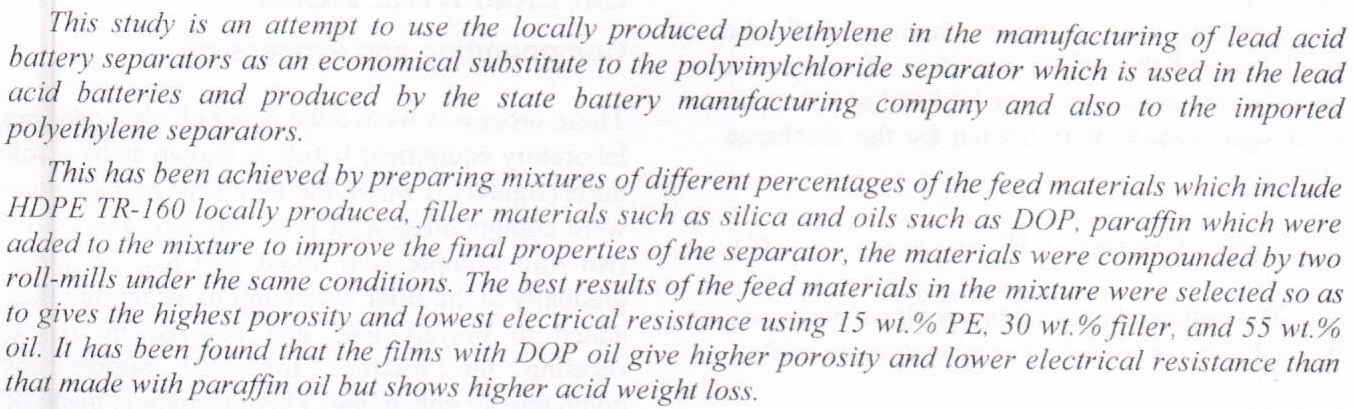
The Manufacture of Lead Acid Battery Separators using Locally Produced Polyethylene

This work targeted studying organogel as a potential floating system. Organgel has an excellent viscoelastic properties, floating system posses a depot property. Different formulations of 12-hydroxyoctadecanoic acid (HOA) in sesame oil were gelled and selecting F1, F3 and F5 HOA organogels for various examinations: tabletop rheology, optical microscopy, and oscillatory rheology studies. Also, the floating properties studies were conducted at in vitro and in-vivo levels. Lastly, the in-vitro release study using cinnarizine (CN) was to investigate the organogel depot property. Based on the results, the selected concentrations of HOA in sesame oil organogels showed temperature transitions fr
... Show More (7)
(7)
 (6)
(6)


Poly(ethylene oxide) is a promising material for solid-state lithium batteries due to its safety, ease of processing, and compatibility with lithium. However, conventional linear PEO falls short of practical requirements due to its limited ionic conductivity, a consequence of the high crystallinity of its ethylene oxide chains. This crystallinity hinders the movement of lithium ions, limiting its performance in solid-state battery applications. In this study, we successfully prepared the plasticized solid polymer electrolytes (PSPEs) based on poly(ethylene oxide) (PEO)/ tetracyanoethylene (TCE) complexed with lithium bis(trifluoromethanesulfonyl)imide (LiTFSI) salt and studied the effect of TCE on structural, mechanical, electrical and elec
... Show More
(64)
(63)
The lead has adverse effects in contamination the aquatic environment, for this reason, a laboratory simulation was conducted using kaolinite collected from the Ga’ara Formation at western Iraq to be considered as a natural sorbent material that can be addressed Pb2+ from the aqueous environments. The Energy-Dispersive X-ray Spectroscopy and atomic absorption spectroscopy clarifying very fine grains and pure phase with a very little quantity of quartz and has a number of active sites for adsorption. The sorption of kaolinite for the Pb2+ has been carefully tested by several designed laboratory experiments. Five lead solutions of different concentrations (25, 50, 75, 100 and 125 ppm) were tested under different values of pH (1.3-9)
... Show More
(4)
Four samples were collected from the wastewater of State Battery Manufacturing Company (SBMC); Babylon 2 factory in AL-Waziriya district, as triplicates. Physical and chemical measurements were carried out such as temperature, pH, Lead concentrations and their ranges were: (19.5-34.5) °C, (6.1-6.4) and (4.5-6.5) mg/L, respectively. Six dominant Bacillus spp. isolates were isolated from these samples; namely, Bacillus subtilis N1, Bacillus subtilis N2, Bacillus subtilis N3, Bacillus cereus N4, Bacillus cereus N5 , Bacillus cereus N6. These isolates were capable of removing Lead from aqueous solutions in a capacity reached 27.6 ± 1.4, 10.1 ± 1.7, 74.5 ± 0.7, 8.93 ± 2.8, 8.1 ± 3.5, 1.6± 0.7 mg/L, respectively. Whereas cell walls,
... Show More
Produced water is accompanied with the production of oil and gas especially at the fields producing by water drive or water injection. The quantity of these waters is expected to be more complicated problem with an increasing in water cut which is expected to be 3-8 barrels water/produced barrel oil.Produced water may contain many constituents based on what is present in the subsurface at a particular location. Produced water contains dissolved solids and hydrocarbons (dissolved and suspended) and oxygen depletion. The most common dissolved solid is salt with concentrations range between a few parts per thousand to hundreds parts per thousand. In addition to salt, many produced waters also contain high levels of heavy metals like zinc, bari
... Show More
(4)
The possibility of using zero-valent iron as permeable reactive barrier in removing lead from a contaminated groundwater was investigated. In the batch tests, the effects of many parameters such as contact time between adsorbate and adsorbent (0-240 min), initial pH of the solution (4-8), sorbent dosage (1-12 g/100 mL), initial metal concentration (50-250 mg/L), and agitation speed
(0-250 rpm) were studied. The results proved that the best values of these parameters achieve the maximum removal efficiency of Pb+2 (=97%) were 2 hr, 5, 5 g/100 mL, 50 mg/L and 200 rpm respectively. The sorption data of Pb+2 ions on the zero-valent iron have been performed well by Langmuir isotherm model in compared with Freundlich model under the studied
(5)
The present work utilizes polyacrylic acid beads (PAA) to remove Alizarin yellow R (AYR)] and Alizarin Red S (ARS) from its solution. The isotherms of adsorption were investigated and the factors that impact them, such as temperature, ionic strength effect, shaking effect, and wet PAA. The isotherms of adsorption of (ARS) were found obeys the Freundlich equation. The isotherms of adsorption of (AYR) were found obeys the Langmuir equation. At various temperatures, the adsorption process on (PAA) was investigated. According to our data, there is a positive correlation between the (ARS and AYR) adsorption on the PAA and temperature (Endothermic process). The computation of the thermodynamic functions (ΔH, ΔG, and ΔS) is based on the foregoi
... Show More
(1)
A high-performance liquid chromatography method was employed for the quantitative determination of ascorbic acid (AA) which called vitamin C in three types of Iraqi citrus (orange mandarin and aurantium ) and to establish this goal , evaluation of ascorbic acid degradation is so important due to its significant criticality when exposure to ordinary atmospheric conditions. The chromatographic analysis of AA was carried out after their sequential elution with KH2PO4 ( as mobile phase) by reverse-phase HPLC technique with C8 column and UV detection at 214 nm. .Bad resolutions was appeared clearly for C8 column , so another alternative condition were carried out to improve the resolution by replacement of C8 by C18 column .Statistical treat
... Show More
Optical fiber chemical sensor based surface Plasmon resonance for sensing and measuring the refractive index and concentration for Acetic acid is designed and implemented during this work. Optical grade plastic optical fibers with a diameter of 1000μm were used with a diameter core of 980μm and a cladding of 20μm, where the sensor is fabricated by a small part (10mm) of optical fiber in the middle is embedded in a resin block and then the polishing process is done, after that it is deposited with about (40nm) thickness of gold metal and the Acetic acid is placed on the sensing probe.
(9)
