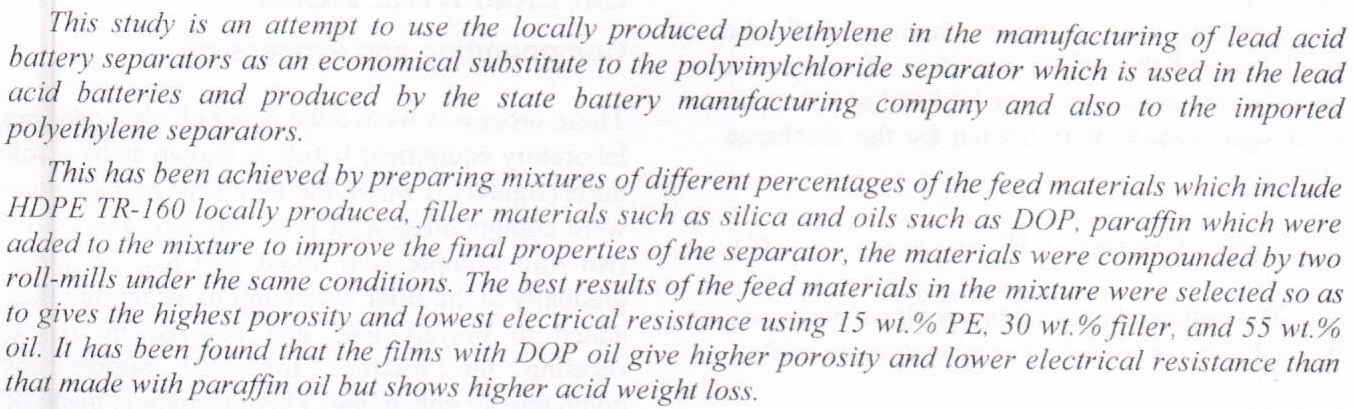
The Manufacture of Lead Acid Battery Separators using Locally Produced Polyethylene

 (1)
(1)

In the present work, leaching process studiedusing organic acids (acetic acid and lactic acid) to extract phosphate from the Iraqi Akashat phosphate ore by separation of calcareous materials (mainly calcite). This approach characterized by energy conservation, environmental enhancement by recovery of calcite as calcium sulfate (gypsum), keeping the physical and chemical properties of apatite. Samples were analyzed using X-ray diffraction and FTIR spectrophotometer. From the obtained experimental data it was found that using the two organic acids yields closed purity values of the produced apatite at the optimum conditions, while at different acid concentrations, it was found that the efficiency of acetic acid is higher at the low acid co
... Show MoreBy- products of corn starch industry were used to prepare media for propagation the lactic acid bacteria as a natural auxotroph. The by- products used were the corn steep water (S) and gluten extract (G) after a proper treatment to get them ready for media preparation. The results showed that it was possible to replace the peptone and meat extract by gluten extract in MRS medium. The growth was approximately similar to that obtained in standard MRS media. Corn steep water (S) was used as well and the growth enhanced by including Tween – 80 at 1% level. The later media named MZ, which was superior for growing standard and local strains and starters. The MZ medium modified by adding acetate and glacial acetic acid similarly to
... Show More
This study aimed to obtain a local isolation of Aspergillus niger and then studied its ability to produce citric acid from raw materials available locally using solid state fermentation. Six local isolates were collected from different sources including some samples of the damaged fruits such as grapefruit, oranges and sindi. Wheat bran was used as a raw material or as culture medium for the production of citric acid from the collected isolates. The conditions for citric acid production were determined by humidity percentage of 1: 1 (water: culture medium), temperature of 28 C, pH 4 and inoculum dose with 5× 10⁶ spore/ml and for 3 days of incubation. The orange was the best model for citric acid production with a concentration of 12.8 mg/m
... Show More
(4)
 (2)
(92)
(92)
(2)
(92)
(92)

Concentrations 25, 50 and 100 mg of nano-capsules linolenic acid and non-capsulated fatty acid for 1kg of Milk was used for yogurt manufacture. The results showed no significant differences in the ratio of titration acidity and pH values between all processed treatments at the beginning and during of period storage. The treatments was added to it coated omega-3 by nano method were the least exposed to the oxidation process from the non-capsules omega-3, And for shield of The poly lactic acid had a significant role in the protection of alpha-linolenic acid against lipolysis by the formation of a protective layer to protect the acid from the activity of lipases enzymes, and the addition of fatty acid linolenic to milk was determined the gr
... Show MoreMicroalgae present much usefulness for antimicrobial research because of its enormous biodiversity and rapid growth rate. From this study results it is reaveled that Chlamydomonas reinhardtii were isolated from a pond of water in the province of Diwaniyah. The culture supernatants were obtained when extracted with methanol solvent. Antimicrobial activity of extracts was tested for pathogens, and the best inhibition zone obtained was against Candida albicans (32mm), S.aureus (15mm), and to E.coli (9mm). While it showed no effect against both S.epidermidis and Klebsiella spp. Biofilm was formed by all tested isolates with differences in its strength formation. The C. reinhardtii
... Show More
(14)
(6)
The goal of this article is to construct fibrewise w-compact (resp. locally w-compact) spaces. Some related results and properties of these concepts will be investigated. Furthermore, we investigate various relationships between these concepts and three classes of fibrewise w-separation axioms.
(13)
(9)
Background Respiratory distress syndrome is one of the most common problems of newborns. Respiratory distress syndrome occurs when there is no enough surfactant in the lungs. Heavy metals are naturally occurring elements that have a high atomic weight and a density at least 5 times greater than that of water. Lead is a heavy metal, it is important environmental toxicant; the toxic effects of lead include many systems in the body like central and peripheral nervous system. Cadmium is heavy metal that exerts toxic effects on the kidney, the skeletal and the respiratory systems, and is classified as a human carcinogen. Nicotine, the main alkaloid of tobacco. It is readily absorbed from tobacco smoke, and its concentration rises over 6-8 hours
... Show More
(1)