Preferred Language
Articles
/
ijcpe-688
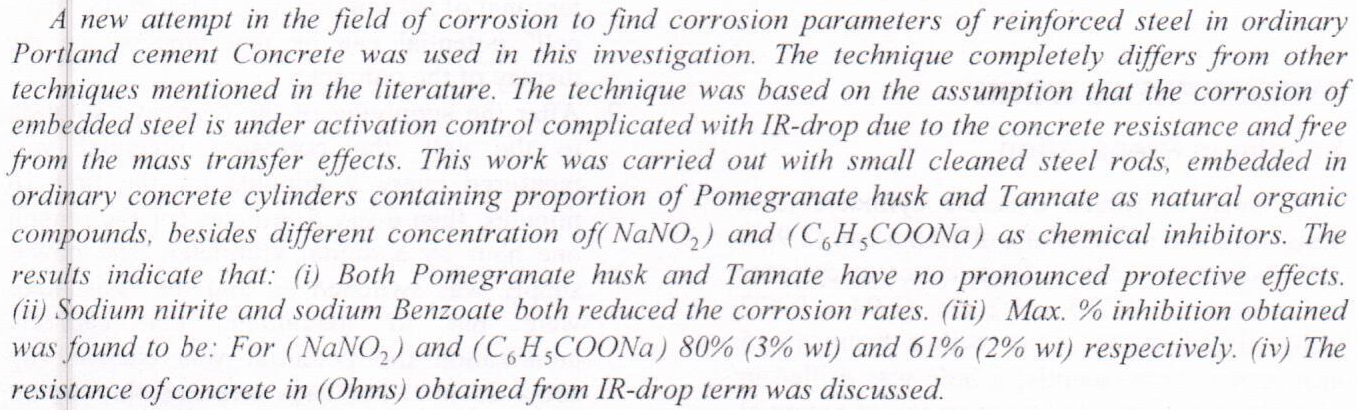
Corrosion Inhibition of Steel Reinforcement in Concrete
...Show More Authors

View Publication Preview PDF
Quick Preview PDF
Publication Date
Fri Jan 01 2016
Journal Name
Journal Of Engineering
Some Properties of Polymer Modified Self-Compacting Concrete Exposed to Kerosene and Gas Oil
...Show More Authors

This thesis aims to study the effect of addition polymer materials on mechanical properties of self-compacting concrete, and also to assess the influence of petroleum products (kerosene and gas oil) on mechanical properties of polymer modified self-compacting concrete (PMSCC) after different exposure periods of (30 ,60 ,90 ,and 180 days).

Two type of curing are used; 28 days in water for SCC and 2 days in water followed 26 days in air for PMSCC.

The test results show that the PMSCC (15% P/C ratio) which is exposed to oil products recorded a lower deterioration in compressive strength's values than reference concrete. The percentages of reduction in compressive strength values of PMSCC (15% P/C ratio) was

... Show More
View Publication Preview PDF
Publication Date
Sun Jan 01 2023
Journal Name
Journal Of Engineering
The Response of Reinforced Concrete Composite Beams Reinforced with Pultruded GFRP to Repeated Loads
...Show More Authors

This paper investigates the experimental response of composite reinforced concrete with GFRP and steel I-sections under limited cycles of repeated load. The practical work included testing four beams. A reference beam, two composite beams with pultruded GFRP I-sections, and a composite beam with a steel I-beam were subjected to repeated loading. The repeated loading test started by loading gradually up to a maximum of 75% of the ultimate static failure load for five loading and unloading cycles. After that, the specimens were reloaded gradually until failure. All test specimens were tested under a three-point load. Experimental results showed that the ductility index increased for the composite beams relative to the refe

... Show More
View Publication Preview PDF
Crossref (10)
Crossref
Publication Date
Wed Sep 01 2021
Journal Name
Computers And Concrete
Improving the seismic performance of reinforced concrete frames using an innovative metallic-shear damper
...Show More Authors

Scopus (14)
Scopus
Publication Date
Wed May 01 2019
Journal Name
Journal Of Engineering
Using Ultrasonic Pulse Velocity Test to Assess the Effect of Water-Cement Ratio on the Compressive Strength of Concrete
...Show More Authors

This study aims to find the effect of water-cement ratio on the compressive strength of concrete by using ultrasonic pulse velocity test (UPVT). Over 230 standard cube specimens were used in this study, with dimensions of 150mm, and concrete cubes were cured in water at 20 °C. Also, the specimens used in the study were made of concrete with varied water-cement ratio contents from 0.48 to 0.59. The specimens were taken from Diyarbakir-Turkey concrete centers and tested at the structure and material science lab, civil engineering, faculty of engineering from Dicle University.  The UPV measurement and compressive strength tests were carried out at the concrete age of 28 days. Their UPV and compressive strength ranged

... Show More
View Publication Preview PDF
Crossref (2)
Crossref
Publication Date
Mon Feb 01 2016
Journal Name
Journal Of Engineering
The Effect of Cement and Admixture Types on the Resistance of High Performance Concrete to Internal Sulphate Attack
...Show More Authors

This work is concerned with the study of the effect of cement types, particularly OPC and SRPC, which are the main cement types manufactured in Iraq. In addition, study the effect of mineral admixtures, which are HRM and SF on the resistance of high performance concrete (HPC) to internal sulphate attack. The HRM is used at (10%) and SF is used at (8 and 10)% as a partial replacement by weight of cement for both types. The percentages of sulphate investigated are (1,2 and 3)% by adding natural gypsum as a partial replacement by weight of fine aggregate. The tests carried out in this work are: compressive strength, flexural strength, ultrasonic pulse velocity, and density at the age of 7, 28, 90 and 120 days.

The r

... Show More
View Publication Preview PDF
Publication Date
Sat Mar 30 2019
Journal Name
Iraqi Journal Of Chemical And Petroleum Engineering
Removal of Manganese Ions (Mn2+) from a Simulated Wastewater by Electrocoagulation/ Electroflotation Technologies with Stainless Steel Mesh Electrodes: Process Optimization Based on Taguchi Approach
...Show More Authors

This study depicts the removal of Manganese ions (Mn2+) from simulated wastewater by combined electrocoagulation/ electroflotation technologies. The effects of initial Mn concentration, current density (C.D.), electrolysis time, and different mesh numbers of stainless steel screen electrodes were investigated in a batch cell by adopting Taguchi experimental design to explore the optimum conditions for maximum removal efficiency of Mn. The results of multiple regression and signal to noise ratio (S/N) showed that the optimum conditions were Mn initial concentration of 100 ppm, C.D. of 4 mA/cm2, time of 120 min, and mesh no. of 30 (wire/inch). Also, the relative significance of each factor was attained by the analysis

... Show More
View Publication Preview PDF
Crossref (6)
Crossref
Publication Date
Sat Mar 30 2019
Journal Name
Iraqi Journal Of Chemical And Petroleum Engineering
Removal of Manganese Ions (Mn2+) from a Simulated Wastewater by Electrocoagulation/ Electroflotation Technologies with Stainless Steel Mesh Electrodes: Process Optimization Based on Taguchi Approach
...Show More Authors

This study depicts the removal of Manganese ions (Mn2+) from simulated wastewater by combined electrocoagulation/ electroflotation technologies. The effects of initial Mn concentration, current density (C.D.), electrolysis time, and different mesh numbers of stainless steel screen electrodes were investigated in a batch cell by adopting Taguchi experimental design to explore the optimum conditions for maximum removal efficiency of Mn. The results of multiple regression and signal to noise ratio (S/N) showed that the optimum conditions were Mn initial concentration of 100 ppm, C.D. of 4 mA/cm2, time of 120 min, and mesh no. of 30 (wire/inch). Also, the relative significance of each factor was attained by the analysis of variance (ANO

... Show More
View Publication Preview PDF
Crossref (6)
Crossref
Publication Date
Tue Aug 01 2023
Journal Name
Journal Of Engineering
The Influence of Waste Plastic Fiber on the Characteristics of Light Weight Concrete with Expanded Polystyrene (EPS) as Aggregate
...Show More Authors

This research aims to create lightweight concrete mixtures containing waste from local sources, such as expanded polystyrene (EPS) beads and waste plastic fibers (WPFs), all are cheap or free in the Republic of Iraq and without charge. The modern, rigid, and mechanical properties of LWC were investigated, and the results were evaluated. Three mixtures were made, each with different proportions of plastic fibers (0.4%, 0.8%, 1.2%), in addition to a lightweight concrete mixture containing steak fibers (0.4%, 0.8%, 1.2%), in addition to a lightweight concrete mixture. It contains 20% EPS. The study found that the LWC caused by the addition of WPFs reduced the density (lightweight) of the concrete mixtures because EPS tends

... Show More
View Publication Preview PDF
Crossref (4)
Crossref
Publication Date
Sun Dec 01 2019
Journal Name
Al-khwarizmi Engineering Journal
An Experimental Study on Electrochemical Grinding Parameters on Hardness and Material Removal Rate for Stainless Steel 316
...Show More Authors

Electrochemical Grinding (ECG) process is a mechanically assisted electrochemical process for material processing. The process is able to successfully machine electrically conducting harder materials at faster rate with improved surface finish and dimensional control. This research studies the effect of applied current, electrolyte concentration, spindle speed and the gap between workpiece and tool on hardness and material removal rate during electrochemical grinding for stainless steel 316. The characteristic features of the electrochemical grinding process are explored through Taguchi-design-based experimental studies. The better hardness can be obtained at 10 A of the current, 150 g/l of the electrolyte concentration, 0.3 mm of gap an

... Show More
View Publication Preview PDF
Publication Date
Thu Nov 02 2023
Journal Name
Journal Of Engineering
The Effect of Using Different Aspect Ratios of Sustainable Copper Fiber on Some Mechanical Properties of High-Strength Green Concrete
...Show More Authors

To achieve sustainability, use waste materials to make concrete to use alternative components and reduce the production of Portland cement. Lime cement was used instead of Portland cement, and 15% of the cement's weight was replaced with silica fume. Also used were eco-friendly fibers (copper fiber) made from recycled electrical. This work examines the impact of utilizing sustainable copper fiber with different aspect ratios (l/d) on some mechanical properties of high-strength green concrete. A high-strength cement mixture with a compressive strength of 65 MPa in line with ACI 211.4R was required to complete the assignment. Copper fibers of 1% by volume of concrete were employed in mixes with four different aspect ratios

... Show More
View Publication Preview PDF
Crossref (6)
Crossref