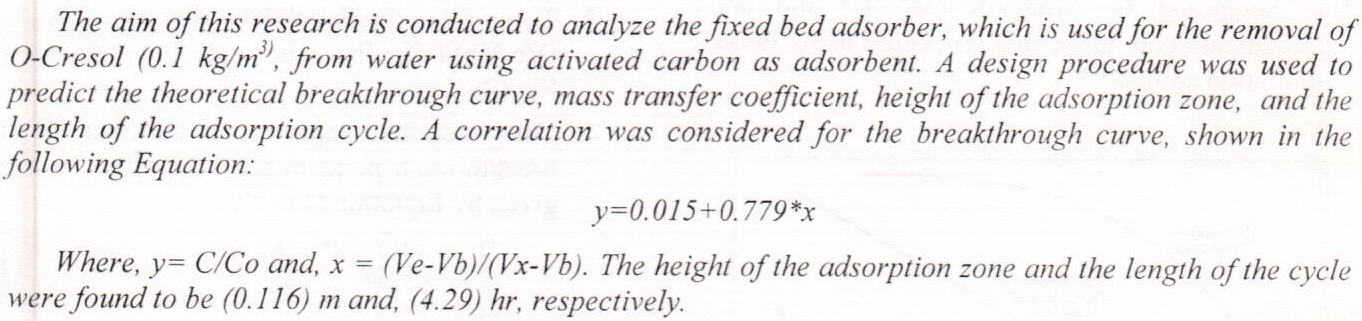
The Analysis of a Fixed Bed Absorber Used for the Removal of Pollutants from Water

Background: Polymeric composites have been widely used as dental restorative materials. A fundamental knowledge and understanding of the behavior of these materials in the oral cavity is essential to improve their properties and performance. The goal of this study was to measure water sorption of four composite resins containing different filler and resin matrix contents. Materials and method: Resin composite specimens giomer (Beautifil II) Filtek™ P90, Filtek™ Z350 XT, and Tetric N Ceram were prepared in a cylindrical mould of 3mm thickness and 6mm diameter (n=10) and light cured . All specimens placed in silica-gel desiccators at 37˚C for seven days, a constant weight was obtained. All samples were immersed in deionized distill
... Show MoreExperimental measurements of viscosity and thermal conductivity of single layer of graphene . based DI-water nanofluid are performed as a function of concentrations (0.1-1wt%) and temperatures between (5 to 35ºC). The result reveals that the thermal conductivity of GNPs nanofluids was increased with increasing the nanoparticle weight fraction concentration and temperature, while the maximum enhancement was about 22% for concentration of 1 wt.% at
35ºC. These experimental results were compared with some theoretical models and a good agreement between Nan’s model and the experimental results was observed. The viscosity of the graphene nanofluid displays Newtonian and Non-Newtonian behaviors with respect to nanoparticles concen
The water supply network inside the building is of high importance due to direct contact with the user that must be optimally designed to meet the water needs of users. This work aims to review previous research and scientific theories that deal with the design of water networks inside buildings, from calculating the amount of consumption and the optimal distribution of the network, as well as ways to rationalize the use of water by the consumer. The process of pumping domestic water starts from water treatment plants to be fed to the public distribution networks, then reaching a distribution network inside the building till it is provided to the user. The design of the water supply network inside the building is
... Show More
Epoxy (EP) – Silica (SiO2) composites are well known composites used in microelectronic industry . So it is important to study their dielectric behavior under different conditions such as
the presence carbon black (UV absorber) and immersion in the water for 30 days .
Dielectric properties were calculated over the frequency range 102 – 106 Hz for epoxy composites with different weight % of micrometer 1.5μm SiO2 particles (60%, 65% and 70wt%) modified with 0.5wt% silane coupling agent to improve adhesion between EP and SiO2 phases .
The concerns about water contaminants affect most developing countries bypassing rivers over them. The issue is challenging to introduce water quality within the allowed limits for drinking, industrial and agricultural purposes. In the present study, physical-chemical parameters measurements of water samples taken from eleven stations were collected during six months in 2020 through flow path along the whole length of Tigris River inside AL Kut city (center of Wassit government) were investigated for six parameters are total hardness TH, hydrogen ion pH, biological oxygen demand BOD5, total dissolved solids TDS, nitrate NO3, and sulfate SO4. The water quality analysis results were compared with the maximum allowable limit concentrat
... Show More (7)
(7)
 (4)
(4)
 (7)
(4)
(7)
(4)

