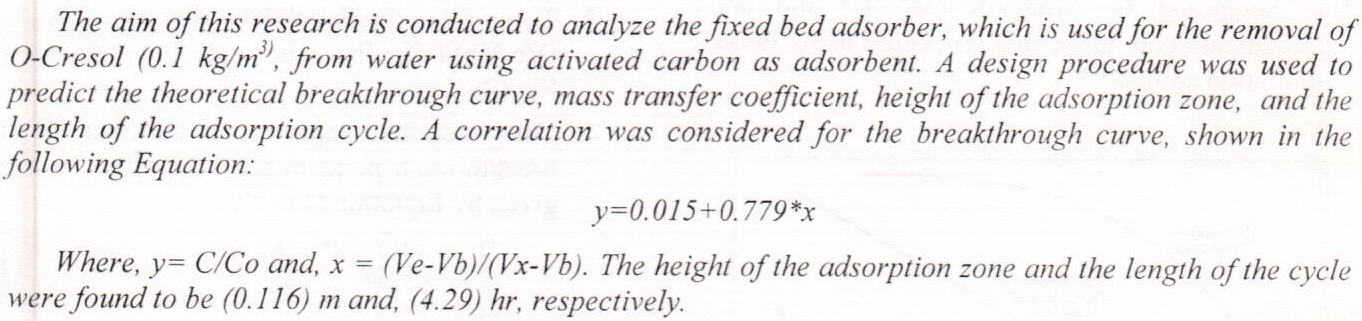
The Analysis of a Fixed Bed Absorber Used for the Removal of Pollutants from Water

The aim: To examine the efficiency of different concentrations of Dimethyl sulfoxide (DMSO) and glycerol as a cytoprotectants in protection of human sperms during cryopres¬ervation in this technique. Materials and methods: Thirty oligozoospermic semen samples were used in this study. Samples diagnosed according to WHO 2010 criteria. Sheep’s ovarian follicles obtained from local slaughterhouse and prepared by slicing the ovaries and evacuating the follicular fluid and oocyte. Each semen sample divided into six equal parts, and diluted 1:1 with cryosolution contains 5%, 10%, 15% DMSO or glycerol and injected within the emptied follicles. After freezing and thawing, the semen mixture aspired outside the follicles and sperm concentr
... Show More

The aim of this paper is to identify Nano-particles that have been used in diagnosis and treatment of leishmaniasis in Iraq. All experiments conducted in this field were based on the following nanoparticles: gold nanoparticles, silver nanoparticles, zinc nanoparticles, and sodium chloride nanoparticles. Most of these experiments were reviewed in terms of differences in the concentrations of nanoparticles and the method that was used in the experiments whether it was in vivo or in vitro. These particles used in most experiments succeeded in inhibiting the growth of Leishmania parasites.

The service system has become a necessity of life in modern cities to be the most basic necessities of modern humans, they constitute a major base, which is based on the sustainability of life in the city and a standard measured through the degree of well-being and progress of civilized peoples and their interaction with the surrounding environment, making the services sector as a need not be an option, whenever the cities widened in population and space whenever provision of services and upgrading the quality and quantity more pressing, which made the subject of the services takes the biggest area of the trends and thinking of urban planners and those who in charge of drawing the cities policies. Consideri
... Show MoreIn the present work the performance of semifluidized bed adsorber was evaluated for removal of phenolic compound from wastewater using commercial activated carbon as adsorbent. P-chlorophenol (4-Chlorophenol) and o-cresol (2-methylphenol) was selected as a phenolic compound for that purpose. The phenols percent removal, in term of breakthrough curves were studied as affected by hydrodynamics limitations which include minimum and maximum semifluidization velocities and packed bed formation in the column by varying various parameters such as inlet liquid superficial velocity (from Uminsf to 8Uminsf m/s), and retaining grid (sometimes referred to as adsorbent loading) to initial static bed height ratio (from 3-4.5). In
... Show More (8)
(8)
 (10)
(10)
Removing hazardous organic pollutants, such as 4-nitrophenol (4-NP) and Congo red (CR) dyes from aqueous media and CO2 from the atmospheric medium remains a significant challenge. Herein, we report a facile in-situ synthetic approach for fabricating CuO-ZnO heterostructure photocatalysts through the surfactant-assisted co-precipitation method. The catalytic results demonstrate that the Cu1O-ZnO photocatalyst exhibits excellent activity under direct sunlight irradiation, owing to the heterostructure formation between the CuO and ZnO. The Cu1O-ZnO photocatalyst showed higher reaction rate constant (k) values of 0.20 min−1 for 4-NP and 0.09 min−1 for CR compared to previous reports. Additionally, efficient CO2 reduction was also achiev
... Show More
(1)
irrigation use at many stations along the Euphrates River inside the Iraqi lands and to try to correlate the results with the satellite image analyses for the purpose of making a colored model for the Euphrates that can be used to predict the quality classifications of the river for irrigation use at any point along the river. The Bhargava method was used to calculate the water quality index for irrigation use at sixteen stations along the river from its entrance to the Iraqi land at Al-Qaim in Anbar governorate to its union with the Tigris River at Qurna in Basrah governorate. Coordinates of the sixteen stations of the Euphrates River were projected at the mosaic of Iraq satellite image which was taken from LANDSAT satellite for bands 1, 2
... Show MoreThis systematic review aimed to investigate the relation between orthodontic treatment (OT) and the incidence of the gingival black triangle (GBT) after completing treatment with a fixed orthodontic appliance, as well as the associated risk factors and the level of alveolar bone. Electronic and hand searches were conducted in three electronic databases for relevant articles published up to March 2022. Retrieved articles went through a two-step screening procedure, and the risk of bias (RoB) was assessed by the Joanna Briggs Institute checklists. The incidence of GBT after OT was set as the primary outcome, while the secondary outcomes were the risk factors associated with GBT and alveolar bone loss following OT. Out of 421 papers, 5
... Show More
(20)
(13)
Biosorption of cadmium ions from simulated wastewater using rice husk was studied with initial concentration of 25 mg/l. Equilibrium isotherm was studied using Langmuir, Freundlich, BET and Timken models. The results show that the Freundlich isotherm is the best fit model to describe this process with high determination coefficient equals to 0.983. There was a good compliance between the experimental and theoretical results. Highest removal efficiency 97% was obtained at 2.5g of adsorbent, pH 6 and contact time 100 min.