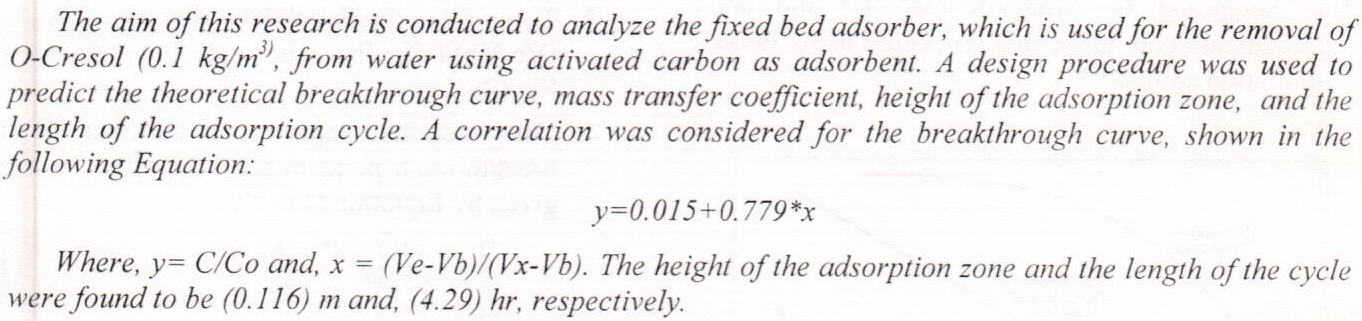
The Analysis of a Fixed Bed Absorber Used for the Removal of Pollutants from Water

New chelating ligand derived from triazole and its complexes with metal ions Rhodium, Platinum and Gold were synthesized. Through a copper (I)-catalyzed click reaction, the ligand produced 1,3-dipolar cycloaddition between 2,6-bis((prop-2-yn-1-yloxy) methyl) pyridine and 1-azidododecane. All structures of these new compounds were rigorously characterized in the solid state using spectroscopic techniques like: 1HNMR, 13CNMR, Uv-Vis, FTIR, metal and elemental analyses, magnetic susceptibility and conductivity measurements at room temperature, it was found that the ligand acts as a penta and tetradentate chelate through N3O2, N2O2, and the geometry of the new complex
... Show More (10)
(10)
 (6)
(6)


The ligand 2-[1-(1H-indol-3-yl)ethylimino) methyl]naphthalene-1-ol, derived from 1-hydroxy-2-naphthaldehyde and 2-(1H-indol-3-yl)ethylamine, was used to produce a new sequence of metal ions complexes. Thus ligand reactions with NiCl2.6H2O, PdCl2, FeCl3.6H2O and H2PtCl6.6H2O were sequentially made to collect mono-nuclear Ni(II), Pd(II), Fe (III), and Pt(IV). (IR or FTIR), Ultraviolet Reflective (UV–visible), Mass Spectra analysis, Bohr-magnetic (B.M.), metal content, chloride content and molar conductivity have been the defining features of the composites. The Fe(III) and Pt(IV) complexes have octahedral geometries, while the Ni(II) complex has tetra
... Show More
(16)
(5)

The ligand 4-amino-N-(5-methylisoxazole-3-yl)-benzene-sulfonamide(L1) (as a chelating ligand) was treated with Pd(II),Pt (IV) and Au(III) ions in alcoholic medium in order to prepare a series of new metal complexes. Mixed ligand complexes of this primary ligand were prepared in alcoholic medium in presence of the co-ligand 4,4'-dimethyl-2,2'-bipyridyl(L2) with Cu(II) ,Pd(II) and Au(III) ions. The complexes were characterized in solid state using flame atomic absorption, elemental analysis C.H.N.S, FT-IR, UV-Vis Spectroscopy, conductivity and magnetic susceptibility measurements. The nature of some complexes formed in ethanolic solution has been studied following the molar ratio method, also stability constant was studied and the complexes f
... Show More
(2)
Objective: To find out the relationship between vaginal bleeding during third trimester and pregnancy outcomes. Methodology: A purposive sample is "Non-probability" of (100) women who had diagnostic vaginal bleeding during third trimester (27-40wk) of pregnancy, and who visited the Bint Al-Huda Hospital for the period from 15th Feb. to 17th May 2015.Validity and reliability of questionnaire are determined through pilot study. Descriptive and inferential statistical procedures were used to analyze the data, and the data were collected by using interview technique, constructed questionnaire has been desig
The purpose of this study is to investigate the histopathological response of dentinopulpal
response of human teeth to the Er: YAG laser cavity preparation in comparison with the conventional
class I cavity preparation. Thirty five sound human upper and lower first premolar teeth which were
needed to be extracted for orthodontic purposes were used in the study. Regarding to the method of
cavity preparation, the teeth were grouped into three groups; Group1; Control group which consists of
seven sound teeth without cavity preparation, Group2; Conventional cavity preparation group and group
3; Er: YAG laser cavity preparation group. Each of Group2 and3 consists of fourteen teeth that is
subdivided into: A. 7teeth that e
Aннотация
В статье представлены явления полисемии и омонимии в специализированной терминосистеме, а именно в геодезической терминологии; определены предпосылки и причины возникновения полисемии и омонимии в профессиональном языке в области геодезии и кадастра; установлены различия и взаимосвязь между понятиями омонимия и полисемия; выделены главных типы полисемантических тер
... Show MoreThe experiment was conducted in two stages: first stage: determination of the most effective dose of Cyperus rotundus tubers aquatic extract in male rats for 5 days, which was concentrated as (200 mg/kg body weight). The second stage was designed to observe and test the protective effects of C. rotundus tubers aquatic extract in the liver and kidney functions of male rats exposed to cadmium chloride poisoning (5 mg/kg bw) for 30 days. The animals were divided into (4) groups within each group (5) animals weighted (200-220g). The results of oral dose of cadmium chloride showed a significant increase of (P˂0.05) in the activity of both enzymes Alanine aminotransferas
... Show More
(2)
(3)
KE Sharquie, SA Al Mashhadani, AA Noaimi, RK Al-Hayani, SA Shubber, Iraqi Postgraduate Medical Journal, 2012 - Cited by 1
(1)