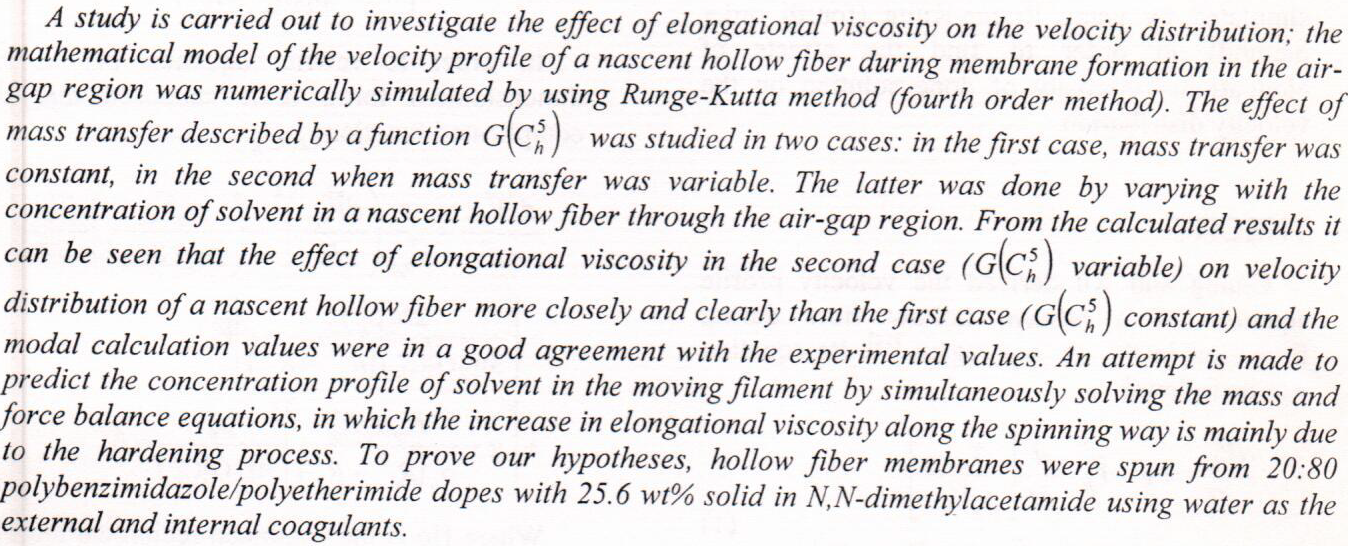
Studying Effect of Elongational Viscosity on the Velocity Distribution for Dry/Wet-Spun Nascent Hollow Fiber Membrane

The content of fatty acid methyl esters (FAME) is a crucial property of biodiesel and serves as an indicator of the transesterification reaction that converts vegetable oil into biodiesel. To facilitate the rapid estimation of FAME quickly in the biodiesel industries, simple methods such as measuring refractive index, density, and dynamic viscosity measurements were employed to monitor the progress of transesterification of castor oil to biodiesel. Blends of castor oil and biodiesel were mixed at different weights to find correlations between FAME content and refractive index, density, and dynamic viscosity measurements. The transesterification of castor oil with methanol was carried out to examine how the refractive index, density,
... Show More

The Boltzmann transport equation is solved by using two- terms approximation for pure gases . This method of solution is used to calculate the electron energy distribution function and electric transport parameters were evaluated in the range of E/N varying from . 172152110./510.VcmENVcm
From the results we can conclude that the electron energy distribution function of CF4 gas is nearly Maxwellian at (1,2)Td, and when E/N increase the distribution function is non Maxwellian. Behavior of electrons transport parameters is nearly from the experimental results in references. The drift velocity of electron in carbon tetraflouride is large compared with other gases
The Boltzmann transport equation is solved by using two- terms approximation for pure gases and mixtures. This method of solution is used to calculate the electron energy distribution function and electric transport parameters were evaluated in the range of E/N varying from . 172152110./510.VcmENVcm
The electron energy distribution function of CF4 gas is nearly Maxwellian at (1,2)Td, and when E/N increase the distribution function is non Maxwellian. Also, the mixtures are have different energy values depending on transport energy between electron and molecule through the collisions. Behavior of electrons transport parameters is nearly from the experimental results in references. The drift velocity of electron in carbon tetraflouride i
Al-Rustamiyah plant is the oldest and biggest sewage treatment plant in Iraq; it locates in the south of Baghdad city. The plant suffers from serious problems associated with overflow and low capacity. The present work aims to upgrade the heart of biological treatment process through suggesting the use of membrane bioreactor; (MBR). In this work, fouling of membrane during sewage treatment has been analyzed experimentally and theoretically by fouling mechanisms. Aeration has been applied in order to control fouling through producing effective diameters of air bubbles close to the membrane walls. Effect of air flow rate on flux decline was investigated. Hermia's models were used to investigate the fouling mechanisms. The results showed th
... Show MoreHalobacterium saccharovorum was isolated from local highsalinity souls named Al-Massab Al-Aam. A growth curve was determined. The average generation time during logarith- mic phase was 17.80±0.62 hr. Bacteriorhodopsin was 1808 lated from the purple membrane, its concentration was 4.8 mg/ml and H.W was 26000. The pattern of other membrane Bpoteins was studied and compared with those of other Boletes. Several unique proteins were isolated and their molecular weights were determined.
In this study, the photodegradation of Congo red dye (CR) in aqueous solution was investigated using Au-Pd/TiO2 as photocatalyst. The concentration of dye, dosage of photocatalyst, amount of H2O2, pH of the medium and temperature were examined to find the optimum values of these parameters. It has been found that 28 ppm was the best dye concentration. The optimum amount of photocatalyst was 0.09 g/75 mL of dye solution when the degradation percent was ~ 96 % after irradiation time of 12 hours, while the best amount of hydrogen peroxide was 7μl/75 mL of dye solution at degradation percent ~97 % after irradiation time of 10 hours, whereas pH 5 was the best value to carry out the reaction at the highest degradation percent. In additio
... Show More (20)
(20)
 (13)
(13)

In this study, the photodegradation of Congo red dye (CR) in aqueous solution was investigated using Au-Pd/TiO2 as photocatalyst. The concentration of dye, dosage of photocatalyst, amount of H2O2, pH of the medium and temperature were examined to find the optimum values of these parameters. It has been found that 28 ppm was the best dye concentration. The optimum amount of photocatalyst was 0.09 g/75 mL of dye solution when the degradation percent was ~ 96 % after irradiation time of 12 hours, while the best amount of hydrogen peroxide was 7μl/75 mL of dye solution at degradation percent ~97 % after irradiation time of 10 hours, whereas pH 5 was the best value to carry out the reaction at the highest degradation percent. In additio
... Show More
(20)
(13)
(6)
(6)
In this study, the photodegradation of Congo red dye (CR) in aqueous solution was investigated using Au-Pd/TiO2 as photocatalyst. The concentration of dye, dosage of photocatalyst, amount of H2O2, pH of the medium and temperature were examined to find the optimum values of these parameters. It has been found that 28 ppm was the best dye concentration. The optimum amount of photocatalyst was 0.09 g/75 mL of dye solution when the degradation percent was ~ 96 % after irradiation time of 12 hours, while the best amount of hydrogen peroxide was 7μl/75 mL of dye solution at degradation percent ~97 % after irradiation time of 10 hours, whereas pH 5 was the best value to carry out the reaction at the highest deg
... Show More
(20)
(13)