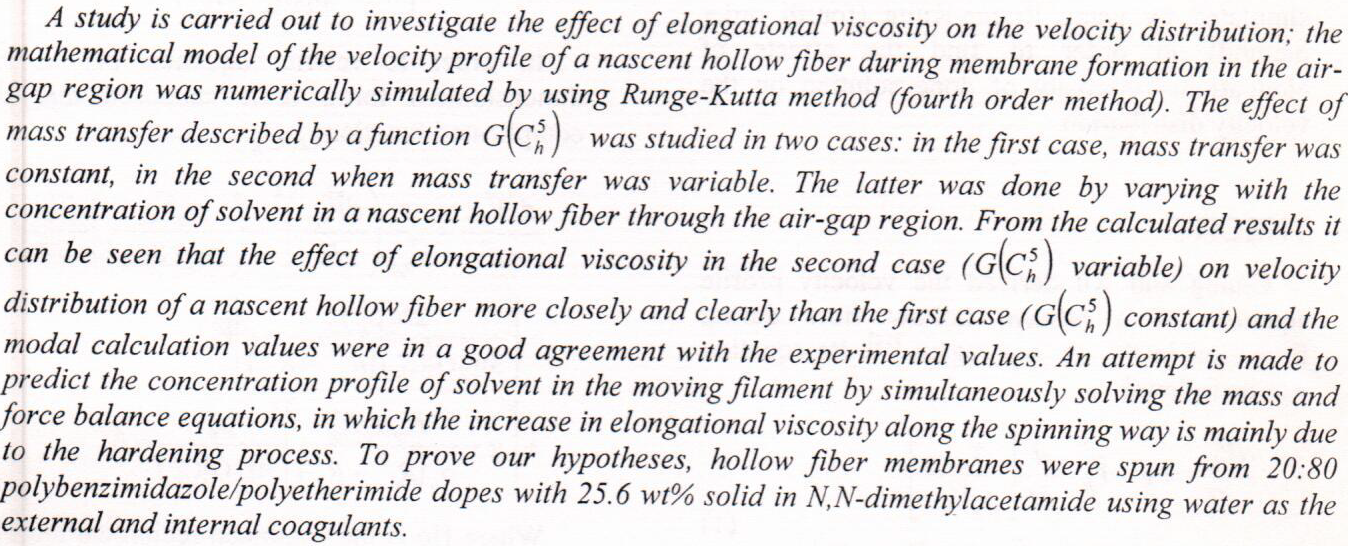
Studying Effect of Elongational Viscosity on the Velocity Distribution for Dry/Wet-Spun Nascent Hollow Fiber Membrane

اثناء تفاعل الديزنة تكونت صبغة أزو جديدة عن طريق تفاعل 3-امينوفينول مع 2,4,6-ثلاثي هيدروكسي اسيتوفينون . ثم تم تفاعل هذا الليكاند مع بعض ايونات العناصر الكروم والحديد الروديوم والروثينيوم بتكفؤهم الثلاثي والكوبلت الثنائي والموليبدينوم سداسي التكافؤ مكونة معقدات فلزية مختلفة بأشكال هندسية متعددة. تم ملاحظة تناسق مجموعة الازو مع ايونات العناصر من خلال ملاحظة ظهور حزم امتصاص الفلز مع النتروجين والاوكسجين ب
... Show More (14)
(14)
 (5)
(5)


 (5)
(1)
(5)
(1)
A new Schiff base [1-((2-(1H-indol-3-yl)ethylimino)methyl)naphthalene-2-ol] (HL) has been synthesized by condensing (2-hydroxy-1-naphthaldehyde) with (2-(1H-indol-3-yl)ethylamine). In turn, its transition metal complexes were prepared having the general formula; [Pt(IV)Cl2(L)2], [Re(V)Cl2(L)2]Cl and [Pd(L)2], 2K[M(II)Cl2(L)2] where M(II) = Co, Ni, Cu] are reported. Ligand as well as metal complexes are characterized by spectroscopic techniques such as FT-IR, UV-visible, 13C & 1H NMR, mass, elemental analysis. The results suggested that the ligand behaves like a bidentate ligand for all the synthesized complexes. On the other hand, theoretical studies of the ligand as well its metal complexes were conducted at gas phase using Hyp
... Show More
(29)
(11)
Biosorption of lead, chromium, and cadmium ions from aqueous solution by dead anaerobic biomass (DAB) was studied in single, binary, and ternary systems with initial concentration of 50 mg/l. The metal-DAB affinity was the same for all systems. The main biosorption mechanisms were complexation and physical adsorption of metallic cations onto natural active functional groups on the cell wall matrix of the DAB. It was found that biosorption of the metallic cations onto DAB cell wall component was a surface process. The main functional groups involved in the metallic cation biosorption were apparently carboxyl, amino, hydroxyle, sulfhydryl, and sulfonate. These groups were part of the DAB cell wall structural polymers. Hydroxyle groups (–O
... Show More
(13)
In study of effective bioactive compounds, we have synthesized the Co((ІІ), Mn(ІІ), Fe(ІІ), Cu(ІІ), Ni(ІІ), and Zn(ІІ) complexes of the Schiff base derived from trimethoprim and2'-amino-4-chlorobenzophenone and characterized by spectroscopic (NMR, IR, Mass, UV–vis,), analytical, TGA studies and magnetic data .The solution electronic spectral study suggests the stoichiometry of the synthesized complexes and Elemental analysis detected the square planer and octahedral geometry of the compounds. The prepared metal complexes presented promoted efficiency versus the screened bacterial (Escherichia Coli and Staphylococcus aureus) antibacterial efficacy against (Staphylococcus aureus, Salmonella spp., E. coli, Vibrio spp., Pseudomona
... Show MoreThe [2-hydroxy -1,2-diphynel-ethanone oxime] was reacted with 1,2- dichloroethan to give the new ligand [H2L].this ligand was reacted with some metal ions (Co(II),Ni(II),Cu(II),Zn(II) and Cd(II) in methanol as a solvent to give a series of new (1:1)complexes of the general formula [ M(HL)]Cl ,( where : M= Co(II),Ni(II),Cu(II),Zn(II) and Cd(II)) are isolated All compounds have been characterized by spectroscopic methods [ I.R , U.V -Vis ] atomic absorption . Chloride content along with conductivity measurements. From the above data the proposed molecular structure for (Co, Cu, Ni, Zn and Cd) complexes adopting a tetrahedral structure.
Abstract: Thorough assessment of the Maxillary,Sinus is very important. Recently 3-dimensional imagewith Cone Beam Computed Tomography (CBCT) is very dependable in Maxillary Sinus diagnosis. The aim of this study is to: shade light on the role of (CBCT) diagnosis of the maxillary sinus anatomical variation and pathological finding among smokers and nonsmokers prior to maxillary sinus lift techniques. Materials and Method: In this study 60 males with age ranged between 20-50 years old, referred for (CBCT) assessment of maxillary sinus in the Specialist Health Center of AL-Sadder city. The scanning were performed using Kodak 9500 (CBCT), the KV was 90, mA10 and scanning time 10 s. Voxel size 0.3mm with( DICOM ) software on a multiplaner re
... Show More
Objective: To identify causes of maternal death in Mizan Aman and Gebretsadik shawo general hospitals
Methodology: A case control study on 595 charts, 119 cases and 476 controls was conducted in Mizan
Aman & Gebretsadik shawo general hospitals. Data was analyzed by STATA 13.1. Propensity score
matching analysis was used to see causes of maternal death.
Results: Hemorrhage were the main direct causes of maternal death which accounts 47.9% (β =0.58
(95% CI (0.28,0.87)) in hospital but when projected to population based the sample (β =0.26 (95% CI
(0.22,0.31)). Followed by infection 36 (25.21%) (β = 0.50 (95% CI (0.08, 0.92)). when projected to
population based the sample PIH 7.6%) is significant cause (β = 0.16
The research amid to find out the extent of Iraqi oil companies commitment to implement internal control procedures in accordance with the updated COSO framework. As the research problem was represented in the fact that many of the internal control procedures applied in the Iraqi oil companies are incompatible with most modern international frameworks for internal control, including the integrated COSO framework, issued by the Committee of Sponsoring Organizations of the Tradeway Committee. The research followed the quantitative approach to handling and analysing data by designing a checklist to represent the research tool for collecting data. The study population was represented in the Iraqi oil companies, while the study sample
... Show More
The aim of the study was to evaluate the efficacy of diode laser (λ=940 nm) in the management of gingival hyperpigmentation compared to the conventional bur method. Materials and methods: Eighteen patients with gingival hyperpigmentation were selected for the study with an age between 12-37 years old. The site of treatment was the upper gingiva using diode laser for the right half and the conventional method for the left half. All patients were re-evaluated after the following intervals: 3 days, 7 days, 1 month and 6 months post-operation. Pain and functions were re-evaluated in each visit for a period of 1 day, 3 days and 1 week post-operation. Laser parameters included 1.5 W in continuous mode with an initiated tip (400 μm) placed in
... Show More