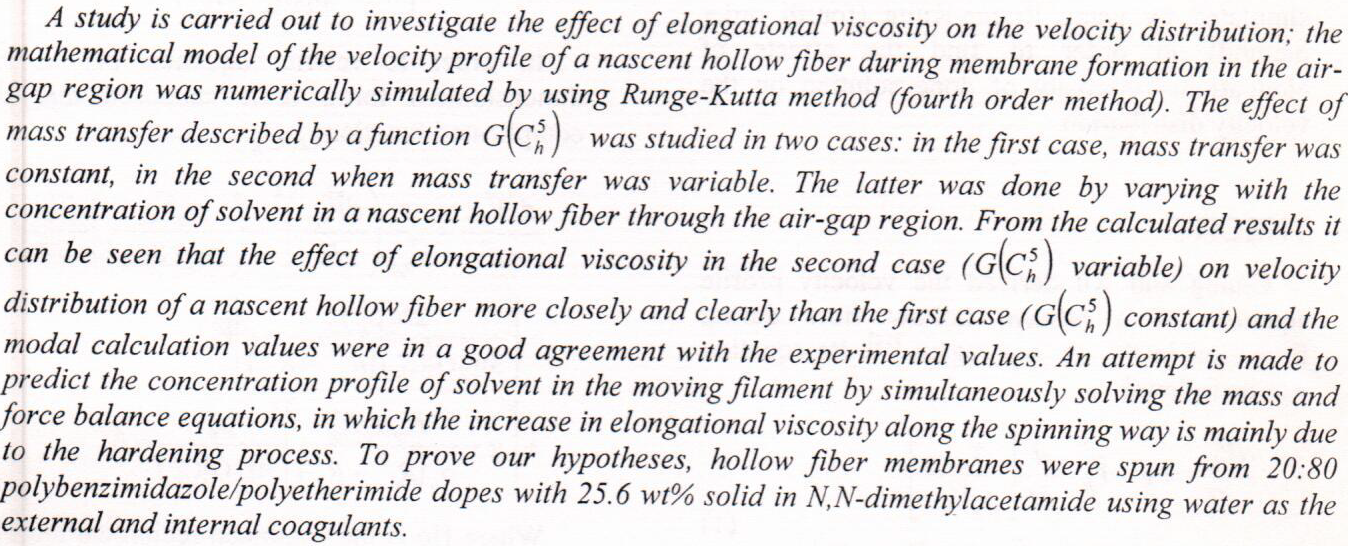
Studying Effect of Elongational Viscosity on the Velocity Distribution for Dry/Wet-Spun Nascent Hollow Fiber Membrane

The electrospun nanofibers membranes have gained considerable interest in water filtration applications. In this work, the fabrication and characterization of the electrospun polyacrylonitrile-based nonwoven nanofibers membrane are reported. Then, the membrane's performance and antifouling properties were evaluated in removing emulsified oil using a cross flow filtration system. The membranes were fabricated with different polyacrylonitrile (PAN) concentrations (8, 11, and 14 wt. %) in N, N-Dimethylformamide (DMF) solvent resulted in various average fiber sizes, porosity, contact angle, permeability, oil rejection, and antifouling properties. Analyses of surface morphology of the fabricated membranes before and after oil removal revealed
... Show More (21)
(21)
 (11)
(11)


 (2)
(2)
(2)
(2)
Metoclopramide (MCP) ion selective electrodes based on metoclopramide-phosphotungstic acid (MCP-PT) ion pair complex in PVC matrix membrane were constructed. The plasticizers used were tri-butyl phosphate (TBP), di-octyl phenyl phosphonate (DOPP), di-butyl phthalate (DBPH), di-octyl phthalate (DOP), di-butyl phosphate (DBP), bis 2-ethyl hexyl phosphate (BEHP). The sensors based on TBP, DOPP, DBPH and DOP display a fast, stable and linear response with slopes 59.9, 57.7, 57.4, 55.3 mV/decade respectively at pH ranged 2-6. The linear concentration range between 1.0×10⁻⁵ – 1.0×10⁻² M with detection limit 3.0×10⁻⁶ and 4.0×10⁻⁶ M for electrodes using TBP, DOPP and DBPH while e
... Show More
(2)
The increase globally fossil fuel consumption as it represents the main source of energy around the world, and the sources of heavy oil more than light, different techniques were used to reduce the viscosity and increase mobility of heavy crude oil. this study focusing on the experimental tests and modeling with Back Feed Forward Artificial Neural Network (BFF-ANN) of the dilution technique to reduce a heavy oil viscosity that was collected from the south- Iraq oil fields using organic solvents, organic diluents with different weight percentage (5, 10 and 20 wt.% ) of (n-heptane, toluene, and a mixture of different ratio
... Show More
(6)
As an important resource, entanglement light source has been used in developing quantum information technologies, such as quantum key distribution(QKD). There are few experiments implementing entanglement-based deterministic QKD protocols since the security of existing protocols may be compromised in lossy channels. In this work, we report on a loss-tolerant deterministic QKD experiment which follows a modified “Ping-Pong”(PP) protocol. The experiment results demonstrate for the first time that a secure deterministic QKD session can be fulfilled in a channel with an optical loss of 9 dB, based on a telecom-band entangled photon source. This exhibits a conceivable prospect of ultilizing entanglement light source in real-life fiber-based
... Show More
(17)
(16)
In this work, effects of using different evaporative cooling pads (ECPs) on the energetic and exergetic efficiency of a direct evaporative air cooler (DEAC) have been theoretically and experimentally investigated. Three types of ECPs were used, i.e., honeycomb cellulose cooler pad (HCCP), shading-cloth cooler pad (SCCP), and aspen wood wool cooler pad (AWWCP). For SCCP and AWWCP, a 3-cm pad thickness was used, while for the HCCP, three different values of pad thickness were used, i.e., 3, 5, and 7 cm. Tests were carried out using air velocities of 8, 14, and 19 m/s, measured at the DEAC outlet. Engineering equation solver (EES) used for performing the required calculations of the various parameters affecting the thermal performance of the D
... Show More
(22)
(21)
Wet granulation method was used instead of conventional pan coating or fluidized –bed coating technique to prepare enteric-coated diclofenac sodium granules, using ethanolic solution of EudragitTM L100 as coating, binding and granulating agent .Addition of PEG400 or di-n-butyl phthalate as a plasticizer was found to improve the enteric property of the coat.
Part of the resulted granules was filled in hard gelatin capsules (size 0), while the other part was compressed into tablets with and without disintegrant.
The release profile of these two dosage forms in 0.1N HCl (pH 1.2)for 2 hours, and in phosphate buffer (pH 6.8) for 45 minutes as well as the release kinetic were compared with that of the en
... Show More
This paper interest to estimation the unknown parameters for generalized Rayleigh distribution model based on censored samples of singly type one . In this paper the probability density function for generalized Rayleigh is defined with its properties . The maximum likelihood estimator method is used to derive the point estimation for all unknown parameters based on iterative method , as Newton – Raphson method , then derive confidence interval estimation which based on Fisher information matrix . Finally , testing whether the current model ( GRD ) fits to a set of real data , then compute the survival function and hazard function for this real data.