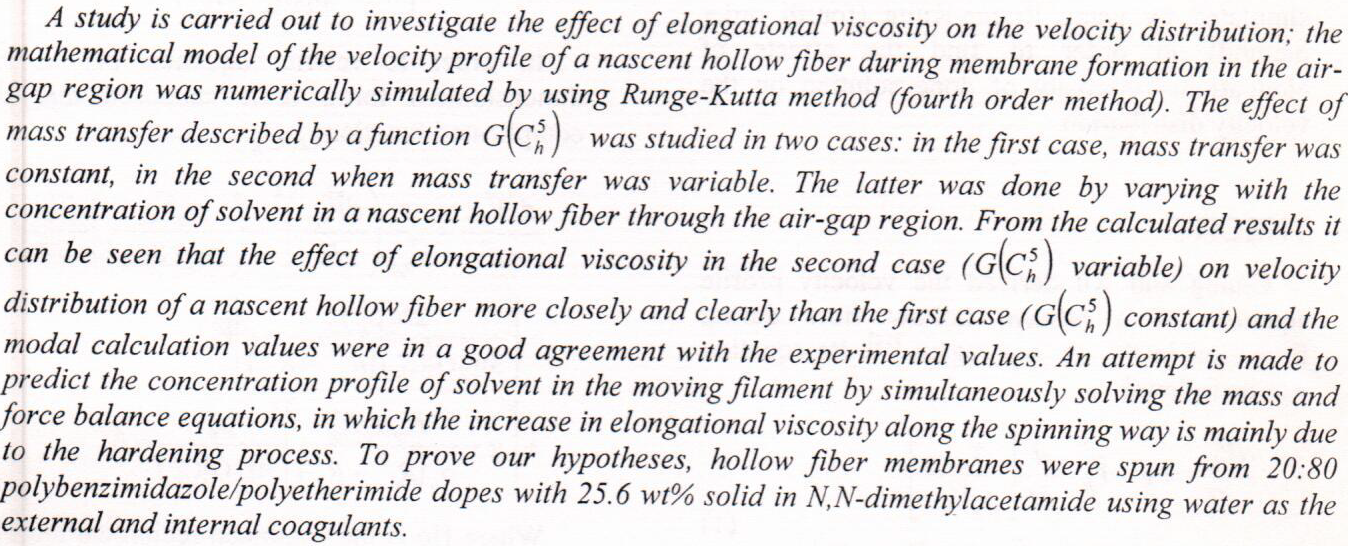
Studying Effect of Elongational Viscosity on the Velocity Distribution for Dry/Wet-Spun Nascent Hollow Fiber Membrane

One of the most important problems in tablet process is to control the flow of the catalyst through the hopper; Controlling the flow can be done either by changing the size of particles or added the different lubricant (stearic acid, starch, graphite) or blending of different lubricants. The study showed that we can control (increase or decrease) on the flow of the catalyst through the hopper by blending different lubricants for the constant percentage. The flow increasing when particles size (0.6 mm) and then decrease with or without lubricants, no effect on flow when particles size lower than (0.2 mm) with use that lubricants, and good flow on (0.4 mm) when use stearic acid and starch.
Thermal performance of closed wet cooling tower has been investigated experimentally and theoretically
in this work. The theoretical model based on heat and mass transfer equations and heat and mass transfer balance equations which are established for steady state case. A new small indirect cooling tower was used for conducting experiments. The cooling capacity of cooling tower is 1 kW for an inlet water temperature of 38oC, a water mass velocity 2.3 kg/m2.s and an air wet bulb temperature of 26oC. This study investigates the relationship between saturation efficiency, cooling capacity and coefficient of performance of closed wet cooling tower versus different operating parameters such wet-bulb temperature, variable air-spray water fl

This study aimed to determine the optimal conditions for extracting basil seed gum in addition to determine the chemical components of basil seeds. Additionally, the study aimed to investigate the effect of the mixing ratio of gum to ethanol when deposited on the basis of the gum yield which was1:1, 1:2, 1:3 (v/v) respectively. The best mixing ratio was one size of gum to two sizes of ethanol, which recorded the highest yield. Based on the earlier, the optimal conditions for extracting basil seed gum in different levels which included pH, temperature, mixing ratio seeds: water and the soaking duration were studied. The optimal conditions were: pH 8, temperature of 60°C, mixing ratio seeds: water 1:65 (w/v) and soaking duration of 30 min
... Show MoreAim: surface modification of titanium using fiber laser 1064 nm to enhance the bond strength to resin cement. Material and Methods: thirty titanium discs of 0.6 cm x 0.3 cm (diameter and thickness respectively) were categorized after preparation into three groups (n=10) as follows: control group with no surface treatment and two test groups were treated with fiber laser after estimation the appropriate parameters in the pilot study which are 81 ns pulse duration, 30,000 Hz frequency, 50 µm spot size and 10,000 mm/s scanning speed and different average power values (10 W and 20 W) depending on the tested group. Titanium discs surface characterization was performed by scanning electron microscope (SEM), a
... Show MoreExperimental study on the effect of cylindrical hollow cathode, working pressure and magnetic field on spatial glow distribution and the characteristics of plasma produced by dc discharge in Argon gas, were investigated by image analyses for the plume within the plasma. It was found that the emission intensity appears as a periodic structure with many peaks appeared between the electrodes. Increasing the pressure leads to increase the number of intensity peaks finally converted to continuous form at high pressure, especially with applied of magnetic field, i.e. the plasma is more stable with the presence of magnetic field. The emission intensity study of plasma showed that the intensity has a maximum value at 1.07 mbar pressure and decre
... Show More
Objective: In order to evaluate the effect of different typed of Separating Medium on the roughness of the fitted
tissue surface of acrylic denture base.
Methodology: Chosen three types of separating medium (Group A Tin foil), (Group B Detery Isolant),(Group C
Cold Mould Seal),used 30 samples of hot cure acrylic resin ,10 samples for each group, after complete curing of
these samples , Profilometer device was used to measure the surface roughness of each sample in all groups.
Results: Using One Way ANOVA Test and LSD test, the results were highly significant in differences among all
groups. Although (Group A) showing lest roughness, (Group B) showing a satisfactory result of roughness, While
(Group C) Showing the hig
Fiber reinforced polymer composite is an important material for structural application. The diversified application of FRP composite has taken center of attraction for interdisciplinary research. However, improvements on mechanical properties of this class of materials are still under research for different applications. In this paper we have modified the epoxy matrix by Al2O3, SiO2 and TiO2 nano particles in glass fiber/epoxy composite to improve the mechanical and physical properties. The composites are fabricated by hand lay-up method. It is observed that mechanical properties like flexural strength, hardness are more in case of SiO2 modified epoxy composite compare to other nano
... Show MoreIn this study, we fabricated nanofiltration membranes using the electrospinning technique, employing pure PAN and a mixed matrix of PAN/HPMC. The PAN nanofibrous membranes with a concentration of 13wt% were prepared and blended with different concentrations of HPMC in the solvent N, N-Dimethylformamide (DMF). We conducted a comprehensive analysis of these membranes' surface morphology, chemical composition, wettability, and porosity and compared the results. The findings indicated that the inclusion of HPMC in the PAN membranes led to a reduction in surface porosity and fiber size. The contact angle decreased, indicating increased surface hydrophilicity, which can enhance flux and reduce fouling tendencies. Subsequently, we evaluated the e
... Show More
This work presents a novel technique for the detection of oil aging in electrical transformers using a single mode optical fiber sensor based on surface plasmon resonance (SPR). The aging of insulating oil is a critical issue in the maintenance and performance of electrical transformers, as it can lead to reduce insulation properties, increase risk of electrical breakdown, and decrease operational lifespan. Many parameters are calculated in this study in order to examine the efficiency of this sensor like sensitivity (S), signal to noise ratio (SNR), resolution (refractive index unit) and figure of merit (FOM) and the values are for figure of merit is 11.05, the signal to noise ratio is 20.3, the sensitivity is 6.63, and the resolution is 3
... Show More (3)
(3)
 (3)
(3)
 (5)
(5)