Preferred Language
Articles
/
ijcpe-678
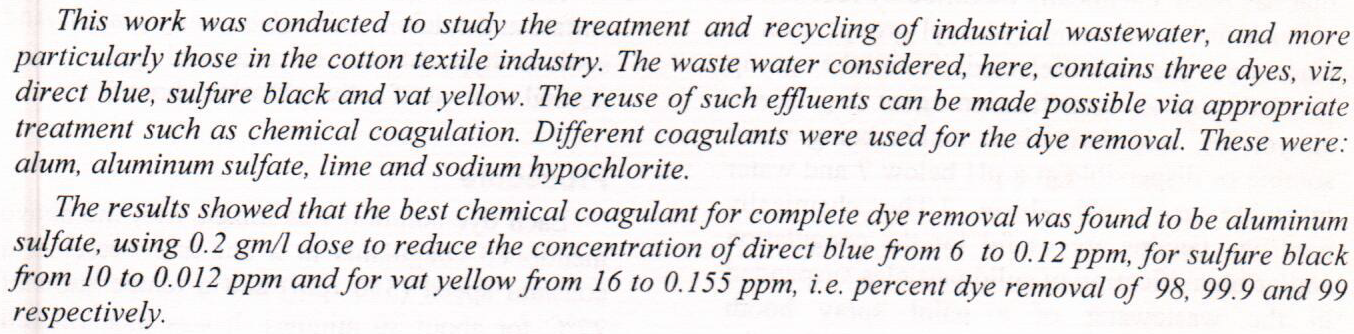
Color Removal from Waste Water by Chemical Coagulation
...Show More Authors

View Publication Preview PDF
Quick Preview PDF
Publication Date
Sun Jul 09 2023
Journal Name
Journal Of Engineering
Increasing of Naphthenes Content in Naphtha by Using Y and  Zeolite Prepared from Iraqi Kaolin
...Show More Authors

This work dealt with separation of naphthenic hydrocarbons from non-naphthenic hydrocarbons and in particular concerns an improved process for increasing the naphthenes concentration in naphtha, The separation was examined using adsorption by Y and  B zeolite in a fixed bed process. The concentration of naphthenes in the influent and effluent streams was determined using PONA classification. The effect of different operating variables such as feed flow rate (2- 4 L/hr); bed length (50 - 80 cm) on the adsorption capacity of Y and  zeolite was studied. Increasing the bed length lead to increase the naphthenes concentration, and increasing the flow rate lead to decrease in the concentration of naphthenes, It was found that the decrease

... Show More
View Publication Preview PDF
Crossref (1)
Crossref
Publication Date
Wed Sep 17 2025
Journal Name
Molecular Biology Reports
Antibacterial effect and MexA efflux pump Inhibition by green-synthesized copper nanoparticles from Mentha piperita
...Show More Authors

View Publication
Scopus (4)
Crossref (6)
Scopus Crossref
Publication Date
Fri Jan 01 2021
Journal Name
Desalination And Water Treatment
Electrosorption of cadmium ions from the aqueous solution by a MnO2/carbon fiber composite electrode
...Show More Authors

The nanostructured MnO2 /carbon fiber (CF) composite electrode was prepared using the anodic electrodeposition process. The crystal structure and morphology of MnO2 particles were determined with X-ray diffraction and field-emission scanning electron microscopy. The electrosorptive properties of the prepared electrode were investigated in the removal of cadmium ions from aqueous solution, and the effect of pH, cell voltage, and ionic strength was optimized and modeled using the response surface methodology combined with Box–Behnken design. The results confirm that the optimum conditions to remove Cd(II) ions were: pH of 6.03, a voltage of 2.77 V, and NaCl concentration of 3 g/L. The experimental results showed a good fit for the Freundli

... Show More
View Publication Preview PDF
Scopus (4)
Crossref (2)
Scopus Clarivate Crossref
Publication Date
Fri Jun 01 2018
Journal Name
Iraqi Journal Of Science
Cleavage of mucin and salivary agglutinin by partiallypurified protease from native strain of Streptococcus mutansan67
...Show More Authors

Scopus (8)
Scopus
Publication Date
Tue May 07 2019
Journal Name
Journal Of Planner And Development
virtual water in consumer goods
...Show More Authors

That water is the lifeblood and without it no life on our planet, he says in the Holy Koran: In the Name of God {{And We made from water every living thing}} truth of God Almighty (the prophets verse 30) The basis of the existence of settlements served human and a source of fresh water close to it easy access to it is used for domestic, agricultural, on a daily basis, even closer look at the map of Iraq to human settlement to find it is a signatory to both sides of the river are thick and less as we moved away from the source of water until they make up a scene like a necklace the river and the stones of cities and settlements served, was the ancient civilizations, countries and capitals Throughout history, choose sites near sour

... Show More
View Publication Preview PDF
Publication Date
Tue Apr 30 2019
Journal Name
Journal Of Planner And Development
The environmental impacts of reviving Hor Alsnav By the water of the river of out fall drain in the province of Dhi Qar
...Show More Authors

The aim of this study is to explain methods to be followed for the recovery Alsnav Hor, who represents the northwest portion of the Hammar Marsh in the province of Dhi Qar, after the drought in which that happened in 2008. The study included description of the region before the drought, the description of its natural and human environments, the economic events and activities, then the study included drought throughout the region, the environmental impacts caused by drought, its impact on social reality, economic and healthy for its environment, and then reached to the problems of social and economic in the region, depending on the Field studies and documented in the specialized government departments, information analysis for the

... Show More
View Publication
Publication Date
Sun Apr 01 2018
Journal Name
Journal Of Economics And Administrative Sciences
The use of water resources in light of the challenges of water security in Iraq
...Show More Authors

Iraq suffers from lack of water resources supply because the headwaters of the rivers located outside its borders and the influence of upstream countries on the quantities of flowing water, in addition to the increase of pressure on available water as a result of population increase and not adopting the principle of rationalization where misuse and wastage and lack of strategic vision to treat and manage water use in accordance with the economic implications fall.  This is reflected fallout on water security and subsequently on national and food security, while the issue of using water resources is development top priority in different countries in the world because of the importance of water effect on the security of indivi

... Show More
View Publication Preview PDF
Crossref
Publication Date
Wed Nov 05 2025
Journal Name
Irrigation And Drainage
Predicting Potential Salinity in River Water for Irrigation Water Purposes Using Integrative Machine Learning Models
...Show More Authors
ABSTRACT<p>Accurate prediction of river water quality parameters is essential for environmental protection and sustainable agricultural resource management. This study presents a novel framework for estimating potential salinity in river water in arid and semi‐arid regions by integrating a kernel extreme learning machine (KELM) with a boosted salp swarm algorithm based on differential evolution (KELM‐BSSADE). A dataset of 336 samples, including bicarbonate, calcium, pH, total dissolved solids and sodium adsorption ratio, was collected from the Idenak station in Iran and was used for the modelling. Results demonstrated that KELM‐BSSADE outperformed models such as deep random vector funct</p> ... Show More
View Publication
Crossref (1)
Scopus Clarivate Crossref
Publication Date
Sun Oct 01 2023
Journal Name
Journal Of Ecological Engineering
Date Palm Fibre Waste Exploitation for the Adsorption of Congo Redis Dye via Batch and Continuous Modes
...Show More Authors

The present study utilised date palm fibre (DPF) waste residues to adsorb Congo red (CR) dye from aqueous solutions. The features of the adsorbent, such as its surface shape, pore size, and chemical properties, were assessed with X-ray diffraction (XRD), BET, Fourier-transform infrared (FTIR), X-ray fluorescence (XRF), and field emission scanning electron microscope (FESEM). The current study employed the batch system to investigate the ideal pH to adsorb the CR dye and found that acidic pH decolourised the dye best. Extending the dye-DPF waste mixing period at 25°C reportedly removed more dye. Consequently, the influence of the starting dye and DPF waste quantity on dye removal was explored in this study. At 5 g/L dye concentration, 48% d

... Show More
View Publication
Scopus (15)
Crossref (12)
Scopus Clarivate Crossref
Publication Date
Mon Aug 19 2024
Journal Name
Scientific Reports
An in-vitro evaluation of residual dentin retained after using novel enzymatic-based chemomechanical caries removal agents
...Show More Authors

To assess the biochemical, mechanical and structural characteristics of retained dentin after applying three novel bromelain‑contained chemomechanical caries removal (CMCR) formulations in comparison to the conventional excavation methods (hand and rotary) and a commercial papain‑contained gel (Brix 3000). Seventy‑two extracted permanent molars with natural occlusal carious lesions (score > 4 following the International Caries Detection and Assessment System (ICDAS‑II)) were randomly allocated into six groups (n = 12) according to the excavation methods: hand excavation, rotary excavation, Brix 3000, bromelain‑contained gel (F1), bromelain‑chloramine‑T (F2), and bromelain chlorhexidine gel (F3). The superficial and deepe

... Show More
View Publication
Scopus (4)
Crossref (6)
Scopus Clarivate Crossref