Preferred Language
Articles
/
ijcpe-678
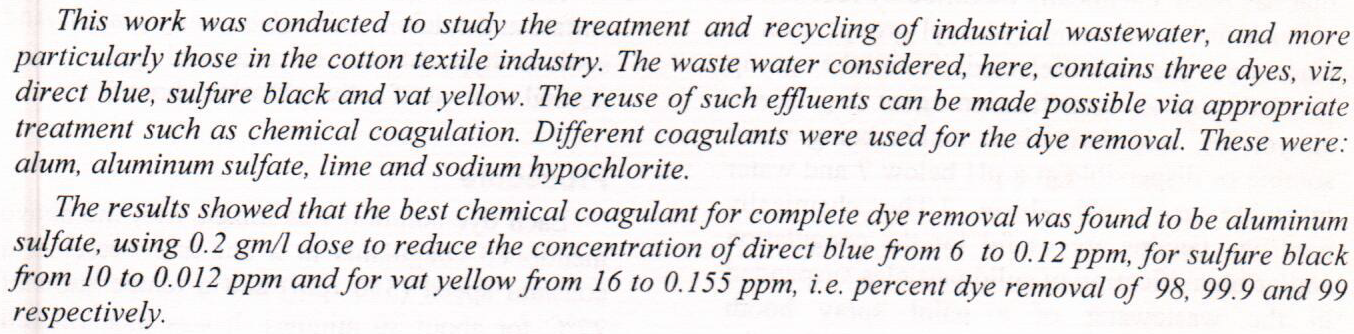
Color Removal from Waste Water by Chemical Coagulation
...Show More Authors

View Publication Preview PDF
Quick Preview PDF
Publication Date
Wed Mar 18 2020
Journal Name
Baghdad Science Journal
In Vitro Bioremediation: A Development Process of Cadmium and Mercury Removal by Environmental Biotechnologies of UV-Mutated Escherichia coli K12 and Bacillus subtilis 168
...Show More Authors
  1. coli K12 and B. subtilis 168 were investigated for their cadmium and mercury tolerance abilities. They were developed by UV mutagenesis technique to increase their tolerances either to cadmium or mercury, and their names then were designated depend on the name and concentration of metals. E. coli K12 Cd3R exhibited bioremediation amount of 6.5 mg Cd/g dry biomass cell. At the same time, its wild-type (E. coli K12 Cd3) was able to remove 5.2 mg Cd/g dry biomass cell in treatment of 17 mg Cd /L within 72 hours of incubation at 37 °C (pH=7) in vitro assays. The results show that E.coli K12 Hg 20 was able to remove 0.050 µg Hg/g dry biomass cell
... Show More
View Publication Preview PDF
Scopus (12)
Crossref (6)
Scopus Clarivate Crossref
Publication Date
Tue May 23 2023
Journal Name
Journal Of Engineering
Assessment of Water Quality Index and Water Suitability of the Tigris River for drinking water within Baghdad City, Iraq
...Show More Authors

In this study water quality was indicated in terms of Water Quality Index that was determined through summarizing multiple parameters of water test results. This index offers a useful representation of the overall quality of water for public or any intended use as well as indicating pollution, water quality management and decision making. The application of Water Quality Index
(WQI) with sixteen physicochemical water quality parameters was performed to evaluate the quality of Tigris River water for drinking usage. This was done by subjecting the water samples collected from eight stations in Baghdad city during the period 2004-2010 to comprehensive physicochemical analysis. The sixteen physicochemical parameters included: Turbidity, A

... Show More
View Publication Preview PDF
Crossref (7)
Crossref
Publication Date
Sat Jun 01 2013
Journal Name
Journal Of Engineering
Assessment of Water Quality Index and Water Suitability of the Tigris River for drinking water within Baghdad City, Iraq
...Show More Authors

In this study water quality was indicated in terms of Water Quality Index that was determined through summarizing multiple parameters of water test results. This index offers a useful representation of the overall quality of water for public or any intended use as well as indicating pollution, water quality management and decision making. The application of Water Quality Index (WQI) with sixteen physicochemical water quality parameters was performed to evaluate the quality of Tigris River water for drinking usage. This was done by subjecting the water samples collected from eight stations in Baghdad city during the period 2004-2010 to comprehensive physicochemical analysis. The sixteen physicochemical parameters included: Turbidity,

... Show More
Publication Date
Sun Apr 30 2023
Journal Name
Al-kindy College Medical Journal
Persistent Intraocular Pressure Elevation after Silicon Oil Removal in Patients with Post-Pars Plana Vitrectomy: IOP Level After SO Removal
...Show More Authors

Background: It is well-known that silicon oil (SO) injection into the vitreous cavity after pars plana vitrectomy is usually associated with high intraocular pressure.

Objectives: To determine the influence of silicon oil (SO) removal on IOP level after pars plana vitrectomy for spontaneous rhegmatogenous retinal detachment (RRD)

Subjects and Methods: A prospective study was conducted at Ibn Al-Haitham eye teaching hospital, Baghdad- Iraq. Intraocular pressure (IOP) was measured pre and post SO removal in patients who have underwent retinal detachment surgery with SO injection of 1000 centistokes (cSt) viscosity. Baseline IOP was measured for all the patient before the SO

... Show More
View Publication Preview PDF
Scopus Crossref
Publication Date
Sun Jan 01 2023
Journal Name
Aip Conference Proceedings
Recovery of methyl orange from aqueous solutions by bulk liquid membrane process facilitated with anionic carrier
...Show More Authors

Dyes are extensively water-soluble and toxic chemicals. The disposing of wastewater rich with such chemicals has severely impacted surface water quality (rivers and lakes). In the current study, an anionic dye, methyl orange, were extracted from wastewater fluids using bulk liquid membranes supplemented with an anionic carrier (Aliquat 336 (QCI)). Parameters including solvent type (carbon tetrachloride and chloroform), membrane stirring speed (100-250 rpm), mixing speed of both phases (50-100 rpm), The feed pH (2-12) and implemented temperature (35-60 °C) were thoroughly analyzed to determine the effect of such variables on extraction effectiveness. Furthermore, the effect of methyl orange (10-50 ppm) in the feed stage and NaOH (0

... Show More
View Publication
Scopus (8)
Crossref (1)
Scopus Crossref
Publication Date
Sun Dec 30 2018
Journal Name
Iraqi Journal Of Chemical And Petroleum Engineering
Removal Of Dissolved Cadmium Ions from Contaminated Wastewater using Raw Scrap Zero-Valent Iron And Zero Valent Aluminum as Locally Available and Inexpensive Sorbent Wastes
...Show More Authors

The current study was to examine the reliability and effectiveness of using most abundant, inexpensive waste in the form of scrap raw zero valent aluminum ZVAI and zero valent iron ZVI for the capture, retard, and removal of one of the most serious and hazardous heavy metals cadmium dissolved in water. Batch tests were conducted to examine contact time (0-250) min, sorbent dose (0.25-1 g ZVAI/100 mL and 2-8 g ZVI/100 mL), initial pH (3-6), pollutant concentration of 50mg/L initially, and speed of agitation (0-250) rpm . Maximum contaminant removal efficiency corresponding to (90 %) for cadmium at 250 min contact time, 1g ZVAI/ 6g ZVI sorbent mass ratio, pH 5.5, pollutant concentration of 50 mg/L initially, and 250 rpm agitation speed wer

... Show More
View Publication Preview PDF
Crossref (12)
Crossref
Publication Date
Sun Oct 15 2023
Journal Name
Bionatura
Examining how PMMA and polyamide denture base materials' physical characteristics are affected by electrolyzed water used as a denture cleaner
...Show More Authors

Denture cleansing is an essential step that can stop cross‑contamination and adds to the health of the patient, denture durability, and the general quality of life. A disinfection technique must be practical and devoid of damaging effects on the material's properties used to construct the denture base. The main aim of this study is to evaluate the effect of three concentrations of electrolyzed water denture cleanser on heat cure acrylic and polyamide after immersion in electrolyzed water. The evaluation is based on their efficacy on surface hardness, wettability, and color stability compared with one submerged in distilled water as a control group. The method consists of eighty samples of heat-cured acrylic and polyamide material.

... Show More
View Publication Preview PDF
Crossref (2)
Scopus Crossref
Publication Date
Sun Oct 31 2021
Journal Name
Iraqi Geological Journal
Optimizing Water Injection Performance by Using Sector Modeling of the Mishrif Formation in West Qurna-1 Oil Field, Southern Iraq
...Show More Authors

The regular job of a reservoir engineer is to put a development plan to increase hydrocarbon production as possible and within economic and technical considerations. The development strategy for the giant reservoir is a complex and challenging task through the decision-making analysis process. Due to the limited surface water treatment facility, the reservoir management team focuses on minimizing water cut as low as possible by check the flow of formation and injected water movement through the Mishrif reservoir. In this research, a representative sector was used to make the review of water injection configuration, which is considered an efficient tool to make study in a particular area of the entire field when compared with the ful

... Show More
Scopus (2)
Scopus Crossref
Publication Date
Sun Oct 01 2017
Journal Name
Journal Of Engineering
Optimization of Surface Roughness for Al-alloy in Electro-chemical Machining (ECM) using Taguchi Method
...Show More Authors

Electro-chemical Machining is  significant  process to remove metal with using  anodic dissolution. Electro-chemical machining use to removed metal workpiece from (7025) aluminum alloy using Potassium chloride (KCl) solution .The tool used was made from copper. In this present the optimize processes input parameter use are( current, gap and electrolyte concentration) and surface roughness (Ra) as output .The experiments on electro-chemical machining with use current (30, 50, 70)A, gap (1.00, 1.25, 1.50) mm and electrolyte concentration (100, 200, 300) (g/L).  The method (ANOVA) was used to limited the large influence factors affected on surface roughness and found the current was the large influence f

... Show More
View Publication Preview PDF
Publication Date
Wed Jan 01 2014
Journal Name
International Journal Of Technical Research And Applications
SYNTHESIS, PHYSICO-CHEMICAL AND ANTIMICROBIAL PROPERTIES OF SOME METAL (II) -MIXED LIGAND COMPLEXES OF TRIDENTATE SCHIFF BASE DERIVES FROM Β-LACTAM ANTIBIOTIC {(CEPHALEXIN MONO HYDRATE)-4-CHLOROBENZALDEHYDE} AND SACCHARIN
...Show More Authors

new Schiff base 4-chlorophenyl)methanimine (6R,7R)-3-methyl-8-oxo-7-(2-phenylpropanamido)-5-thia-1-azabicyclo[4.2.0]oct-2-ene-2-carboxylate= (HL)= C23H20 ClN3O4S) has been synthesized from β-lactam antibiotic (cephalexin mono hydrate(CephH)=(C16H19N3O5S.H2O) and 4-chlorobenzaldehyde . Figure(1) Metal mixed ligand complexes of the Schiff base were prepared from chloride salt of Fe(II),Co(II),Ni(II),Cu(II),Zn(II) and Cd (II), in 50% (v/v) ethanol –water medium (SacH ) .in aqueous ethanol(1:1) containing and Saccharin(C7H5NO3S) = sodium hydroxide. Several physical tools in particular; IR, CHN, 1H NMR, 13C NMR for ligand and melting point molar conductance, magnetic moment. and determination the percentage of the metal in the complexes by fl

... Show More
Preview PDF