Study of the Factors Affecting Cells of Sodium Chlorate Production
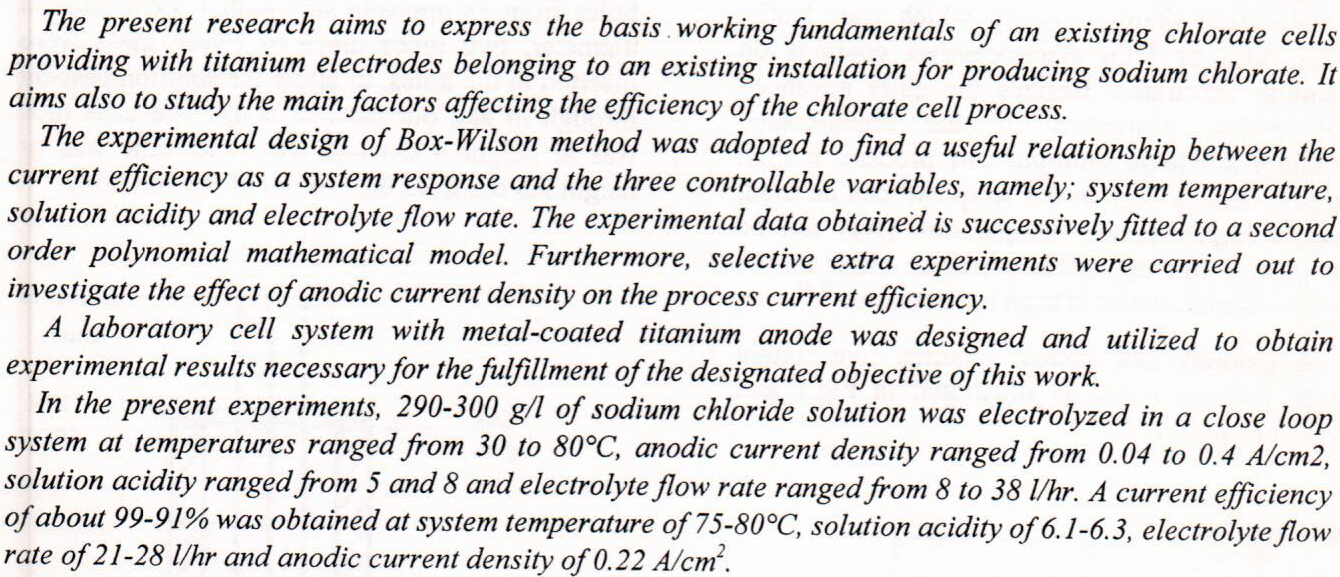

Research summarized in applying the model of fuzzy goal programming for aggregate production planning , in General Company for hydraulic industries / plastic factory to get an optimal production plan trying to cope with the impact that fluctuations in demand and employs all available resources using two strategies where they are available inventories strategy and the strategy of change in the level of the workforce, these strategies costs are usually imprecise/fuzzy. The plant administration trying to minimize total production costs, minimize carrying costs and minimize changes in labour levels. depending on the gained data from th
... Show More
 (73)
(73)
 (71)
(71)


DEMs, thus, simply regular grids of elevation measurements over the land surface.The aim of the present work is to produce high resolution DEM for certain investigated region (i.e. Baghdad University Campus\ college of science). The easting and northing of 90 locations, including the ground-base and buildings of the studied area, have been obtained by field survey using global positioning system (GPS). The image of the investigated area has been extracted from Quick-Bird satellite sensor (with spatial resolution of 0.6 m). It has been geo-referenced and rectified using 1st order polynomial transformation. many interpolation methods have been used to estimate the elevation such as ordinary Kriging, inverse distance weight
... Show More
(2)
The current study was designed to explore the association between the pigments production and biofilm construction in local Pseudomonas aeruginosa isolates. Out of 143 patients suffering from burns, urinary tract infections (UTI), respiratory tract infections and cystic fibrosis obtained from previous study by Mahmood (2015), twenty two isolates (15.38%) were identified from (11) hospitals in Iraq, splitted into three provinces, Baghdad, Al-Anbar and Karbala for the duration of June 2017 to April 2018. Characterization was carried out by using microscopical, morphological and biochemical methods which showed that all these isolates belong to P. aeruginosa. Screening of biofilm production isolates was carried out by usi
... Show More
(7)
(2)
(4)
Production and characterization of methionine γ- lyase from Pseudomonas putida and its effect on cancer cell lines
(9)
(9)
Background: Pumpkin seeds are a valuable source of high-quality protein and can be utilized as functional food ingredients due to their properties, such as solubility, foam formation, and stability. This study aims to produce protein isolate and its enzymatic hydrolysates from local pumpkin seeds to study their properties. Methodology: Preparing defatted pumpkin seeds for protein extraction, followed by the enzymes’ hydrolysis using Trypsin and Pepsin enzymes separately and together in two methods. The determination of amino acids and the degree of hydrolysis was conducted; moreover, protein properties were studied, including solubility, emulsifying activity, stability index, foaming capacity, and stability. Results: A protein sample was
... Show More
(11)
(5)
(3)
(1)