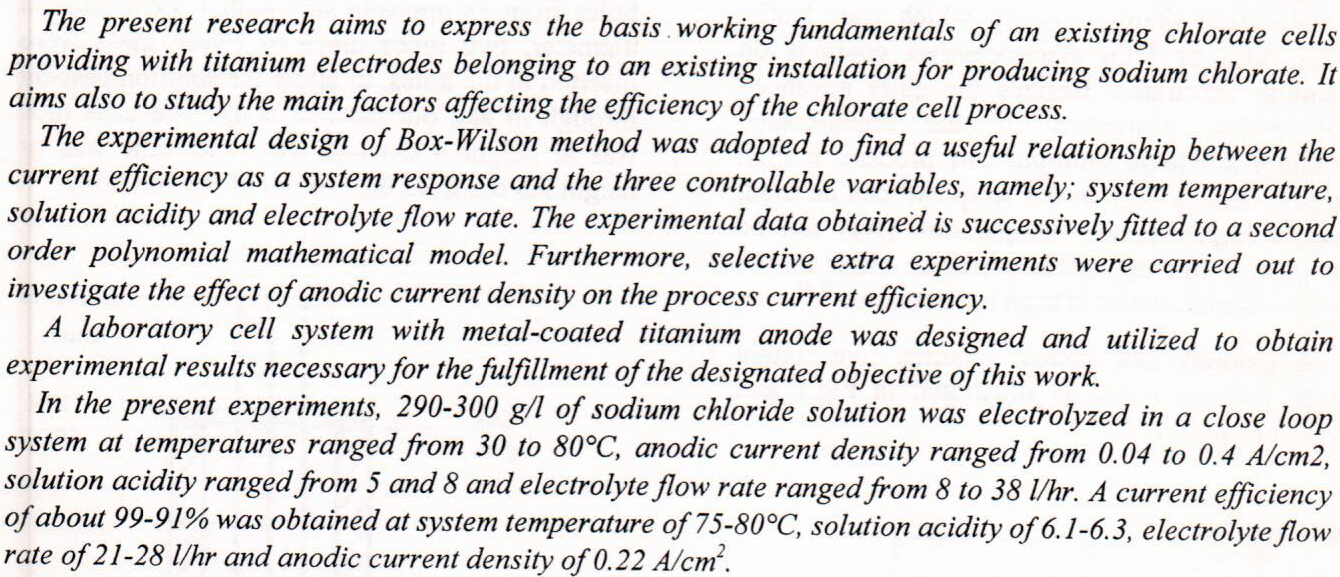
Study of the Factors Affecting Cells of Sodium Chlorate Production

Used cooking oil was undergoing trans-esterification reaction to produce biodiesel fuel. Method of production consisted of pretreatment steps, trans-esterification, separation, washing and drying. Trans-esterification of treated oils was studied at different operation conditions, the methanol to oil mole ratio were 6:1, 8:1, 10:1, and 12:1, at different temperature 30, 40, 50, and 60 º C, reaction time 40, 60, 80, and 120 minutes, amount of catalyst 0.5, 1, 1.5, and 2 wt.% based on oil and mixing speed 400 rpm. The maximum yield of biodiesel was 91.68 wt.% for treated oils obtained by trans-esterification reaction with 10:1 methanol to oil mole ratio, 60 º C reaction temperature, 80 minute reactio
... Show More (9)
(9)
 (7)
(7)


 (21)
(18)
(21)
(18)
Development and population expansion have the lion's share of driving up the fuel cost. Biodiesel has considerable attention as a renewable, ecologically friendly and alternative fuel source. In this study, CaO nanocatalyst is produced from mango leaves as a catalysis for the transesterification of waste cooking oil (WCO) to biodiesel. The mango tree is a perennial plant, and its fruit holds significant economic worth due to its abundance of vitamins and minerals. This plant has a wide geographical range and its leaves can be utilized without any negative impact on its growth and yield. An analysis was conducted to determine the calcium content in the fallen leaves, revealing a significant quantity of calcium that holds potential fo
... Show More
(15)
(9)
Understanding, promoting, and teaching media literacy is an important societal challenge. STEM educators are increasingly looking to incorporate 21st century skills such as media literacy into core subject education. In this paper we investigate how undergraduate Computer Science (CS) students can learn media literacy as a by-product of collaborative video tutorial production. The paper presents a study of 34 third-year CS undergraduates who, as part of their learning, were each asked to produce three video tutorials on Raspberry Pi programming, using a collaborative video production tool for mobile phones (Bootlegger). We provide results of both quantitative and qualitative analysis of the production process and resulting video tutorials,
... Show More
(22)
(17)
Nowadays, there is increased interest in the biosynthesis of microbial melanin related to their numerous biological functions and applications in many fields, especially in medical fields, including immune-modulating, antimicrobial antibiotic, antiviral antivenin, anticancer, antitumor activity, and anti-biofilm activity. Pyomelanin is a hydrophobic macromolecule that is typically dark brown or black in color, formed by the oxidative polymerization of phenolic or indolic compounds. Pyomelanin is reported to be safe for consumption, thus providing a crucial strategy for biocontrol of biofilm. Furthermore, natural pyomelanin is known as a potent antioxidant, photoprotective, and free radical scavenging. Objective: This study focuses on the
... Show More
(1)
(153)
(141)
Nuclear structure of 20,22Ne isotopes has been studied via the shell model with Skyrme-Hartree-Fock calculations. In particular, the transitions to the low-lying positive and negative parity excited states have been investigated within three shell model spaces; sd for positive parity states, spsdpf large-basis (no-core), and zbme model spaces for negative parity states. Excitation energies, reduced transition probabilities, and elastic and inelastic form factors were estimated and compared to the available experimental data. Skyrme interaction was used to generate a one-body potential in the Hartree-Fock calculations for each selected excited states, which is then used to calculate the single-particle matrix elements. Skyrme interac
... Show More
(2)
(2)