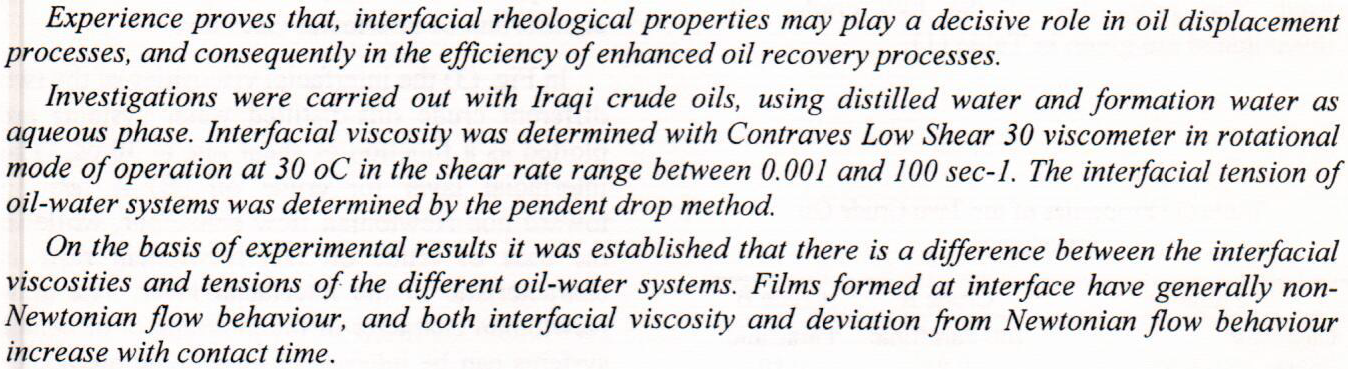
Interfacial Rheological Properties of Iraqi Crude Oils Water System

 (3)
(3)

 (22)
(22)
Water Quality Index (WQI) as a tool to assess the water quality status provides advice related to the use of water quality monitoring data and it is a way for combining the complex water quality data into a single value or single statement.The present study was conducted on Al- Hilla river in the middle of Iraq from August 2012 to July 2013 at five selected stations in the river, from Al- Musaib city to Al- Hashimya at the south of Hilla to determine its suitability for aquatic environment (GWQI), drinking water (PWSI) and irrigation (IWQI).This index offers a useful representation of the overall quality of water for public or any intended use as well as indicating pollution, water quality management, and decision making. According to th
... Show More
(10)
 (1)
(1)

Diyala River is a tributary of Tigris River, it is one of the important rivers in Iraq. It covers a total distance of 445 km (275 miles). 32600 km2is the area that drains by Diyala River between Iraqi-Iranian borders. This research aims to evaluate the water quality index WQI of Diyala River, where three stations were chosen along the river. These stations are D12 at Jalawlaa City at the beginning of Diyala River, the second station is D15 at Baaquba City at the mid distance of the river, and the third station is D17 which is the last station before the confluence of Diyala River with Tigris River at Baghdad city. Bhargava method was used in order to evaluate the water quality index for both irrigation and drink
... Show More
(9)
(7)
Water pollution is an issue that can be exacerbated by drought as increased concentrations of unwanted substances are a consequence of lower water levels. Polluted water that flows into natural marshlands leads to the deposition of pollutants in the interior of the marsh. Here we present evidence that the interior of the Central Marsh (CM) in southern Iraq suffers from higher levels of pollution than areas closer to the source of water entering the marsh (the Euphrates River). A 1.7m embankment that halts the flow of the Euphrates is only infrequently breached and so the CM is effectively the terminal destination of the waters (and their associated pollutants and agricultural waste) flowing from the West of Iraq.
A range of water
... Show More
(9)
(3)
The estimation of recharge to ground water is the important basics to improve the use of ground water with other available resources, and to save ground water resource from depletion, especially when using large quantity of ground water during a long time such as for agricultural purposes. Al-Wand River Basin in Iraq suffers from water shortage of its requirement of Blajo–Al-Wand Project, and to cover this shortage, the ground water plays a good role to overcome this problem. In this study, three methods were used to estimate the recharge and ground water storage for Al-Wand Basin, these methods are: Water Table Fluctuation (WTF), Water Balance of Climatic for Basin, and Water Table Balance for Basin. The results showe
... Show MoreIn this study, the turbulent buoyancy driven fluid flow and heat transfer in a differentially heated rectangular enclosure filled with water is quantified numerically. The two dimensional governing differential equations are discretized using the finite volume method. SIMPLE algorithm is employed to obtain stabilized solution for high Rayleigh numbers by a computational code written in FORTRAN language. A parametric study is undertaken and the effect of Rayleigh numbers (1010 to 1014), the aspect ratio (30, 40 and 50), and the tilt angle (10o to 170o ) on fluid flow and heat transfer are investigated. The results of the adopted model in the present work is compared with previously published results and a qualitative agreement and a good
... Show More
The steady 3-D raw water turbulent flow is numerically investigated. This flow is formed of solid silica sand (quartz) carried by water in stainless steel pipe. The flow in a straight pipe and flow in a pipe with a sudden contraction are analyzed using a two-way coupled Eulerian-Lagrangian approach. Erosion rate is estimated by Oka erosion model combined with the constant coefficient of restitution. The effect of solid particles mass flow rate, inlet velocity, particle diameter, internal pipe diameter, orientation, contraction coefficient, and wall pipe contraction angle on erosion rate are examined. The predicted erosion is distributed homogenously for straight pipe, while the step wall area of the contraction is the most eroded part. The
... Show More
(3)
(1)
(11)