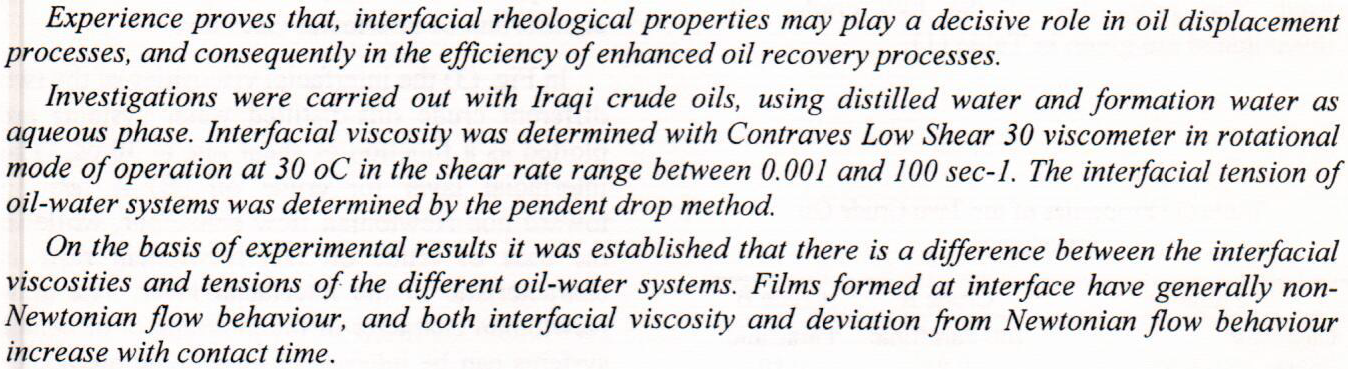
Interfacial Rheological Properties of Iraqi Crude Oils Water System

Sustainable crop production in a coarse soil texture is challenging due to high water permeability and low soil water holding capacity. In this paper, subsurface water retention technology (SWRT) through impermeable polyethylene membranes was placed at depth 35 cm below ground surface and within the root zone to evaluate and compare the impact of these membranes and control treatment (without using the membranes) on yield and water use efficiency of eggplant inside the greenhouse. The study was conducted in Al-Fahamah Township, Baghdad, Iraq during spring growing season 2017. Results demonstrated the yield and water use efficiencies were 3.483 kg/m2 and 5.653 kg/m3, respectively for SWRT treatment p
... Show More (6)
(6)

A new technique in cultivation by installing membrane sheet below the crop’s root zone was helped to save irrigation water in the root zone, less farm losses, increasing the field water use efficiency and water productivity. In this paper, the membrane sheet was installed below the root zone of zucchini during the summer growing season 2017 in open field. This research was carried out in a private field in Babil governorate at Sadat Al Hindiya Township reached 72 km from Baghdad. Surface trickle irrigation system was used for irrigation process. Two treatment plots were used, treatment plot T1 using membrane sheet and treatment plot T2 without using the membrane sheet. The applied irrigation water, time of
... Show More
(4)
The aim of this work is to produce samples from Iraqi raw materials like Husyniat Bauxite (raw and burnt) and to study the effect of some additives like white Doekhla kaolin clays and alumina on that material properties were using sodium silica as a binding material. Five mixtures were prepared from Bauxite (raw and burnt) and kaolin clays, with an additive of (40) ml from sodium silica and alumina of (2.5, 5, 7.5,10 wt %) percentage as a binding material. the size grading was through sieving. The formation of all specimens was conducted by a measured gradually semi-dry pressing method under a compression force of (10) Tons and humidity ratio ranging from (5-10) % from mixture weight. Drying all specimens was done and then they were burn
... Show MoreIn this study, the water treatment plants located on the Tigris River within Baghdad city were subjected to qualitative and quantitative assessments. Based on location, the plants from upstream to downstream are Al-Karkh, East Tigris, Al-Karamah, Al-Wathbah, Al-Wehdah, Al-Kadiseyah, Al-Dora, and Al-Rashid. Data from 2009 to 2020 on the turbidity, total dissolved solids, Alkalinity, hardness, chloride, calcium, and temperature were used in the qualitative assessment while data on the treated water production and population served were used in the quantitative assessment. The above Data was acquired from the Municipality of Baghdad. The turbidity was mainly used as a fair gauge to assess the performance of the water treatment plants in Baghda
... Show More
The study of the future of the international system currently appears, according to scientific data and existing facts in light of the emergence of international actors from non-states and international informal institutions, to be heading towards a non-polarity system and this trend is fueled by many variables to reduce polarity, and it is expected in the future that the international system will turn into a non-polarity.
The water quality index is the most common mathematical way of monitoring water characteristics due to the reasons for the water parameters to identify the type of water and the validity of its use, whether for drinking, agricultural, or industrial purposes. The water arithmetic indicator method was used to evaluate the drinking water of the Al-Muthana project, where the design capacity was (40000) m3/day, and it consists of traditional units used to treat raw water. Based on the water parameters (Turb, TDS, TH, SO4, NO2, NO3, Cl, Mg, and Ca), the evaluation results were that the quality of drinking water is within the second category of the requirements of the WHO (86.658%) and the first category of the standard has not been met du
... Show More
(3)
It can be said that the Security of water in Basra from the visual task vital strategic issues of concern to the attention of researchers in various attributions and those interested in water, environmental, economic, social, cultural and political affairs ... etc. This view of the great importance of the issue of water in the occupied Basra, which is characterized by parochialism and scarcity, When looking at the sources of our daily lives and in our reality today. We find that millions of people living on the two main exporters Tabaaan oil and water. And depleted oil wealth However Manfred him the most attention because we entered it surpasses all other sources of income, but is not it a littl
... Show More
The water quality index is the most common mathematical way of monitoring water characteristics due to the reasons for the water parameters to identify the type of water and the validity of its use, whether for drinking, agricultural, or industrial purposes. The water arithmetic indicator method was used to evaluate the drinking water of the Al-Muthana project, where the design capacity was (40000) m3/day, and it consists of traditional units used to treat raw water. Based on the water parameters (Turb, TDS, TH, SO4, NO2, NO3, Cl, Mg, and Ca), the evaluation results were that the quality of drinking water is within the second category of the requirements of the WHO (86.658%) and the first category of the standard has not
... Show More (5)
(3)
(5)
(3)
The present study refers to a ready-made three components epoxy based paint made by the Modern Paints Industries Company (Al-Za'farania, Baghdad) subjected to several tests in order to improve its specifications by optimizing the application conditions. The paint components are under the trade names: Resin (D-5547), Hardener (H-1457) and Thinner (P-851). The paint is used for painting drinking water reservoirs from inside.