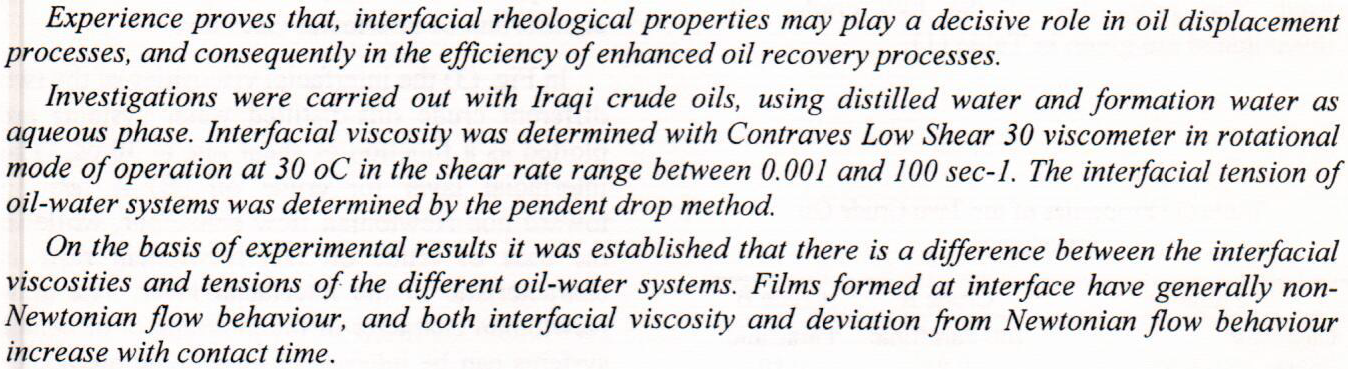
Interfacial Rheological Properties of Iraqi Crude Oils Water System

In this study, iron oxide nanoparticles (α-Fe₂O₃ NPs) were prepared using a readily available chili pepper plant extract from local markets. This study aims to evaluate the magnetic properties of α-Fe₂O₃ prepared in green chemistry from Capsicum plant extract. After several simple preparatory steps, such as washing and cutting, they were treated with an inorganic complex (potassium hexacyanoferrate) (K3[Fe(CN)₆]). In the first analytical step, the in vitro detection of the plant extract solution after reaction with the potassium hexacyanoferrate (III) complex revealed characteristic adsorption bands of the cyanide group, which disappeared upon complexation. The iron oxide NPs were characterized using various methods, including X
... Show More

The current study deals with host-guest complex formation between cucurbit [7] urils as host and lansoprazole as guesti using PM3 (semi empirical molecules orbital calculations) also DFT calculations. In this complex, the formation of hydrogen bonding may be occurred through portal oxygen atoms(O2) of cucurbit [7] urils and amine groups (NH 2 )of the drug. The energies of HOMO and LUMO orbital’s have been computed for the host guest complex and its components. The result of the stabilization energy explained a complex formation.
Optical properties of chromium oxide (Cr2O3) thin films which were prepared by pulse laser deposition method, onto glass substrates. Different laser energy (500-900) mJ were used to obtain Cr2O3 thin films with thickness ranging from 177.3 to 372.4 nm were measured using Tolansky method. Then films were annealed at temperature equal to 300 °C. Absorption spectra were used to determine the absorption coefficient of the films, and the effects of the annealing temperature on the absorption coefficient were investigated. The absorption edge shifted to red range of wavelength, and the optical constants of Cr2O3 films increases as the annealing temperature increased to 300 °C. X-ray diffraction (XRD) study reveals that Cr2O3 thin films are a
... Show More (1)
(1)
Structural and optical properties of CdO and CdO0.99Cu0.01 thin
films were prepared in this work. Cadmium Oxide (CdO) and
CdO0.99Cu0.01semiconducting films are deposited on glass substrates
by using pulsed laser deposition method (PLD) using SHG with Qswitched
Nd:YAG pulsed laser operation at 1064nm in 6x10⁻² mbar
vacuum condition and frequency 6 Hz. CdO and CdO0.99Cu0.01 thin
films annealed at 550 C̊ for 12 min. The crystalline structure was
studied by X-ray diffraction (XRD) method and atomic force
microscope (AFM). It shows that the films are polycrystalline.
Optical properties of thin films were analyzed. The direct band gap
energy of CdO and CdO0.99Cu0.01 thin films were determined from
(αhυ)1/2 v
(1)
This work aims to investigate the tensile and compression strengths of heat- cured acrylic resin denture base material by adding styrene-butadiene (S- B) to polymethyl methacrylate (PMMA). The most well- known issue in prosthodontic practice is fracture of a denture base. All samples were a blend of (90%, 80%) PMMA and (10%, 20%) S- B powder melted in Oxolane (Tetra hydro furan). These samples were chopped down into specimens of dimensions 100x10x2.5mm to carry out the requirements of tensile tests. The compression strength test specimens were shaped into a cylinder with dimensions of 12.7mm in diameter and 20mm in length. The experimental results show a significant increase in both tensile and compression strengths when compared to cont
... Show More (8)
(2)
(8)
(2)
 (12)
(11)
(3)
(3)
(12)
(11)
(3)
(3)
In the present work we prepared heterojunction not homogenous CdS/:In/Cu2S) by spray and displacement methods on glass substrate , CdS:In films prepared by different impurities constration. Cu2S prepared by chemical displacement method to improve the junction properties , structural and optical properties of the deposited films was achieved . The study shows that the film polycrystalline by XRD result for all film and the energy gap was direct to 2.38 eV with no effect on this value by impurities at this constration .
thin films of se:2.5% as were deposited on a glass substates by thermal coevaporation techniqi=ue under high vacuum at different thikness