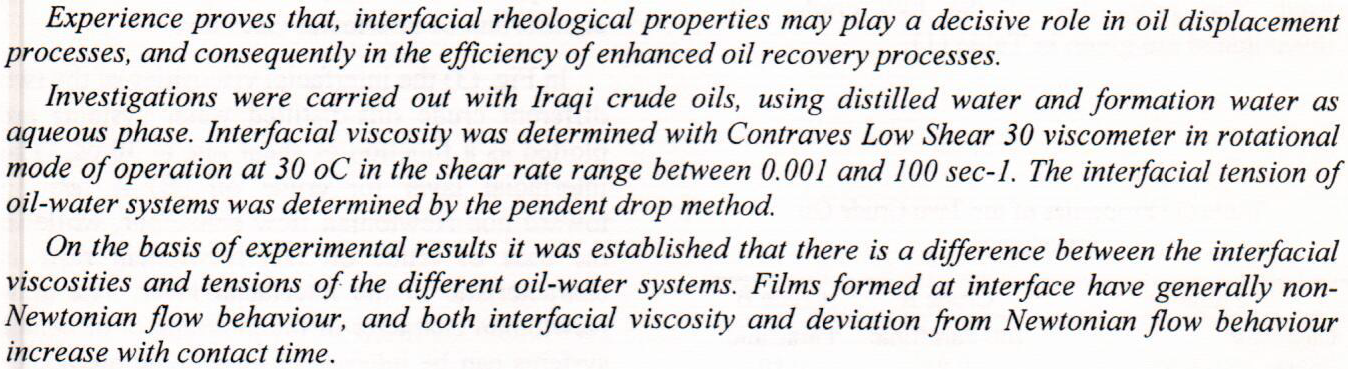
Interfacial Rheological Properties of Iraqi Crude Oils Water System

Abstract: The issue of rebuilding the strategiccapacity of Iraq after the occupation and the US invasion in 2003 has been oneof the most contentious issues of debate and debate. It raises a number ofpolitical, social, economic, military and security problems. We say politicalprimarily because the climate and political conditions play a large and activerole along with other factors complementary to them. The important questionthat arises here is: How can the ruling political blocs move to the stage ofreconstruction without reservations? In order to answer this question, wedivided the study into three main axes. The first deals with the concept ofpower and its types. The second axis deals with the relationship betweenstrategic capa
... Show More
Leishmaniasis is one of the important parasitic diseases, affecting mainly low social class people indeveloping countries, and is more prevalent and endemic in the tropical and subtropical regions of old worldand new world. Despite ofbroad distribution in Iraq,little known about the geneticcharacteristics of thecausative agents. So this study was aimed to evaluate the genetic varietyoftwo IraqiLeishmaniatropicaisolatesbased on heat shock protein gene sequence 70 (HSP70) in comparison with universal isolates recordedsequences data. After amplification and sequencing of HSP70 gene,the obtainedresults were alignment alongwith homologous Leishmania sequences retrieved from NCBI by using BLAST. The analysis results showedpresence of particular g
... Show More (2)
(2)
 (1)
(1)


Mansuriya Gas field is an elongated anticlinal structure aligned from NW to SE, about 25 km long and 5-6 km wide. Jeribe formation is considered the main reservoir where it contains condensate fluid and has a uniform thickness of about 60 m. The reservoir is significantly over-pressured, (TPOC, 2014).
This research is about well logs analysis, which involves the determination of Archie petrophysical parameters, water saturation, porosity, permeability and lithology. The interpretations and cross plots are done using Interactive Petrophysics (IP) V3.5 software.
The rock parameters (a, m and n) values are important in determining the water saturation where (m) can be calcul
... Show More
The research is aimed at dynamics the dynamics of the artistic form within the theater and the dynamics of this movement in the development of the form and the multiplicity of meaning. This research came to address a problem of great importance in the creation of the image and the form of theatrical presentation. The evolution and transformation within the display system requires a dynamic structure that enables the form of growth and growth. The aim of the research was to identify the dynamics of form in the Iraqi theater. The researcher then identified two terms: form and motor.
In the theoretical framework, it was divided into two sections: the first (the dynamics of the artistic form) and the second (the dynamics of the act of dir
(1)
Competencies topic in general , and Administrative competencies in specific, are considered as important subject in the contemporary administrative literature in all countries as well as in public and privet Organizations. For this reason, we have need to study those competencies in many Iraqi Organizations.
Two Organizations wer chosen for this research one of them is the Institution of taxation, and the other is the General company of Electric the data and information related to the research have been collected by desined questioner which has been given to a sample of (50) persions divided eqully between the two maintioned organizations.
The results of the study had differences
... Show More
Theatrical performances began with the Greeks when the theatrical scenes and skeletal figures were encoded, where the large wall of the Alskina, which contains three doors, the middle of them with a high height, and the two sides took the natural size, where the middle door indicated a symbolism of the god or demigods, as we find the condensation of the symbol in the architecture of the theater, and the symbol was taken In the theatrical scene, the development semantically and aesthetically, and interpreting and interpreting the current day, where the laser light formed the symbolism of the contemporary virtual scene, and in order to identify the aesthetics of the symbol in the theatrical scene, the current research was evaluated into fo
... Show More
Background: Endometrial Cancer (EC) is the malignant tumor originating from endometrium cell (lining of the uterus). EC incidence and mortality have increased in recent years. Routinely used methods for EC diagnosis and treatment are histopathological tissue culture after surgery and postoperative radiotherapy, however there is still not enough efficient treatment for recurrence or progression of this disease. So, there is a critical need for further EC identification by new biological ways for the prognostic diagnosis of it. Objective: This study aimed to look for ways by which could help in diagnosis of EC before the hysterectomy. Materials and Methods: 55 patients with EC and 57 healthy women were involved in this study (up to 45 years)
... Show More
(1)