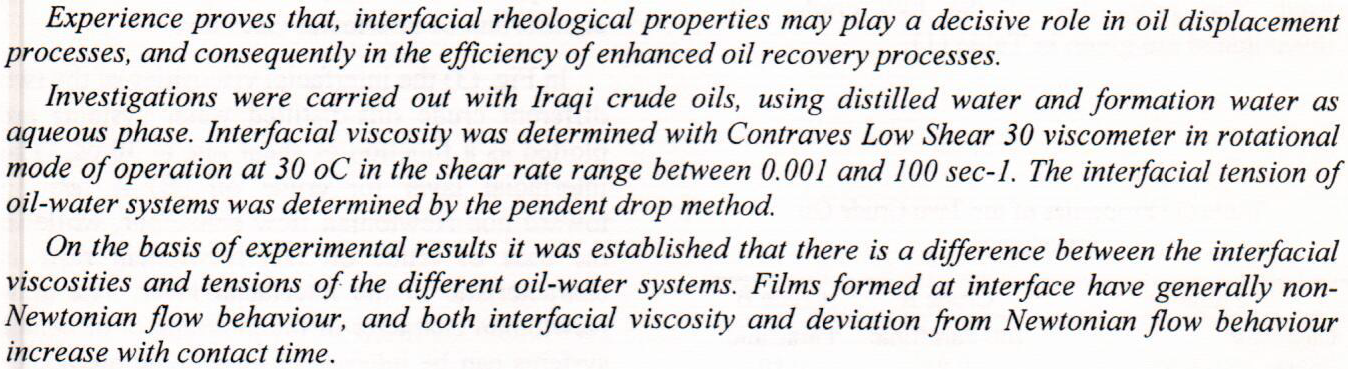
Interfacial Rheological Properties of Iraqi Crude Oils Water System

 (1)
(1)


 (11)
(11)
 (3)
(3)
This paper describes the geotechnical properties of Al-Ammarah soil of Ammarah city in Messan Governorate-southern parts of Iraq. Data and other information taken from numbers of geotechnical reports that performed under the supervision of Consulting Engineering Bureau of Baghdad University. This research is devoted to study the correlation between different physical properties such as (LL, PI, LI, n,t, e) with different mechanical properties such as (qu, cc, cs, SPT). The correlation is verified using simple regression analysis. From the regression results it was found that there is direct correlation between different parameters. By using the correlation-with some information- preliminary investigation stages and studies of any s
... Show MoreThe solution casting method was used to prepare a polyvinylpyrrolidone (PVP)/Multi-walled carbon nanotubes (MWCNTs) nanocomposite with Graphene (Gr). Field Effect Scanning Electron Microscope (FESEM) and Fourier Transformer Infrared (FTIR) were used to characterize the surface morphology and optical properties of samples. FESEM images revealed a uniform distribution of graphene within the PVP-MWCNT nanocomposite. The FTIR spectra confirmed the nanocomposite information is successful with apperaring the presence of primary distinct peaks belonging to vibration groups that describe the prepared samples.. Furthermore, found that the DC electrical conductivity of the prepared nanocomposites increases with increasing MWCNT concentratio
... Show More
(2)
(3)
In this study, the acid-alkaline transesterification of refined coconut seed oil (RCOSO) to fatty acid methyl ester was followed by the production of a trimethylolpropane-based thermosensitive biolubricant using potassium hydroxide, and its physicochemical characteristics were evaluated. The American Standard Test for Materials (ASTM) was employed to ascertain the biolubricant's pour point and index of viscosity, which were found to be -4 oC and 283.75, respectively. The opposite connection between lubricant viscosity and temperature was shown by the measured viscosities at varied transesterification to be transformed into biodiesel. Following this, a biolubricant was created by further transesterifiedtemperature. The ester gr
... Show More
(1)
The structural, optical properties of copper oxide thin films ( CuO) thin films which have been prepared by thermal oxidation with exist air once and oxygen another have been studied. Structural analysis results of Cu thin films demonstrate that the single phase of Cu with high a crystalline structure with a preferred orientation (111). X-ray diffraction results confirm the formation of pure (CuO) phase in both methods of preparation. The optical constant are investigated and calculated such as absorption coefficient, refractive index, extinction coefficient and the dielectric constants for the wavelengths in the range (300-1100) nm.
(5)
(3)
In this research, the effect of reinforcing epoxy resin composites with a filler derived from chopped agriculture waste from oil palm (OP). Epoxy/OP composites were formed by dispersing (1, 3, 5, and 10 wt%) OP filler using a high-speed mechanical stirrer utilizing a hand lay-up method. The effect of adding zinc oxide (ZnO) nanoparticles, with an average size of 10-30 nm, with different wt% (1,2,3, and 5wt%) to the epoxy/oil palm composite, on the behavior of an epoxy/oil palm composite was studied with different ratios (1,2,3, and 5wt%) and an average size of 10-30 nm. Fourier Transform Infrared (FTIR) spectrometry and mechanical properties (tensile, impact, hardness, and wear rate) were used to examine the composites. The FTIR
... Show More
(7)
In this study, a double frequency Q-switching Nd:YAG laser beam (1064 nm and λ= 532 nm, repetition rate 6 Hz and the pulse duration 10ns) have been used, to deposit TiO2 pure and nanocomposites thin films with noble metal (Ag) at various concentration ratios of (0, 10, 20, 30, 40 and 50 wt.%) on glass and p-Si wafer (111) substrates using Pulse Laser Deposition (PLD) technique. Many growth parameters have been considered to specify the optimum condition, namely substrate temperature (300˚C), oxygen pressure (2.8×10⁻⁴ mbar), laser energy (700) mJ and the number of laser shots was 400 pulses with thickness of about 170 nm. The surface morphology of the thin films has been studied by using atomic force microscopes (AFM). The Root Mean Sq
... Show More
(2)
The main purpose of this paper, is to characterize new admissible classes of linear operator in terms of seven-parameter Mittag-Leffler function, and discuss sufficient conditions in order to achieve certain third-order differential subordination and superordination results. In addition, some linked sandwich theorems involving these classes had been obtained.
(1)
(2)