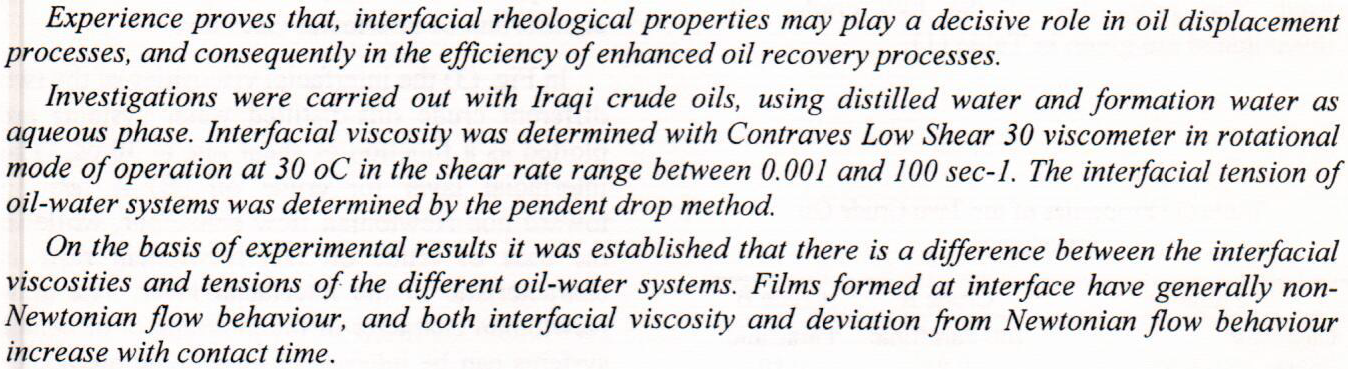
Interfacial Rheological Properties of Iraqi Crude Oils Water System

To reduce the effects of discharging heated water disposed into a river flow by a single thermal source, two parameters were changed to get the minimum effect using optimization. The first parameter is to distribute the total flow of the heated water between two disposal points (double source) instead of one and the second is to change the distance between these two points. In order to achieve the solution, a two dimensional numerical model was developed to simulate and predict the changes in temperature distribution in the river due to disposal of the heated water using these two points of disposal.
MATLAB-7 software was used to build a program that could solve the governing partial equations of thermal pollution in rivers by using t
تسعى تركيا ضمن سياساتها المائية ومنذ زمن بعيد وبأصرار على تنفيذ المزيد من بناء السدود والمشاريع التخزينية المائية على حوضي دجلة والفرات، الامر الذي يؤدي بالضرورة الى تناقص معدل الواردات المائية لنهري دجلة والفرات الداخلة للاراضي العراقية .وبالتالي التأثير على مقومات التنمية الزراعية العربية بشكل عام والتنمية الزراعية بالعراق بشكل خاص ومن ثم تهديد الامن الغذائي الوطني.
لذا فأن البحث يهد
... Show More
Excessive intake of fluoride, mainly through drinking water is a serious health hazard affecting humans worldwide. In this study, the defluoridation capacities of locally available raw waste beef bones have been estimated. Several experimental parameters including contact time, pH, bone dose, fluoride initial concentration, bone grains size, agitation rate, and the effect of co-existence of anions in actual samples of wastewater were studied for fluoride removal from aqueous solutions. Results indicated excellent fluoride removal effeciency up to 99.7% at fluoride initial concentration of 10 mg F/L and 120 min contact time. Maximum fluoride uptake was obtained at neutral pH range 6-7. Fluoride removal kinetic was well described by the ps
... Show More
Sodium adsorption ratio (SAR) is considered as a measure of the water suitability for irrigation usage. This study examines the effect of the physicochemical parameters on water quality and SAR, which included Calcium(Ca+2), Magnesium(Mg+2), Sodium (Na+), Potassium (K), Chloride (Cl-), Sulfate(SO4-2), Carbonate (CO3-2), Bicarbonate (HCO3-), Nitrate (NO3-), Total Hardness (TH), Total Dissolved Salts (TDS), Electrical Conductivity (EC), degree of reaction (DR), Boron (B) and the monthly and annually flow discharge (Q). The water samples were collected from three stations across the Tigris River in Iraq, which flows through Samarra city (upstream), Baghdad city (central) and the end of Kut city (downstream) for the periods of 2016-201
... Show MoreThe chlorine concentration variation in Baghdad water networks was studied. The
chlorine data were collected from Mayoralty of Baghdad and Ministry of Environment
(MOE) for the networks for both sides of the city Karkh and Rasafa for (2008-2009). The
study of these data indicates that there are no systematic testing program .Classified GIS
maps showed that the areas far from the treatment plants have almost always low
chlorine concentration .This indicates that the problem of the low chlorine concentration
in the far areas is due to cracks of pipe along the conveyance path ,as expected. The area's
most frequently have low concentration are Al-sadir,Al-Kadhimya, and Al-Amiria . It
was found also that the chlorine c
The present work aims to study the removal of dyes from wastewater by reverse osmosis process. Two dyes were used direct blue 6, and direct yellow. Experiments were performed with feed concentration (75 – 450 ppm), operation temperature (30 – 50 oC) and time (0.2 – 2.0 hr). The membrane used is thin film composite membrane (TFC). It was found that modal permeate concentration decreases with increasing feed concentration and time operating, while permeate concentration increases with increasing feed temperature. Also it was found that product rate increase with increasing temperature, but it decrease with increasing feed concentration and time. The concentration of reject solution showed an increase with increasing feed concentratio
... Show More (43)
(43)
 (36)
(36)


Groundwater quality deterioration due to anthropogenic natural activities and its immense utilization in various sectors is considered a great concern. The aim of this study is to determine the groundwater quality parameters at various sources in and around Dhaka city and compare them with Bangladesh drinking water standards. In this study, six groundwater quality parameters (pH, DO, COD, TS, TDS, and arsenic) and ten groundwater samples are analyzed to determine the water quality. The collected samples have maximum and minimum pH values of 6.9 and 6.4, respectively. Maximum and minimum DO values are 0.3 and 0.1 mg/L, respectively. The arsenic concentration is 0 mg/L for all collected groundwater samples. The maximum and minimum COD
... Show More
(23)
(17)
In this study, phytoplankton density, chlorophyll-a, and selected physico- chemical parameters were investigated in Erbil wastewater channel. The surveys were carried out monthly from May 2003 to April 2004. Samplings were established on three sites from headwaters to the mouth. The results showed that pH was in alkaline side of neutrality, with significant differences (P<0.05) between sites 1 and 3. TSS concentration decreased from site 1 toward site 2 (mean value, 80.15 to 25.79 mg.l-1). A clear gradual increase in mineral content (TDS) observed from site one of the channel towards the mouthpart. Soluble reactive phosphate has a concentration maximum mean value reached 48.4 µg.l-1 which is recorded in site 2. A high positive relat
... Show More
(2)
