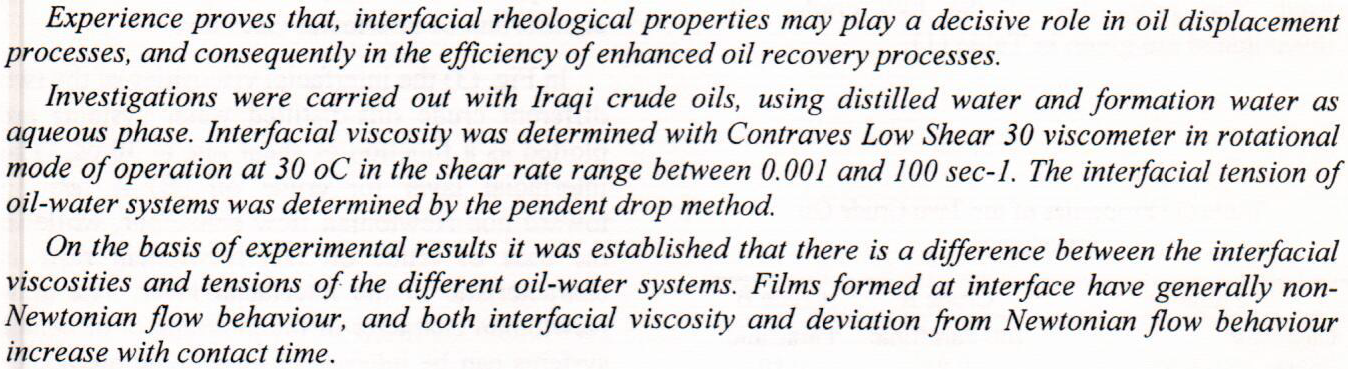
Interfacial Rheological Properties of Iraqi Crude Oils Water System

 (37)
(37)
 (31)
(31)



Biosorpion of lead (Pb), Cadmium (Cd) and Nickl(Ni) by dried biomass of Chara sp. for sample of BMP was used as alternative approach of conventional method. The range of removal percentages was between 92-97%, 70-98.7% and 46.6-96.6% for Pb, Cd and Ni respectively at 3h.Treatment time, with 300-500 mg dried weight from Chara sp. powder at pH 4, with 60 rpm at shaker. FTIR analysis showed the active groups which are responsible for sequestration of heavy metals represented by carboxyl, hydroxyl alkyl, amine and amide. The Biosorption equilibrium experiment for elements showed that the highest sorption percentage for three elements was, Pb 96.6% after 30 minute, for Cd was 100% after 15 minute and 40% to Ni after 75 minute, while the biosorp
... Show More
The object of the presented study was to monitor the changes that had happened in the main features (water, vegetation, and soil) of Al-Hammar Marsh region. To fulfill this goal, different satellite images had been used in different times, MSS 1973, TM 1990, ETM+ 2000, 2002, and MODIS 2009, 2010. A new technique of the unsupervised classification called (Color Extracting Technique) was used to classify the satellite images. MATLAP programming used the technique and separated Al-Hammar Marsh from other water features (rivers, irrigated lands, etc.) when calculated the changes in the water content of the study region. ArcGIS 9.3 (arcMAP, arcToolbox) were used to achieve this work and calculate area of each class.
(2)
A modified chemical method was used to prepare titanium dioxide nanoparticles (TiO2 NPs), which were diagnosed by several techniques: X-ray diffraction, Fourier transform infrared, field emission scaning electron microscopy, energy disperse X-ray, and UV-visible spectroscopy, which proved the success of the preparation process at the nanoscale level. Where the titanium oxide particles have an average particle size equal to 6.8 nm, titanium dioxide particles were used in the process of adsorption of Congo red dye from its aqueous solutions using a batch system. The titanium oxide particles gave an adsorption efficiency of Congo red dye up to more than 79 %. The experimental data of the adsorption process were analyzed with kinetic models and
... Show More
(2)
An integrated GIS-VBA (Geographical Information System – Visual Basic for Application), model is developed for selecting an optimum water harvesting dam location among an available locations in a watershed. The proposed model allows quick and precise estimation of an adopted weighted objective function for each selected location. In addition to that for each location, a different dam height is used as a nominee for optimum selection. The VBA model includes an optimization model with a weighted objective function that includes beneficiary items (positive) , such as the available storage , the dam height allowed by the site as an indicator for the potential of hydroelectric power generation , the rainfall rate as a source of water . In a
... Show More
This study aims to evaluate drinking water quality at the Al Wahda plant (WTP) in Baghdad city. A conventional water treatment plant with an average flow rate of 72.82 MLD. Water samples were taken from the influent and effluent of the treatment plant and analyzed for some physicochemical and biological parameters during the period from June to November 2020. The results of the evaluation indicate that treated water has almost the same characteristics as raw water; in other terms, the plant units do not remove pollutants as efficiently as intended. Based on this, the station appears to be nothing more than a series of water passage units. However, apart from Total dissolved solids, the mean values of all parameters in the study were
... Show More
(1)
(1)
(1)
Field experiment was conducted to test the effect of saline water 2 and7 dSm-1 potassium fertilizer rate 150,300 and 450 kg/donum on nitrogen fixation in Pisum sativum L. nodules. The experiment included anatomy study .Results water salinity ( 2,7 dSm-1) as a main plot and fertilizer rates as a sub plot. Results indicated that irrigation with saline water 7 dSm-¹ caused a significant decrease in N contents especially in the lower parts of the plants. The percentage of the N decreased in lower leaves to (0.01%) under 7dSm-¹ and 300 kg/donum fertilizer; however the percentage increased in the upper leaves to (2.80%) under with 2dSm-¹of irrigation water and 300 kg/ donum fertilizer rate. Fresh weight decreased to 6.26g under 7 dSm
... Show More
This study aims to evaluate drinking water quality at the Al Wahda plant (WTP) in Baghdad city. A conventional water treatment plant with an average flow rate of 72.82 MLD. Water samples were taken from the influent and effluent of the treatment plant and analyzed for some physicochemical and biological parameters during the period from June to November 2020. The results of the evaluation indicate that treated water has almost the same characteristics as raw water; in other terms, the plant units do not remove pollutants as efficiently as intended. Based on this, the station appears to be nothing more than a series of water passage units. However, apart from Total dissolved solids, the mean values of all parameters in th
... Show More
(1)