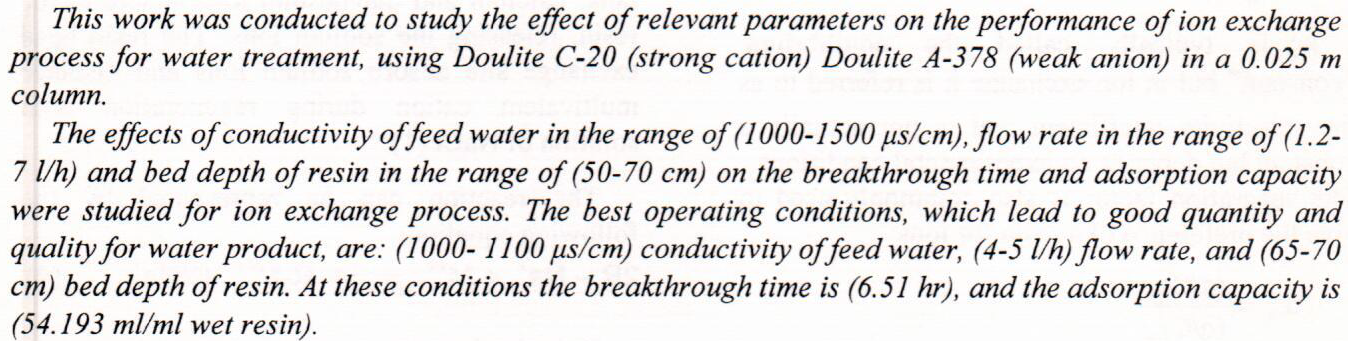
Water Treatment of Cooling Towers Blowdown by Ion Exchange

 (23)
(23)
 (21)
(21)


 (1)
(1)
(11)
(3)
(1)
(1)
(11)
(3)
This study investigates the impact of copper sulfate (CuSO4) doping and glycerin plasticization on the structural, electrical, dielectric, and optical properties of poly(vinyl alcohol) (PVA), polyvinyl pyrrolidone (PVP), and glycerin gel polymer electrolytes (GPEs). The GPEs were prepared using a solution casting method with varying CuSO4 concentrations (5 and 10 wt.%). X-ray diffraction analysis revealed the semi-crystalline nature of the polymer blend and also confirmed the presence of CuSO4. Fourier transform infrared spectroscopy confirmed the miscibility of PVA, PVP, and glycerin through interchain hydrogen bonding and indicated the successful incorporation of Cu2+ ions into the polymer blend matrix. The PVA/PVP/glycerin blend containi
... Show More
(2)
(3)
This study aims to prepare new compounds and investigate them spectroscopically and biologically against selected types of positive and negative bacteria and fungi to demonstrate their biological effectiveness. The prepared ligand combining formaldehyde, indole, sulfa benzamide, and 2-mercapto benzimidazole, a Mannich base ligand (L) was synthesized. The six metal ions including Cobalt (II), Nickel (II), Copper (II), Palladium (II), Platinum (IV), and gold (III) have interacted with the ligand and formed new complexes. Different spectroscopic methods, including C.H.N.S., FTIR, UV- Range visible, 1HNMR, 13CNMR, mass spectra, magnetic moment, and molar conductivity were used to suggest the new geometry of the complexes. The resul
... Show More
(1)
New azo ligand 2-((4-formyl-3-hydroxynaphthalen-2-yl) diazenyl) benzoic acid (H2L) was synthesized from the reaction of 2-aminobenzoic acid and2-hydroxy-1-naphthaldehyde. Monomeric complexes of this ligand, of general formulae [MII(L)(H2O)] with (MII = Mn, Co, Ni, Cu, Zn, Pd, Cd and Hg ) were reported. The compounds were isolated and characterized in solid state by using 1H-NMR, FT-IR, UV–Vis and mass spectral studies, elemental microanalysis, metal content, magnetic moment measurements, molar conductance and chloride containing. These studies revealed tetrahedral geometries for all complexes except PdII complex is Square planar. The study of complexes formation via molar ratio of (M:L) as (1:1). Theoretical treatments of compounds in gas
... Show More
(1)
Abstract Lateral Epicondylitis (LE) which has been referred to as the Tennis Elbow as well is a lesion affecting common tendinous origins of wrist extensors due to chronic overuse injury that results in damaging common extensor tendons which join forearm extensor muscles to humerus. The aim of the present evidence-based clinical statement is reviewing scientific evidences for efficacy of a variety of the rehabilitation methods, chronic lateral epicondylitis management. It is focused upon treating chronic lateral epicondylitis and the latest developments in physiotherapy area for managing chronic lateral epicondylitis. Due to the fact that primary physical impairments in the LE are decreased is the strength of the grip, fundamentally due to
... Show More
(2)
(1)
Diazotization reaction between 1-(2,4,6-trihydroxy-phenyl)-ethanone and diazonium salts produced the ligand 4-(3-Acetyl-2,4,6-trihydroxy-phenylazo)-N-(5-methyl-isoxazol-3-yl)- benzenesulfonamide, which in turn reacted with the metal ions (Ni2+, Zn2+, Pd2+ and Pt4+) forming stable complexes with Octahedral geometry suggest of (Ni2+ and Pt4+), Zn2+ complex Tetrahedral and Pd2+ complex Square planer. The creation of such complexes was detected by employing spectroscopic means involving ultraviolet-visible, which proved the obtained geometries; FT-IR confirmed the formation of the azo group and the coordination with metal ions through it. Thermogravimetric analysis studies demonstrated the coordination of water residues (aqua or hydrate) with m
... Show MoreIn this research, an experimental study was conducted to high light the impact of the exterior shape of a cylindrical body on the forced and free convection heat transfer coefficients when the body is hold in the entrance of an air duct. The impact of changing the body location within the air duct and the air speed are also demonstrated. The cylinders were manufactured with circular, triangular and square sections of copper for its high thermal conductivity with appropriate dimensions, while maintaining the surface area of all shapes to be the same. Each cylinder was heated to a certain temperature and put inside the duct at certain locations. The temperature of the cylinder was then monitored. The heat transfer coefficient were then cal
... Show More