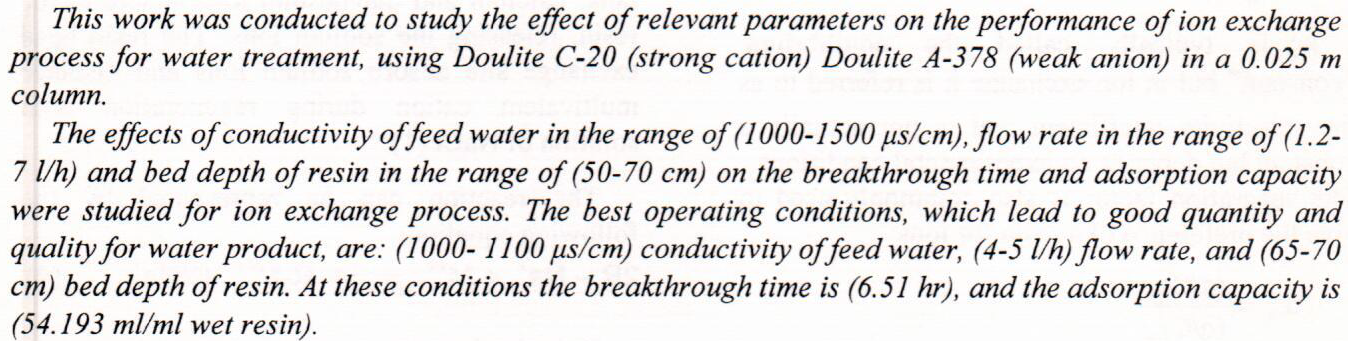
Water Treatment of Cooling Towers Blowdown by Ion Exchange

Objective: To evaluate and compare the effect of mechanical surface treatment (groove, aluminum oxide particles)
with 45 degree bevel type of joint on tensile bond strength of acrylic specimens repaired by two curing methods
(microwave and water both).
Methodology: Eighty specimens (80) were prepared from pink heat cure acrylic resin. They were divided into two
main groups (40 specimen repaired by microwave energy and 40 specimens repaired by water bath method).Each
group can be divided into four subgroups of ten according to the surface treatment. The control group A was left
intact, group B received no surface treatment, group C and D received surface treatment by (groove, 50 m aluminum
oxide particles). Specimens
ABSTRACT
This study aimed to choose top stocks through technical analysis tools specially the indicator called (ratio of William index), and test the ability of technical analysis tools in building a portfolio of shares efficient in comparison with the market portfolio. These one technical tools were used for building one portfolios in 21 companies on specific preview conditions and choose 10 companies for the period from (March 2015) to (June 2017). Applied results of the research showed that Portfolio yield for companies selected according to the ratio of William index indicator (0.0406) that
... Show MoreTHE Schiff base reaction played an important role of the condensation reaction between 2-aminophenol and Glyoxylic acid in the presence of calculated amounts of KOH as a catalyst. The reaction has been carried out in ethanol under reflux and stirring condition for 3.5 hrs. All syntheses were carried out under hydrogen gas forming a new potassium (E)-1-hydroxy-2-(2-hydroxyphenylimino)ethanolate ligand type [NO2]. The ligand of the general formula K2[Mn(L2)] type and its Mnп complex K2[Mn(N2O4)] type, has been characterized by spectroscopic methods (F.T-I.R. and U.V-Vis.), elemental analysis (C.H.N) metal content, magnetic susceptibility measurement, Thin-layer chromatography (T.L.C), X-RD powder diffraction, 1H-NMR, 13C-NMR molar conductanc
... Show MoreThis work presents a computer studying to simulate the charging process of a dust grain immersed in plasma with negative ions. The study based on the discrete charging model. The model was developed to take into account the effect of negative ions on charging process of dust grain.
The model was translated to a numerical calculation by using computer programs. The program of model has been written with FORTRAN programming language to calculate the charging process for a dust particle in plasma with negative ion, the time distribution of a dust charge, number charge equilibrium and charging time for different value of ηe (ratio of number density of electron to number density of positive ion).
The dependence of the energy losses or the stopping power for the ion contribution in D- T hot plasma fuels upon the corresponding energies and the related penetrating factorare arrive by using by a theoretical approximation models. In this work we reach a compatible agreement between our results and the corresponding experimental results.

 (31)
(31)
 (25)
(25)


Gel polymer electrolytes (GPEs) have attracted considerable attention for rechargeable battery applications because of their high ionic conductivity, mechanical flexibility, and enhanced safety. In the present work, copper-ion-conducting PVA/HPMC gel polymer electrolytes were successfully prepared by the solution casting method using a 50:50 PVA/HPMC blend. Different CuSO₄ concentrations (10, 20, and 30 wt%) were incorporated into the polymer matrix, followed by the addition of 3 mL PANI/[BMIM][BF₄] polyionic liquid. The prepared electrolytes were characterized using scanning electron microscopy (SEM), differential scanning calorimetry (DSC), thermogravimetric analysis (TGA), and electrochemical impedance spectroscopy (EIS). SEM analysi
... Show More
this research paper aims at measuring and analyzing the influence of the stock exchange on the economic development in the Kingdom. This is done through comparing the Gross Domestic Product (GDP) as a changeable factor affiliated with some independent variables in the KSA stock exchange. These variables are (All Share Index {TASI}, Market Value, Trade Volume Index, number of companies and number of shares). The study covers the period from 2003 to 2017 and adapts the measuring method in analyzing this relation using the Multiple Linear Regression (Stepwise) and (SPSS). The study affirmed the validity of the
... Show More
Abstract
The researcher seeks, through different aspects of the search, to reach a set of objective concerning in content creation a clear vision about conceptual and practical dimension of relation and effects between (Leader-Member Exchange, and Organizational Commitment) to construct a framework of a pragmatic model as a solution to research problem and it questions. The theoretical problem is derived basically from the scarcity of Arab studies and researches that deal by study and analyses for such important of The two variables blend. The practical problem depends in deriving from reality of every day work in the Iraqi ministry of defense.
On this basis, a formula of research problem for pur
... Show More
(3)