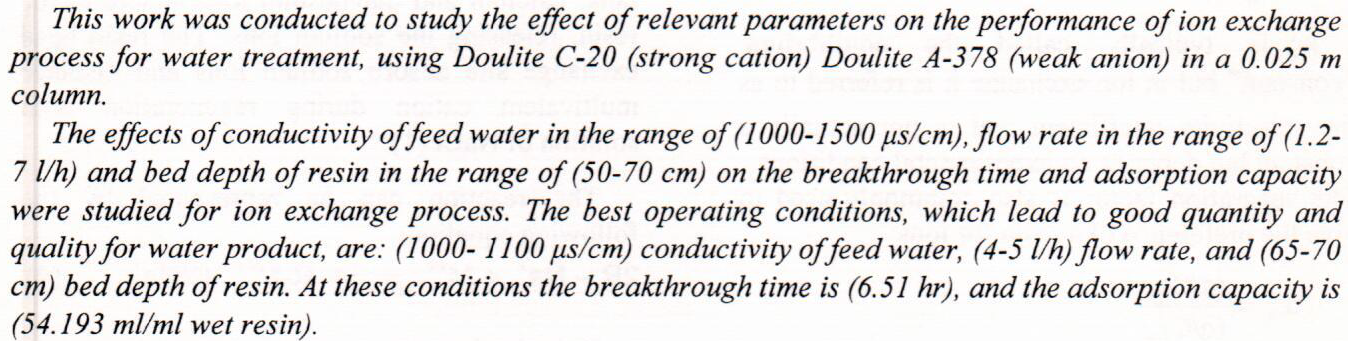
Water Treatment of Cooling Towers Blowdown by Ion Exchange

A spectrophotometric determination of azithromycin was optimized using the simplex model. The approach has been proven to be accurate and sensitive. The analyte has been reacted with bromothymol blue (BTB) to form a colored ion pair which has been extracted in chloroform in a buffer medium of pH=4 of potassium phthalate. The extracted colored product was assayed at 415 nm and exhibited a linear quantification range over (1 - 20) g/ml. The excipients did not exhibit any interferences with the proposed approach for assaying azithromycin in pharmaceutical formulations.

This paper experimentally investigates the heating process of a hot water supply using a neural network implementation of a self-tuning PID controller on a microcontroller system. The Particle Swarm Optimization (PSO) algorithm employed in system tuning proved very effective, as it is simple and fast optimization algorithm. The PSO method for the PID parameters is executed on the Matlab platform in order to put these parameters in the real-time digital PID controller, which was experimented with in a pilot study on a microcontroller platform. Instead of the traditional phase angle power control (PAPC) method, the Cycle by Cycle Power Control (CBCPC) method is implemented because it yields better power factor and eliminates harmonics
... Show More (1)
(1)

 (2)
(3)
(2)
(3)

Abstract : A research was conducted to study the process parameters affecting hexavalent chromium Cr (VI) (carcinogenic compound) the removal percentage from the electrical industries company waste water that contain 88 mg/l of Cr (VI) concentration by adsorption onto tea wastes. Synthetic water with 88 mg/l Cr (VI) concentration was used. Several operation parameters affecting Cr (VI) removal efficiency were investigated, such as pH, initial Cr (VI) concentration, stirring time and tea wastes dose. The experimental results reveal that maximum Cr (VI) removal reached up to 94.26% at pH of 2, stirring time of 180 minute, tea wastes do
... Show More
Formation of Au–Ag–Cu ternary alloy nanoparticles (NPs) is of particular interest because this trimetallic system have miscible (Au–Ag and Au–Cu) and immiscible (Ag– Cu) system. So there is a possibility of phase segregation in this ternary system. At this challenge it was present attempts synthetic technique to generate such trimetallic alloy nanoparticles by exploding wire technique. The importance of preparing nanoparticles alloys in distilled water and in this technique makes the possibility of obtaining nanoparticles free of any additional chemical substance and makes it possible to be used in the treatment of cancer or diseases resulting from bacterial or virus with least toxic. In this work, three metals alloys Au-Ag-Cu
... Show More
(2)
An experimental study was carried out for an evaporative cooling system in order to investigate the effect of using an aluminum pad coated with fabric polyester. In the present work, it was considered to use a new different type of cooling medium and test its performance during the change in the wet-bulb temperature and dry-bulb temperature of the supply air outside of the pad, the relative humidity of the supply air, the amount of air supplied (300-600) CFM and also the change of the amount of circulated water (1.75, 2.5, 4.5) liter per minute. A decrease in the WBT of the air was obtained, whereas the WBT of the air entering the pad was 26.5 . In contrast, the WBT of the outside air had reached 23 even though eva
... Show More
(89)
(98)
A new method is characterized by simplicity, accuracy and speed for determination of Oxonuim ion in ionisable inorganic acid such as hydrochloric (0.1 - 10) ,Sulphuric ( 0.1 - 6 ),nitric ( 0.1 - 10 ), perchloric ( 0.1 - 7 ), acetic (0.1 - 100 ) and phosphoric ( 0.1 - 30 ) ( mMol.L-1 )acids. By continuous flow injection analysis. The proposed method was based on generation of bromine from the Bro-3-Br-- H3O+. Bromine reacts with fluorescein to quenches the fluorescence . A sample volume no.1 (31μl) and no.2 (35μl) were used with flow rate of 0.95 mL.min-1 using H2O line no.1as carrier stream and 1.3 mL.min-1 using fluorescein sodium salt line no.2. Linear regression of the concentration ( mMol.L-1 ) Vs quenched fluorescence gives a correla
... Show MoreA total of 60 samples of drinking water filtrated by Reverser 0smosis Filtration System from April to October 2012, from different houses in Baghdad – Al Resafa, so as to identify the eggs and cysts of protozoa. Two methods applied direct smear and staining technique with zeal nelson stain, which appeared Tape warm eggs, Ascaris lumbrecoides eggs and oocyst of Cryptospordium sp. This study revealed that total contamination rate with intestinal parasites in tap water were 96.6% this high rate, refers to filtrate tap water by reverse osmosis system was useful to prevent or reduce the contamination of drinking water, in order to reduce risks to public health; So recommended to apply this method at water purification stations. Dis
... Show More
(2)
In this study the thermal conductivity of the epoxy composites were characterized as function of volume fraction, particle size of fillers and the time of immersion(30,60,90)days in water .Composites plates were prepared by incorporating (bi-directional) (0º-90º) glass fiber and silicon carbide (SiC) particles of (0.1,0.5,1)mm as particle size at (10%,20%,30%,40%) percent volume in epoxy matrix.
The composites shows slightly increase of the thermal conductivity with increasing volume fraction, particle size and increase with increasing the days of immersion in water. The maximum thermal conductivity (0.51W/m.K) was obtained before the immersion in water at 90 days for epoxy reinforcement by bi-directional glass fiber and SiC particl