Water Treatment of Cooling Towers Blowdown by Ion Exchange
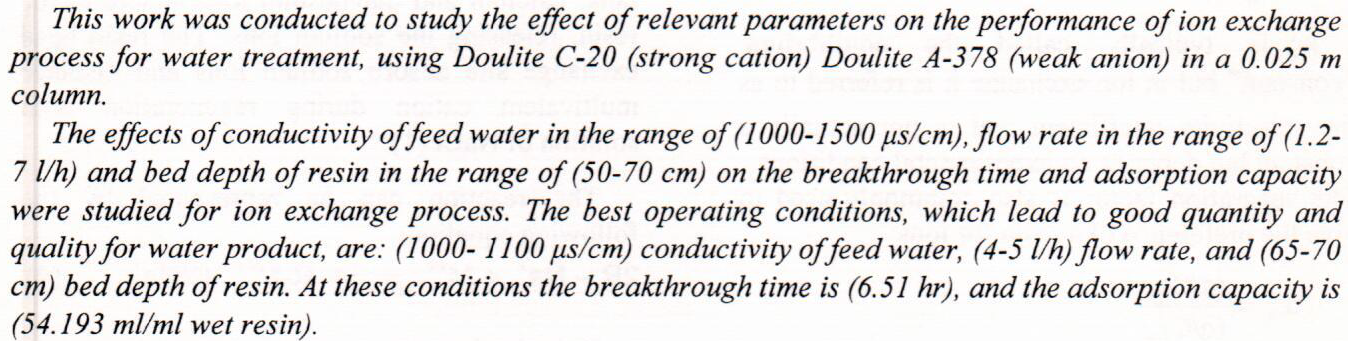

 (12)
(12)
 (6)
(6)


In this study, successive electrocoagulation (EC) and electro-oxidation (EO) processes were used to minimize some of the major pollutants in real wastewater, such as organics (detected by chemical oxygen demand (COD)), and turbidity. The wastewater utilized in the present study was collected from the Midland Refinery Company in Baghdad-Iraq. The performance of the successive batch EC-EO processes was studied by utilizing Graphite and Aluminum (Al) as monopolar anode electrodes and stainless steel (st.st.) as the cathode. The Taguchi experimental design approach was used to attain the best experimental conditions for COD reduction as a major response. Starting from chemical oxygen demand COD of (600 ppm), the effects of current densi
... Show More
(24)
In this study, successive electrocoagulation (EC) and electro-oxidation (EO) processes were used to minimize some of the major pollutants in real wastewater, such as organics (detected by chemical oxygen demand (COD)), and turbidity. The wastewater utilized in the present study was collected from the Midland Refinery Company in Baghdad-Iraq. The performance of the successive batch EC-EO processes was studied by utilizing Graphite and Aluminum (Al) as monopolar anode electrodes and stainless steel (st.st.) as the cathode. The Taguchi experimental design approach was used to attain the best experimental conditions for COD reduction as a major response. Starting from chemical oxygen demand COD of (600 ppm), the effects of current density (C
... Show More
(24)
(4)
The concerns about water contaminants affect most developing countries bypassing rivers over them. The issue is challenging to introduce water quality within the allowed limits for drinking, industrial and agricultural purposes. In the present study, physical-chemical parameters measurements of water samples taken from eleven stations were collected during six months in 2020 through flow path along the whole length of Tigris River inside AL Kut city (center of Wassit government) were investigated for six parameters are total hardness TH, hydrogen ion pH, biological oxygen demand BOD5, total dissolved solids TDS, nitrate NO3, and sulfate SO4. The water quality analysis results were compared with the maximum allowable limit concentrat
... Show More
(11)
(4)
Recently, many materials have shown that they can be used as alternatives to chemicals materials in order to be used to improve the properties of drilling fluids. Some of these materials are banana peels and corn cobs which both are considered environmentally- friendly materials. The results of the X-ray diffraction examination have proved that the main components of these materials are cellulose and hemicellulose, which contribute greatly to the increasing of the effectiveness of these two materials. Due to their distinct composition, these two materials have improved the rheological properties (plastic viscosity and yield point) and reduced the filtration of the drilling fluids to a large extent. The addition rates used for each o
... Show More
(7)
The present study involves experimental analysis of the modified Closed Wet Cooling Tower (CWCT) based on first and second law of thermodynamics, to gain a deeper knowledge in this important field of engineering in Iraq. For this purpose, a prototype of CWCT optimized by added packing under a heat exchanger was designed, manufactured and tested for cooling capacity of 9 kW. Experiments are conducted to explore the effects of various operational and conformational parameters on the towers thermal performance. In the test section, spray water temperature and both dry bulb temperature and relative humidity of air measured at intermediate points of the heat exchanger and packing. Exergy of water and air were calculated by applying the exergy
... Show MoreThis work involves hard photon rate production from quark -gluon plasma QGP interaction in heavy ion collision. Using a quantum chromodynamic model to investigate and calculation of photons rate in 𝑐𝑔 → 𝑠𝑔𝛾 system due to strength coupling, photons rate, temperature of system, flavor number and critical. The photons rate production computed using the perturbative strength models for QGP interactions. The strength coupling was function of temperature of system, flavor number and critical temperature. Its influenced by force with temperature of system, its increased with decreased the temperature and vice versa. The strength coupling has used to examine the confinement and deconfinement of quarks in QGP properties and inf
... Show More
(2)
(7)