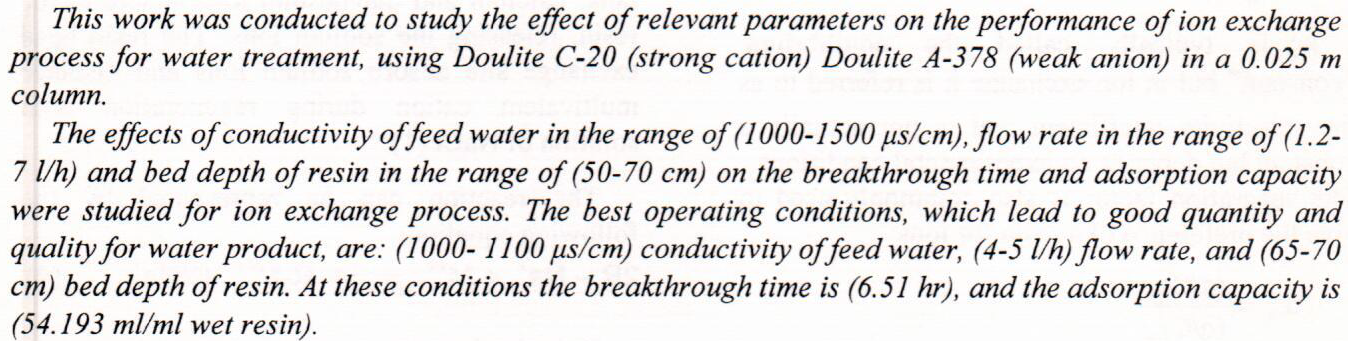
Water Treatment of Cooling Towers Blowdown by Ion Exchange

Background: Implantology is a fast growing area in dentistry. One of the most common issues encountered in dental implantation procedures is the lack of adequate preoperative planning. Conventional radiography may not be able to assess the true regional three-dimensional anatomical presentation. Multi Slice Computed Tomography provides data in 3-dimentional format offering information on craniofacial anatomy for diagnosis; this technology enables the virtual placement of implant in a 3-Dimensional model of the patient jaw (dental planning). Patients, Material and Methods: The sample consisted of (72) Iraqi patients indicated for dental implant (34 male and 38 female), age range between (20-70) years old. They were examined during a time p
... Show MoreTerrestrial isopods play an important role in the biodegradation of many wastes which gives agreat importance in the nutrient cycles and ecosystem services , therefore this paper aims to use species

At present, numerous novel chemical compounds face challenges related to their limited solubility in aqueous environments. These compounds are classified under the Biopharmaceutical Classification System (BCS) as either class II or class IV substances. Different carriers were used to increase their solubility. Candesartan cilexetil (CC) is one of the most widely used antihypertensive drugs, which belongs to class II drugs. The aim of this research was to enhance the solubility and dissolution rate of CC through a complexation approach involving β-cyclodextrin and its derivatives, specifically hydroxypropyl beta cyclodextrin (HP-β-CD), methyl beta cyclodextrin (M-β-CD), and sulfonyl ether beta-cyclodextrin (SBE-β-CD), serving as
... Show More (1)
(1)

The main objective of this study is to introduce a systematic design procedure for short-span segmental beams following a sophisticated ACI 440.2R-17 design procedure. The general aspects of innovative short-span segmental beams are easy to fabricate, economical and rapidly placed in pre-specified positions. Short-span segmental beams fabricated from individual precast plain-concrete blocks and CFRP plates. Recently, experimental tests performed on short-span segmental beams, by the authors, investigated CFRP plate-bonding, CFRP plate cross-sectional area, the thickness of plate-bonding epoxy resin, surface-to-surface condition of concrete blocks, as well as, interface condition of the bonding surface. The experimental program comprises tes
... Show More
(5)
 (5)
(5)
In this study, the response and behavior of machine foundations resting on dry and saturated sand was investigated experimentally. In order to investigate the response of soil and footing to steady state dynamic loading, a physical model was manufactured to simulate steady state harmonic load at different operating frequencies. Total of 84 physical models were performed. The footing parameters are related to the size of the rectangular footing and depth of embedment. Two sizes of rectangular steel model footing were tested at the surface and at 50 mm depth below model surface. Meanwhile the investigated parameters of the soil condition include dry and saturated sand for two relative densities 30% and 80%. The response of the footing was ela
... Show More
(36)
Pharmaceuticals are widely distributed in different applications and also released into the environment. Adsorption of Ciprofloxacin HCl (CIPH) on Porcelinaite was studied at ambient conditions. The adsorption isotherms can be well described using the Freundlich and Temkin equations. The pH of the solution influences significantly the adsorption capacity of Porcelinaite, the adsorption of CIPH increased from the initial pH 1.3 and then decreased over the pH rang of 3.8-9. The adsorption is sensitive to the change in ionic Strength, which indicate that electrostatic attraction is a significant mechanism for sorption process. The enthalpy change (∆H) for the adsorption of CIPH onto Porcelinaite signifies an endothermic adsorption. The ∆G
... Show MoreA new Spectrophotometric method, is for individual and simultaneous determination of Ciprofloxacin hydrochloride(CIP) and Mebeverin hydrochloride(MEB) by the first and second derivative mode techniques. The first and second derivative spectra of these compounds permitted individual and simultaneous determination of CIP and MEB in concentration range of (4-28μg/mL) by measuring the amplitude of peak- to- base line and the area under peak at selected spectrum intervals. The methods showed a reasonable precision and accuracy and have been applied to determine CIP and MEB in four different pharmaceutical preparations.
(1)
(1)
Abstract :- In this paper, silver nanoparticles had been prepared by chemical reduction method. Many tests had been done to it such as UV-Visible spectrophotometer, XRD, AFM&SEM test. finally an attempt had been done to get the optimum condition to control the grain size of silver Nanoparticles by variation the heating period and other parameters which has an effect in silver Nanoparticles synthesis process. in this method we can get a silver nanoparticles in the size range from 52 to 97 nm.