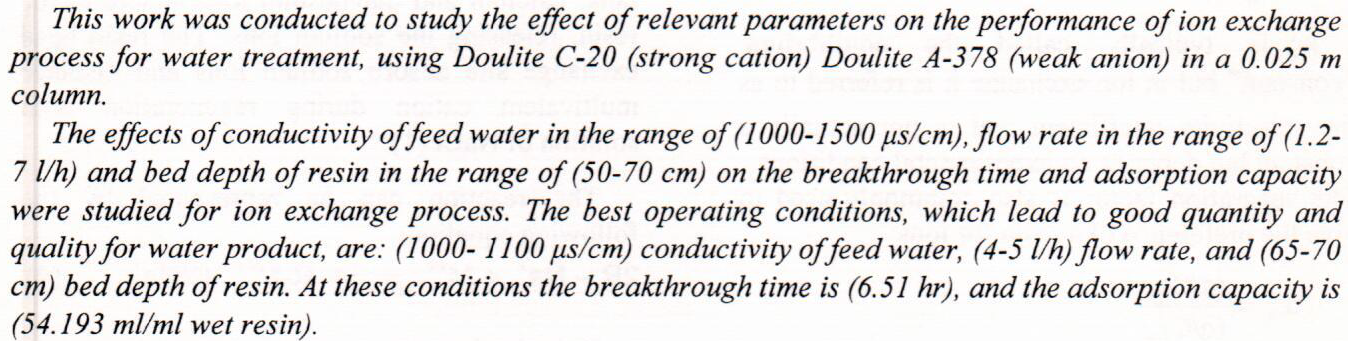
Water Treatment of Cooling Towers Blowdown by Ion Exchange

This research examines how Al-Sabah newspaper addressed violations of women’s rights in Iraq. Using content analysis, a sample of 157 articles published from July 1, 2021, to December 31, 2021, was analyzed. The study reveals diverse journalistic treatments, with interpretive approaches employed in addressing violations of Iraqi women’s rights. Social violations of women’s rights were the primary focus, and various forms of newspaper articles, including opinion pieces, were commonly used.
 (1)
(1)

Background: Lung cancer is a common disease for patients over the age of 50 years, especially males due to smoking habits. This study aimed to compare the modulation complexity score (MCS) for the advanced treatment planning techniques which the intensity modulated radiation therapy (IMRT) and volumetric modulated arc therapy (VMAT). Materials and Methods: Thirty patients who had non-small lung cancerous tumors on their left side participated in this study. The range ages were 68 to 98 years, the heights were between 151 and 182cm and they having weights from 46 to 79 kg. For Each patient will create two plans dial using two different techniques, which will be Intensity Modulated Radiation Therapy (IMRT) and Volumetric Modulated Arc Therapy
... Show More (4)
(4)

The Iraqi marshes are considered the most extensive wetland ecosystem in the Middle East and are located in the middle and lower basin of the Tigris and Euphrates Rivers which create a wetlands network and comprise some shallow freshwater lakes that seasonally swamped floodplains. Al-Hawizeh marsh is a major marsh located east of Tigris River south of Iraq. This study aims to assess water quality through water quality index (WQI) and predict Total Dissolved Solids (TDS) concentrations in Al-Hawizeh marsh based on artificial neural network (ANN). Results showed that the WQI was more than 300 for years 2013 and 2014 (Water is unsuitable for drinking) and decreased within the range 200-300 in years 2015 and 2016 (Very poor water). The develope
... Show MoreThis research discusses application Artificial Neural Network (ANN) and Geographical InformationSystem (GIS) models on water quality of Diyala River using Water Quality Index (WQI). Fourteen water parameterswere used for estimating WQI: pH, Temperature, Dissolved Oxygen, Orthophosphate, Nitrate, Calcium, Magnesium,Total Hardness, Sodium, Sulphate, Chloride, Total Dissolved Solids, Electrical Conductivity and Total Alkalinity.These parameters were provided from the Water Resources Ministryfrom seven stations along the river for the period2011 to 2016. The results of WQI analysis revealed that Diyala River is good to poor at the north of Diyala provincewhile it is poor to very polluted at the south of Baghdad City. The selected parameters wer
... Show MoreA field experiment was conducted in Yusufiya sub-district - Mahmudiya township/Baghdad governorate in silty loam texture soil during the spring season of 2020. The experiment included three treatments with three replicates, as the Randomized Complete Block Design (RCBD) was used according to the arrangement of the split design block. The treatments are in the irrigation system, which included surface drip irrigation (T1) and sprinkler irrigation (T2). Secondly, the Irrigation levels including the irrigation using 0.70 Pan Evaporation Fraction PEF (I1), irrigation using 1.00 PEF (I2), and irrigation using 1.30 PEF (I3). Coupled with, Pota
... Show More
(2)
(1)
n this paper, we formulate three mathematical models using spline functions, such as linear, quadratic and cubic functions to approximate the mathematical model for incoming water to some dams. We will implement this model on dams of both rivers; dams on the Tigris are Mosul and Amara while dams on the Euphrates are Hadetha and Al-Hindya.
The Iraqi marshes are considered the most extensive wetland ecosystem in the Middle East and are located in the middle and lower basin of the Tigris and Euphrates Rivers which create a wetlands network and comprise some shallow freshwater lakes that seasonally swamped floodplains. Al-Hawizeh marsh is a major marsh located east of Tigris River south of Iraq. This study aims to assess water quality through water quality index (WQI) and predict Total Dissolved Solids (TDS) concentrations in Al-Hawizeh marsh based on artificial neural network (ANN). Results showed that the WQI was more than 300 for years 2013 and 2014 (Water is unsuitable for drinking) and decreased within the range 200-300 in years 2015 and 2016 (Very poor water). The
... Show More
(4)
 (10)
(10)