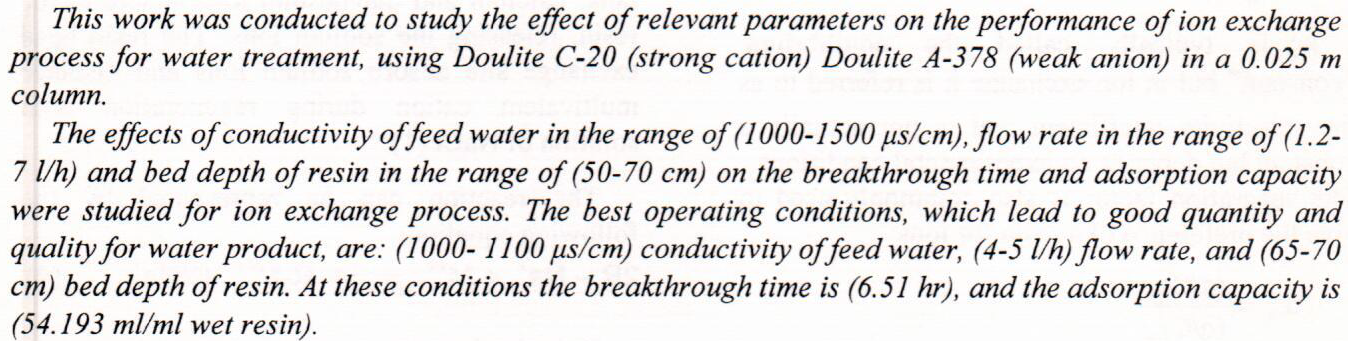
Water Treatment of Cooling Towers Blowdown by Ion Exchange

 (5)
(5)
 (4)
(4)


 (1)
(1)
(1)
(1)
Contamination of surface and groundwater with excessive concentrations of fluoride is of significant health hazard. Adsorption of fluoride onto waste materials of no economic value could be a potential approach for the treatment of fluoride-bearing water. This experimental and modeling study was devoted to investigate for the first the fluoride removal using unmodified waste granular brick (WGB) in a fixed bed running in continuous mode. Characterization of WGB was carried out by FT-IR, SEM, and EDX analysis. The batch mode experiments showed that they were affected by several parameters including contact time, initial pH, and sorbent dosage. The best values of these parameters that provided maximum removal percent (82%) with the in
... Show More
(21)
(13)
Corrosion inhibitors are widely used in industry to reduce the corrosion rate of metals and alloys. Corrosion inhibitors adsorb onto metallic surfaces and insulate them from deterioration. Plants abundant in nature offer a cost-effective replacement for toxic chemical inhibitors on the market. The current research used the potentiostatic polarization technique at room temperature to explore the inhibitory impact of water hyacinth extract on the corrosion of low-carbon steel specimens in a 3.5% NaCl solution. The Tafel curve was used to assess corrosion inhibition activity, with the best inhibition efficiency reaching 79.36% at a concentration of 200 ppm. Cyclic polarization indicated the type of corrosion was general corrosion. The
... Show More
(2)
tA novel synthesis procedure is presented for preparing triethanolamine-treated graphene nanoplatelets(TEA-GNPs) with different specific areas (SSAs). Using ultrasonication, the covalently functionalizedTEA-GNPs with different weight concentrations and SSAs were dispersed in distilled water to prepareTEA-GNPs nanofluids. A simple direct coupling of GNPs with TEA molecules is implemented to synthesizestable water-based nanofluids. The effectiveness of the functionalization procedure was validated by thecharacterization and morphology tests, i.e., FTIR, Raman spectroscopy, EDS, and TEM. Thermal conduc-tivity, dispersion stability, and rheological properties were investigated. Using UV–vis spectrometer, ahighest dispersion stability of 0.876
... Show More
(97)
Gabriel Garcia Marquez, the Nobel laureate of literature in 1982, is one of the most famous Latin American writers who have been distinguished by the magic of realism. We can say the months in the world and he is almost the most controversial for many reasons and for these reasons he did not accept that his novels turn into movies Marquez agreed to turn one of his most important and most beautiful novels, "Love in the Time of Cholera," which he wrote in 1985 and agreed to convert to a film in 2006 after the novel was bought by the author for $ 3 million. Mike Noel to bring out
Background: Titanium implant is widely used in dentistry because of its extraordinary biocompatibility and mechanical properties. To increase bone–implant connection and provide early loading after placement, implant is stored in different storage medium and treated with UV light. Both of them are applicable methods to increase the bioactivity of titanium and overcome the biological aging. This study was designed to assess the effect of vacuum storage method and air storage with and without UV light treated of Cp Ti implant mechanically and histologically. Materials and methods: Titanium screws were acid etched and prepared in four different modes using different storage methods (air or vacuum and, with or without UV treatment. The implan
... Show MoreAsmari is the main productive reservoir in Abu Ghirab oilfield in the south-east part of Iraq. It has history production extends from 1976 up to now with several close periods. Recently, the reservoir suffers some problems in production, which are abstracted as water production rising with oil production declining in most wells. The water problem type of the field and wells is identified by using Chan's diagnostic plots (water oil ratio (WOR) and derivative water oil ratio (WOR') against time). The analytical results show that water problem is caused by the channeling due to high permeability zones, high water saturation zones, and faults or fracturing. The numerical approach is also used to study the water movement inside the reser
... Show More
(1)
The CO2-Assisted Gravity Drainage process (GAGD) has been introduced to become one of the mostinfluential process to enhance oil recovery (EOR) methods in both secondary and tertiary recovery through immiscibleand miscible mode. Its advantages came from the ability of this process to provide gravity-stable oil displacement forenhancing oil recovery. Vertical injectors for CO2 gas have been placed at the crest of the pay zone to form a gas capwhich drain the oil towards the horizontal producing oil wells located above the oil-water-contact. The advantage ofhorizontal well is to provide big drainage area and small pressure drawdown due to the long penetration. Manysimulation and physical models of CO2-AGD process have been implemented
... Show MoreIn this research, a novel synthesis of CaONPs has been developed via an environmentally friendly, green method. Garlic extract (Allium sativum) was used as a green-reducing and stabilizing agent for CaONPs. The average particle size of CaONPs was approximately 24.42 nm. The synthesized CaONPs were identified by using Fourier transform infrared (FT-IR) spectroscopy, U.V.-vis spectrum, X-ray diffraction (XRD), Field Emission-Scanning Electron Microscopy (FE-SEM), Transmission Electron Microscopy, transmission electron microscopy (TEM), Energy Dispersive X-ray spectroscopy (EDX), Atomic Force Microscopy (AFM), and zeta potential (Zp) analysis. The current study highlights the notable applications for CaONPs. First, an antimicrobial assay revea
... Show More