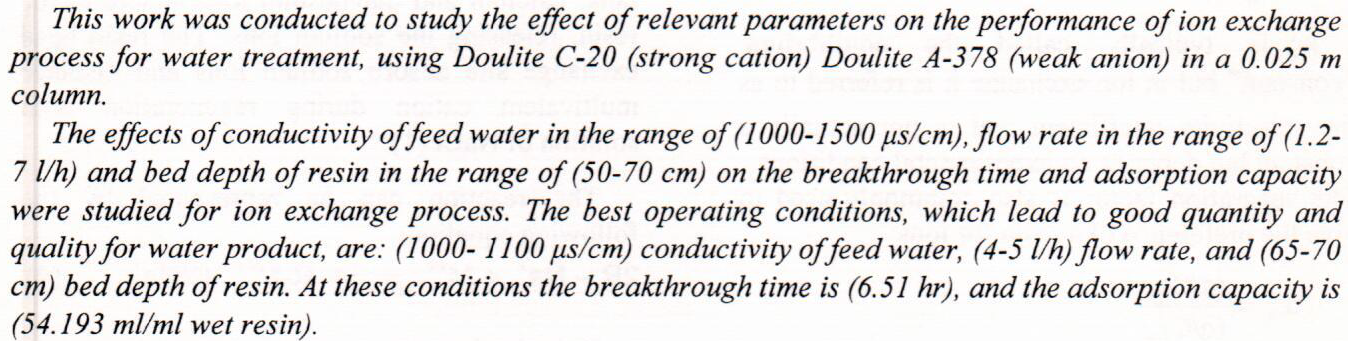
Water Treatment of Cooling Towers Blowdown by Ion Exchange

The major objectives of this research are to analyze the behavior of road embankments
reinforced with geotextiles constructed on soft soil and describe the finite element analysis by using
ANSYS program ver. (5.4). The ANSYS finite element program helps in analyzing the stability of
geo- structure (embankment) in varied application of geotextiles reinforcement to enhance the best
design for embankment.
The results of analysis indicate that one of the primary function of geotextiles reinforcement was to
reduce the horizontal displacement significantly. With the inclusions of reinforcement, the horizontal
displacement reduced by about (81%), while the vertical displacement reduced by (32%). The effect
of geotextiles
 (1)
(1)

This study aims to assess the removal efficiency andestablish the BOD5 and COD statisticalcorrelation of the sewage flowing in Al-Diwaniyah wastewater treatment plant in Iraq during the study period (2005-2016). The strength of the influent wastewater entering the plant varied from medium to high in strength. High concentrations of BOD5 and COD in the effluent were obtained due to the poor performance of the plant. This was observed from the BOD5 /COD ratios that did not confirm with the typical ratios for the treated sewage. To improve the performance of this plant, regression equations for BOD5 and COD removal percentages were suggested which can be used to facilitate evaluation of liquid waste and optimal control process. The equations
... Show MoreKE Sharquie, HR Al-Hamamy, AA Noaimi, KA Ali, Journal of Cosmetics, Dermatological Sciences and Applications, 2015 - Cited by 3
Four localities were selected in Euphrates River and Ramadi sewage treatment plant to collect water samples monthly during the period between October 2001 to July 2002 . Total cell count of phytoplankton and its physico- chemical concentrations were determined . The study aimed to demonstrate the effect of Ramadi sewage treatment plant on Euhprates River . It is concluded that the sewage had an dilution effect for the total hardness , total alkalinity , electrical conductivity and salinity of Euphrates River , but it is also caused in the presence of a contaminated area . This was cleared from the depletion of dissolved oxygen and high values of biological oxygen demand with lower valuse of pH in this area . The water of Euphrates
... Show More
(1)
Diabetic neuropathy is a form of nerve damage that can occur in people who have diabetes. High blood sugar (glucose) induced nerve damage in every part of the body. The nerves in the legs and feet were the most frequently affected. The extent to which a diabetic patient's body is impaired is calculated by the degree of nervosa harm.The purpose of this present study is estimation BMI,IL-10 , nesfatin-1 and HS-CRP in Iraqi DN patients before and after treatment via tegretol as well as it is the first study sheds light on the relationship between Nesfatin -1 and other parameters ( BMI,IL-10 and HS-CRP) also predication of Nesfatin-1 as a newly biomarker in patients with diabetic neuropathy. The present study consist of from 30 cohort G1 as hea
... Show MoreBACKGROUND: The humeral shaft fractures have a good rate of union, despite this fact, still there is a significant rate of nonunion after nonoperative treatment and more often after operative treatment. AIM: The aim of the study is to evaluate the autogenous onlay graft with compression plate for treatment of persistent humeral shaft non-union with failed previous surgery both radiological and functional outcome. MATERIALS AND METHODS: A prospective study on twenty patients having persistent aseptic non-union age between 20 and 60 years old, after failed surgical treatment of fractures humeral shaft in Al-Zahra teaching and Al-Kindy teaching hospitals, while infected nonunion, diabetes mellitus, secondary metastasis, smoking, a
... Show More
This study has been carried out to evaluate the expression level of beta 2 microglobulin gene on patients infected by hepatitis C virus before and after treatment with interferon. The study included 117 hepatitis C patients comprising as 63 pre-treated patients, the range of age was between 20-65 year with a mean age of 48.12 ± 16.1 and 54 post-treated patients with age range was between 23-63 year with the mean of 46.1 ± 18.1. Also it was found that more than half of patients were located within third and fourth decade i.e. 30-49 year, with a percentage of 52.4% and 55.6 % for pre-treatment and post-treatment patients respectively. Moreover , regarding both groups, males are more than females with the ratio of ( 3.2:1) among p
... Show More
Background: Obesity is considered an important risk factor for periodontal disease. It has been reported that reactive oxygen species linking both diseases, systemic melatonin supplementation as antioxidant therapy, was addressed as an adjuvant to scaling and root surface debridement (SRP) to enhance the treatment of periodontitis. Objective: To investigate the efficacy of systemic melatonin administration in periodontitis-obese patients as an adjuvant to scaling and root surface debridement (SRP). Methods: A randomized clinical trial was conducted at a dental-specialized center. Eighty subjects were included and allocated into group-I: twenty periodontium-healthy, normal-weight people; group-II: 30 obese patients with stage-III tre
... Show More (1)
(1)
(1)
(1)
Efficient management of treated sewage effluents protects the environment and reuse of municipal, industrial, agricultural and recreational as compensation for water shortages as a second source of water. This study was conducted to investigate the overall performance and evaluate the effluent quality from Al- Rustamiya sewage treatment plant (STP), Baghdad, Iraq by determining the effluent quality index (EQI). This assessment included daily records of major influent and effluent sewage parameters that were obtained from the municipal sewage plant laboratory recorded from January 2011 to December 2018. The result showed that the treated sewage effluent quality from STP was within the Iraqi quality standards (IQS) for disposal and t
... Show MoreBackground: Congenital heart disease is one of the most common developmental anomalies in children. These patients commonly have poor oral health that increase caries risk. Dental management of children with congenital heart disease requires special attention, because of their heightened susceptibility to infectious endocarditis. The aims of this study were to assess the severity of dental caries of primary and permanent teeth and treatment needs in relation to nutritional indicator (Body Mass Index) among children with congenital heart disease. Materials and Methods: In this case-control study, case group consisted of 399 patients aged between 6-12 years old with congenital heart disease were examined for dental status in Ibn Al-Bitar spec
... Show More
(2)