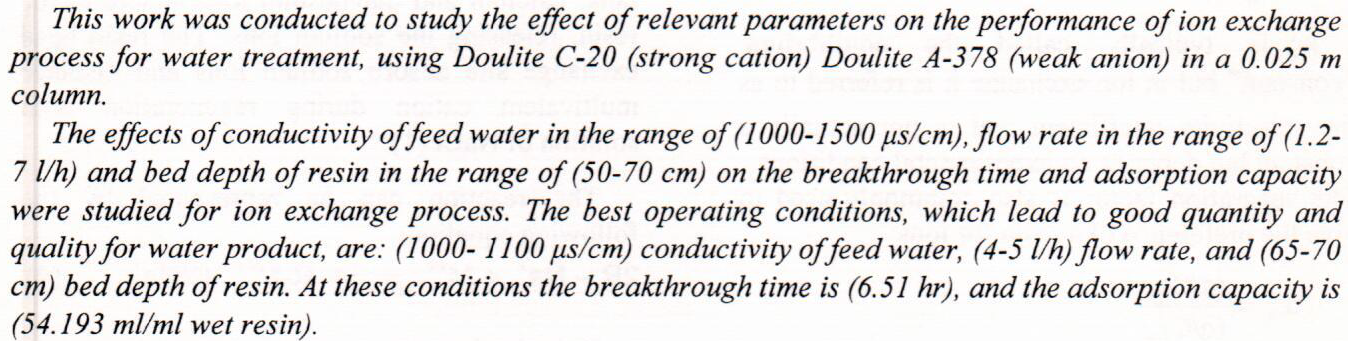
Water Treatment of Cooling Towers Blowdown by Ion Exchange

Background: Hyperlipidemia is an elevated fat (lipids), mostly cholesterol and triglycerides, in the blood. These lipids usually bind to proteins to remain circulated so-called lipoprotein. Aims of the study: To determine taste detection threshold and estimate the trace elements (zinc) in serum and saliva of those patients and compare all of these with healthy control subjects. Methods: Eighty subjects were incorporated in this study, thy were divided into two groups: forty patients on simvastatin treatment age between (35-60) years, and forty healthy control of age range between (35-60) years. Saliva was collected by non-stimulated technique within 10 minutes. Serum was obtained from each subject. Zinc was estimated in serum and saliva
... Show More (2)
(2)
 (2)
(2)


Microbiological contamination by fungi impacts the quality and safety of wheat grain storage. This study aimed to evaluate the efficacy of cold plasma in restricting the growth of the fungus, Aspergillus niger, which was isolated from wheat grains. A dielectric barrier discharge (DBD) operating at atmospheric pressure generated cold plasma that was used to treat the fungus, and the impact of this treatment was investigated at various periods 1, 2, 4, 6, and 15 minutes. The results revealed a highly significant decrease in the growth and number of spores of Aspergillus niger compared to the controls. This study revealed an efficient technique for enhancing wheat grain storage that could be a foundation for further large-scale studies.
... Show More
(6)
(4)
This study examined the adsorption behavior of anionic dye (orange G) from aqueous solution onto the raw and activated a mixture of illite, kaolinite and chlorite clays from area of Zorbatiya (east of Iraq).The chemical treatment involved alkali and acid activation. The alkali activation obtained by treated the raw clay (RC) with 5M NaOH (ACSO) and the acid activation founded by treated it with 0.25M HCl (ACH) and 0.25M (ACS). The thermal treatment carried out by calcination the produce activated clay at 750oC for acid activation and 105oC for alkali activation. Batch
... Show Morethis study aimed to study the effect of Cordia myxa extract on the growth and activities of the following types of bacteria : Escherichia coli , Pseudomonas aeruginosa, Proteus Spp., Klebsiella pneumoniae , Staphylococcus aureus, Streptococcus pyogenes , Bacillus subtilus, and the yeast Candida albicans .the results showed an inhibitory effect of the methanol extract on both the growth and activity of the tested microbes .this was reflected by the minimum inhibitory concentration ( MIC ) of different type of bacteria and the yeast.
(1)
This work is devoted to the modeling of streamer discharge, propagation in liquid dielectrics (water) gap using the bubble theory. This of the electrical discharge (streamer) propagating within a dielectric liquid subjected to a divergent electric field, using finite element method (in two dimensions). Solution of Laplace's equation governs the voltage and electric field distributions within the configuration, the electrode configuration a point (pin) - plane configuration, the plasma channels were followed, step to step. The results show that, the electrical discharge (streamer) indicates the breakdown voltage required for a 3mm atmospheric pressure dielectric liquid gap as 13 kV. Also, the electric potential and field distributions sho
... Show More
The main objective of this study is to experimentally investigate the effect of the CMC polymeric drag reducer on the pressure drop occurred along the annulus of the wellbore in drilling operation and investigate the optimum polymer concentration that give the minimum pressure drop. A flow loop was designed for this purpose consist from 14 m long with transparent test section and differential pressure transmitter that allows to sense and measure the pressure losses along the test section. The results from the experimental work show that increasing in polymer concentration help to reduce the pressure drop in annulus and the optimum polymer concentration with the maximum drag reducing is 0.8 kg/m3. Also increasing in flow rate a
... Show More
To identify the fungi associated with water hyacinth (Eichhornia crassipes [Mart.] Solms), an aquatic weed, which presents in Tigris river from Baghdad south ward. Five regions from middle and south of Iraq (Al-Noumanya, Saeid Bin-Jubier, Al-Azizia, Al-Reyfay and Al-Hay) were selected for this study. Twelve fungal species were isolated. Alternaria alternata, Acremonium sp and Cladsporium herbarum, were the most frequently species (91.66 % ,50 % and 25 %) respectively. The fungi Alternaria alternata, Acremonium sp. and Phoma eupyrena were more aggressive to water hyacinth as (91.66%,83,33%, and 75%) in pathogenicity test.
(10)
It is well known that drilling fluid is a key parameter for optimizing drilling operations, cleaning the hole, and managing the rig hydraulics and margins of surge and swab pressures. Although the experimental works represent valid and reliable results, they are expensive and time consuming. In contrast, continuous and regular determination of the rheological fluid properties can perform its essential functions during good construction. The aim of this study is to develop empirical models to estimate the drilling mud rheological properties of water-based fluids with less need for lab measurements. This study provides two predictive techniques, multiple regression analysis and artificial neural networks, to determine the rheological
... Show More