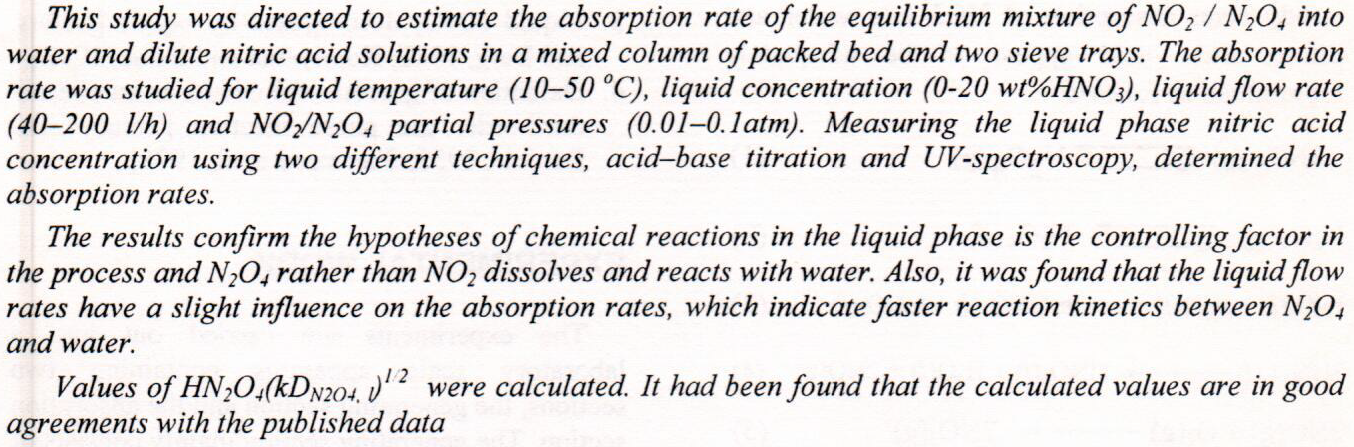
Absorption of NO2 into Water and Nitric Acid Solutions in a Fixed Column

 (6)
(6)
 (8)
(8)


The relationship of hyperuricemia to kidney disease, diabetes, hypertension and the risk of cardiovascular diseases remain controversial. The aim of this study is to evaluate the use of uric acid (UA) levels to find the higher risk of cardiovascular disease (CVD) in patients with end stage renal disease that have diabetic nephropathy (DN), nephropathy with hypertension (NH) and patients with both diabetic nephropathy with hypertension (DNH). This study deals with 115 patients with end-stage renal disease under hemodialysis sub-grouped into 35 patients with (DN), 40 patients with (NH), and 40 patients with (DNH). Some biochemical parameters were determined in the serum of all participants such as HbA1c, fasting blood glucose (FBG), UA, urea,
... Show More
(1)
Metal nanoparticles can serve as an efficient nano-heat source with confinement photothermal effects. Thermo-plasmonic technology allows researchers to control the temperature at a nanoscale due to the possibility of precise light propagation. The response of opto-thermal generation of single gold-silica core-shell nanoparticle immersed in water and Poly-vinylpyrrolidone surrounding media is theoretically investigated. Two lasers (CW and fs pulses) at the plasmonic resonance (532 nm) are utilized. For this purpose, finite element method is used via COMSOL multiphysics to find a numerical computation of absorption cross section for the proposed core –shell NP in different media. Thermo-plasmonic response for both lasers is studied. The
... Show More
(21)
(9)
 (15)
(12)
(15)
(12)
A simple , sensitive and accurate spectrophotometric method for the trace determination of bismuth (III) has been developed .This method is based on the reaction of bismuth (III) with arsenazo(III) in acid solution (pH=1.9) to form a blue water soluble complex which exhibits maximum absorption at 612nm .Beer's law is obeyed over the concentration range of 2-85 ?g bismuth (III) in a final volume of 20 mL( i.e. 0.1 – 4.25?g.mL-1) with a correlation coefficient of (0.9981) and molar absorptivity 1.9×10⁴ L.mol-1.cm-1 . The limit of detection (LOD) and the limit of quantification (LOQ) are 0.0633 and 0.0847 ?g.mL-1 , respectively . Under optimum conditions,the stoichiometry of the reaction between bismuth (III) and arsenazo(III) r
... Show More
Natural polymers are often non-toxic, biodegradable, biocompatible, and safe. A novel ligand was synthesized as a natural polymer using chitosan and oleander plant extract [(2R,3S,4R,5S)-5-(acetoxyamino)-4-hydroxy-3,6-dimethoxytetrahydro-2H-pyran-2-yl) methyl (16R)-3-(((2S,4S,5R)-4-methoxy-2,5-dimethyltetrahydro-2H-pyran-2-yl)oxy-10,13,16-trimethyl-17-(5-oxo-2,5-dihydrofuran-3-yl) hexadecahydro-14H-cyclopenta [a] phenanthren-14-yl) phthalate] (Chitosan-Ph-Oleander). This ligand and its complexes with several metals (Cr+3, Mn+2, Fe+3, Ni+2, Cu+2, Zn+2) were characterized using FTIR, UV-visible and 1H-NMR spectroscopy, as well as by molar conductivity, magnetic moment, and TGA analysis. The biological activity for the prepared polymer
... Show More
(2)
Chlorine disinfection is a globally used method to ensure the safety of drinking water. However, it has not always been successful against viruses and, therefore, it is important to find new methods to disinfect water. Seventeen different coliphages were isolated from the treated municipal wastewater. These coliphages and MS2 were treated with different dosages of chlorine in drinking water, and a combined chlorine/ultraviolet irradiation treatment for the chlorine-resistant coliphages. Chlorine disinfection with 0.3–0.5 mg/L total chlorine (free Cl-dosage 0.12–0.21 mg/L) for 10 min achieved 2.5–5.7 Log10-reductions for 11 sensitive coliphages. The six most resistant coliphages showed no reduction with these chlorine concentra
... Show More
(36)
(37)
This study was carried out to study effect of magnetic water ( M0 and M) and different concentrations of coconut extract in Fragaria x ananassa (Duch) C.V Festival. The results showed significant differences in the plants treated with magnetic water ( 0.12 Tesla) and different concentrations of coconut extract C1 (0%), C2 (2.5%), C3 (5%), C4 (7.5%) and C5 (10%) in vegetative parameters as in leaf area and chlorophyll in treatment M0C3 was (53.72 Dcm2, 50.00), respectively, highest leaf number and plant dry weight in MC4 (12.77,14.22 gm), respectively. Results recorded significant differences in fruit parameters such as weight in MC1 (18.97 gm). The maximum fruit number was in MC3 (110), the greatest fruit size was in MC4 (15.78 cm3) and the
... Show More
(43)
(36)
Groundwater quality deterioration due to anthropogenic natural activities and its immense utilization in various sectors is considered a great concern. The aim of this study is to determine the groundwater quality parameters at various sources in and around Dhaka city and compare them with Bangladesh drinking water standards. In this study, six groundwater quality parameters (pH, DO, COD, TS, TDS, and arsenic) and ten groundwater samples are analyzed to determine the water quality. The collected samples have maximum and minimum pH values of 6.9 and 6.4, respectively. Maximum and minimum DO values are 0.3 and 0.1 mg/L, respectively. The arsenic concentration is 0 mg/L for all collected groundwater samples. The maximum and minimum COD
... Show More
(23)
(17)