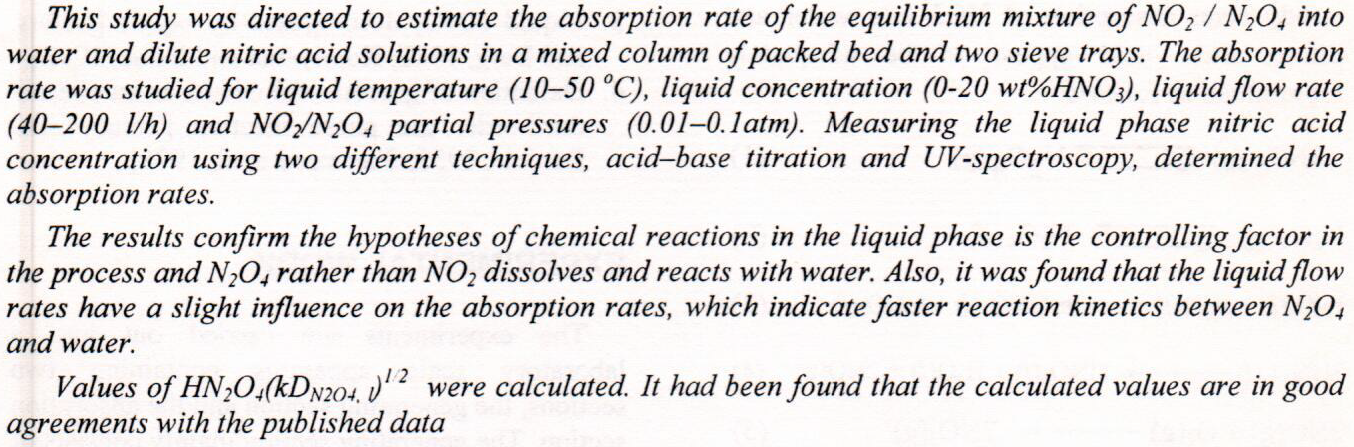
Absorption of NO2 into Water and Nitric Acid Solutions in a Fixed Column

Expired drug Metoclopramide was investigated as an antibacterial corrosion inhibitor for carbon steel in 0.5M H3PO4 solution using the electrochemical method at 30oC and 60oC. The results showed that this drug is an efficient inhibitor for carbon steel and the efficiency reached to 82.244 % for 175 ppm at 30oC and 76.146% for 225 ppm at 60oC. The adsorption of drug on carbon steel surface follows Langmuir adsorption isotherm with small values of adsorption-desorption constant. The polarization plots revealed that Metoclopramide acts as mixed-type inhibitor. Some parameters of inhibition process were calculated and discussed. The surface morphology of the carbon steel speci
... Show More (6)
(6)

A total of nine swab samples were collected from inflamed teeth and gingiva of human’soral cavity from a dentist clinic in Baghdad. All specimens were cultured in Mitis Salivarius agar medium and the isolated bacterial pure colonies werethen identified by using VITEK2. Three samples were diagnosed and identified as Staphylococcus lentus. One of the three isolates which showed a distinctive heavy growth on the media was selected for further analysis in this study. Paper disk diffusion method was used to detect the antibacterial activityof three of mouthwash solutions (Zak, Colgate and Listerine). The results showed that “Colgate†was the most active solution with antibacterial activity compared with the other two s
... Show More (4)
(3)
(4)
(3)

The interactions of drug amoxicillin with maltose or galactose solutions with a variation of temperature have been discussed by taking in the volumetric and viscometric procedures. Physical properties [densities (ρ) and viscosities (η)] of amoxicillin (AMOX) aqueous solutions and aqueous solutions of two type saccharides (maltose and galactose 0.05m) have been measured at T = (298.15, 303.15 and 308.15) K under atmospheric pressure. The apparent molar volume (ϕv cm3mole-1) has been evaluated from density data and fitted to a Redlich-Mayer equation. The empirical parameters of the Mayer-Redlich equation and apparent molar volume at infinite dilution Ø°v were explicated in terms of interactions from type solute-solvent and solute
... Show More
(4)
(3)
The purpose of this research is to identify
the effect of the translation of poetic poem into an artistic picture in the achievement of retention among fifth grade students.
In order to verify the research goal, the first two hypotheses were determined. There are no statistically significant differences between the average scores of the experimental group who study (according to the technical picture) ) And the control group (according to the traditional method of art education) at the level of significance (0,05). The second is that there are no statistically significant differences between the average of the experimental group who study (according to the technical picture) and the control group who study (On According to the trad
Objective: The antimicrobial efficacy of three disinfection solutions: 5.25% sodium hypochlorite (NaOCl), 2% chlorhexidine (CHX) and Listerine mouthwash were investigated as routine chair-side gutta-percha (GP) disinfection reagents. Design: four groups of gutta percha points were contaminated with E. faecalis bacteria then disinfected by immersion in different solutions (5.25% sodium hypochlorite, 2% chlorhexidine gluconate, Listerine mouth wash and distilled water as control) after 1 and 7 days culturing periods. The antibacterial efficacy of these disinfection solutions was evaluated by using colonies per units (CPU) Methods: Forty GP cones (F3 Dentsply) were sterilized with ethylene oxide gas before immersed contamination within broth m
... Show More
(13)
(12)

Unstable angina pectoris often leads to acute myocardial infarction. Since uric acid is thought to be risk factor for cardiovascular disease and considered a major antioxidant in human blood .The level of uric acid and lipid peroxidation in the sera of patients with unstable angina and myocardial infarction were measured and compared to the healthy individuals. Twenty-nine patients with unstable angina and twenty-nine patients with myocardial infarction were studied and compared to twenty-five healthy individuals. Uric acid was measured by using Human Kit. Malondialdelyde (MDA) a lipid peroxidation marker, was measured by thiobarbituric acid method .Significant elevation of uric acid and MDA were observed in the sera of pati
... Show More
Taguchi experimental design (TED) is applied to find the optimum effectiveness of aqueous Red Pomegranate Peel (RPP) extract as a green inhibitor for the corrosion of mild steel in 2M H3PO4 solution. The Taguchi methodology has been used to study the effects of changing, temperature, RPP concentration and contact period, at three levels. Weight-loss measurements were designed by construction a L9 orthogonal arrangement of experiments. Results of the efficiencies of inhibition were embraced for the signal to noise proportion & investigation of variance (ANOVA). The results were further processed with a MINITAB-17 software package to find the optimal condition
... Show MoreIn this paper, Touchard polynomials (TPs) are presented for solving Linear Volterra integral equations of the second kind (LVIEs-2k) and the first kind (LVIEs-1k) besides, the singular kernel type of this equation. Illustrative examples show the efficiency of the presented method, and the approximate numerical (AN) solutions are compared with one another method in some examples. All calculations and graphs are performed by program MATLAB2018b.
(6)
(1)
An efficient combination of Adomian Decomposition iterative technique coupled Elzaki transformation (ETADM) for solving Telegraph equation and Riccati non-linear differential equation (RNDE) is introduced in a novel way to get an accurate analytical solution. An elegant combination of the Elzaki transform, the series expansion method, and the Adomian polynomial. The suggested method will convert differential equations into iterative algebraic equations, thus reducing processing and analytical work. The technique solves the problem of calculating the Adomian polynomials. The method’s efficiency was investigated using some numerical instances, and the findings demonstrate that it is easier to use than many other numerical procedures. It has
... Show More
(4)