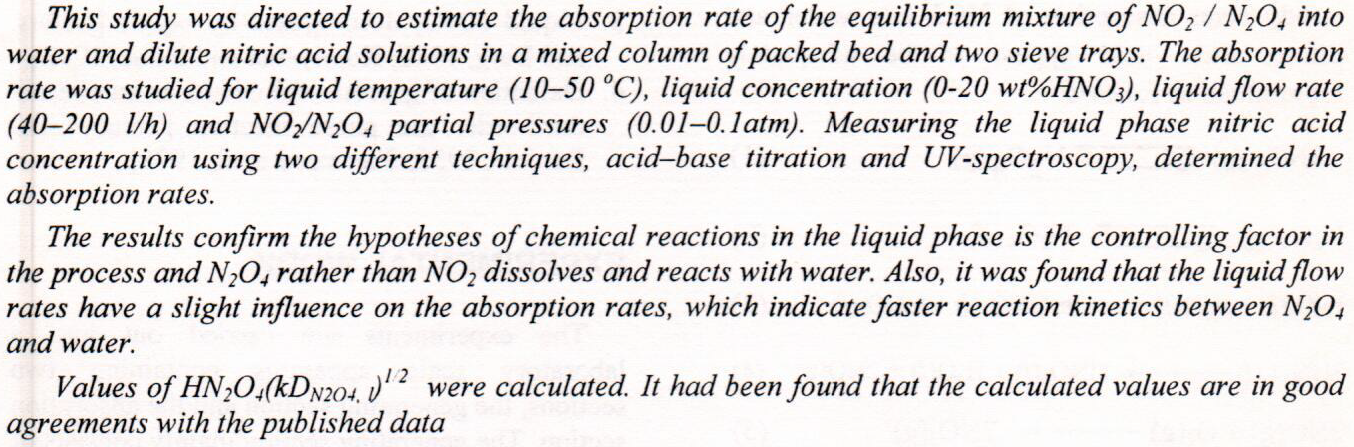
Absorption of NO2 into Water and Nitric Acid Solutions in a Fixed Column

The availability of low- cost adsorbent namely Al-Khriet ( a substance found in the legs of Typha Domingensis) as an agricultural waste material, for the removal of lead and cadmium from aqueous solution was investigated. In the batch tests experimental parameters were studied, including adsorbent dosage between (0.2-1) g, initial metal ions concentration between (50-200) ppm (single and binary) and contact time (1/2-6) h. The removal percentage of each ion onto Al-Khriet reached equilibrium in about 4 hours. The highest adsorption capacity was for lead (96%) while for cadmium it was (90%) with 50 ppm ions concentration, 1 g dosage of adsorbent and pH 5.5. Adsorption capacity in the binary mixture were reduce at about 8% for lead a
... Show MoreWith the advent of the globalization, the rapid development in technology and the intensity of competition companies attemptto maintain competition advantages and retain customers. The traditional methods in managerial accounting become irrelevance to achieve the objectives of these companies especially with the rapid changes in modern manufacturing environment .Thus there is a need to new tools in accounting such as lean accounting, which is considered as a costing method that support creating value for the customer by costing the entire value stream, eliminating waste in the accounting process, reduced lead time, improved quality, lowered time delivery and increased available capacity. Using value stream focuses not only on the waste&n
... Show MoreThe aim of this study is to evaluate the anti fungal activity of a combination of essential oils against water molds. HPLC analysis was done to evaluate the quantity and quality of the active compounds in this combination which extracted from three herbs( Peppermint Menthapiperita ,Thyme Thymusvulgaris, Common sage Salvia officinalis L.) and the active compounds are Camphor,Menthol,,Thujone and Thymol with different concentrations. In this study (MIC) , (MFC) were measured and (LD50) determined after 48,96 h from fingerlings treatment of common carp in aquariums .The results of (MIC) were 0.025µl/ml for Aphanomyces sp. and 0.015µl/ml for both Achlya sp. and Fusariumsolani which showed significant differences(p<0.05) from Malachite gre
... Show More
Titanium oxide nanoparticles-modified smectite (SMC-nTiO2) as a low-cost adsorbent was investigated for the removal of Rhodamine B (RhB) from aqueous solutions. The adsorbents (SMC and SMC-nTiO2) were characterized by scanning electron microscopy, Fourier transforms infrared spectroscopy, and energy-dispersive X-ray spectroscopy. The effects of various parameters like contact time, adsorbent weight, pH, and temperatures were examined. Three kinetic equations (pseudo-first-order (PFO), pseudo-second-order (PSO), and intra-particle diffusion) were used to evaluate the experimental kinetic of the data and the results showed that the adsorption process is in line with the PSO kinetic model. Adsorption equilibrium isotherms were modeled using La
... Show MoreThe aim of this paper was to investigate the removal efficiencies of Zn+2 ions from wastewater by adsorption (using tobacco leaves) and forward osmosis (using cellulose triacetate (CTA) membrane). Various experimental parameters were investigated in adsorption experiment such as: effect of pH (3 - 7), contact time (0 - 220) min, solute concentration (10 - 100) mg/l, and adsorbent dose (0.2 - 5)g. Whereas for forward osmosis the operating parameters studied were: draw solution concentration (10 - 150) g/l, pH of feed solution (4 - 7), feed solution concentration (10 - 100) mg/l. The result showed that the removal efficiency by using adsorption was 70% and the removal efficiency by using forward osmosis was 96.2 %.
... Show MoreRemoval of heavy metals from waste water has received a great deal of attention. The compare Cr
(VI) adsorption characteristics removing from wastewater by using thermally modified and non-modified
eggshells were examined
In this work, a local sunflower husk (SFH) was used as a natural surface for removing Basic Green-4 (BG4) dye, as a watersoluble pollutant. The effect of initial concentration, contact time, the mass of surface of the dye with the SFH as well as the medium temperature was studied. The application of Langmuir, Freundlich isotherms on the collected data of the adsorption process found to harmonize to Freundlich equation more than that of Langmuir. However, the adsorbed mass of BG4 dye showed a direct increase with the increase of SFH mass and equilibrium was achieved within a 60min window. The interaction of BG4 with SFH surface was spontaneous and exothermic. The empirical kinetic outcomes at ambient temperatures were applied to pseudo 1st a
... Show More
 (7)
(7)
 (3)
(3)
 (2)
(1)
(2)
(1)