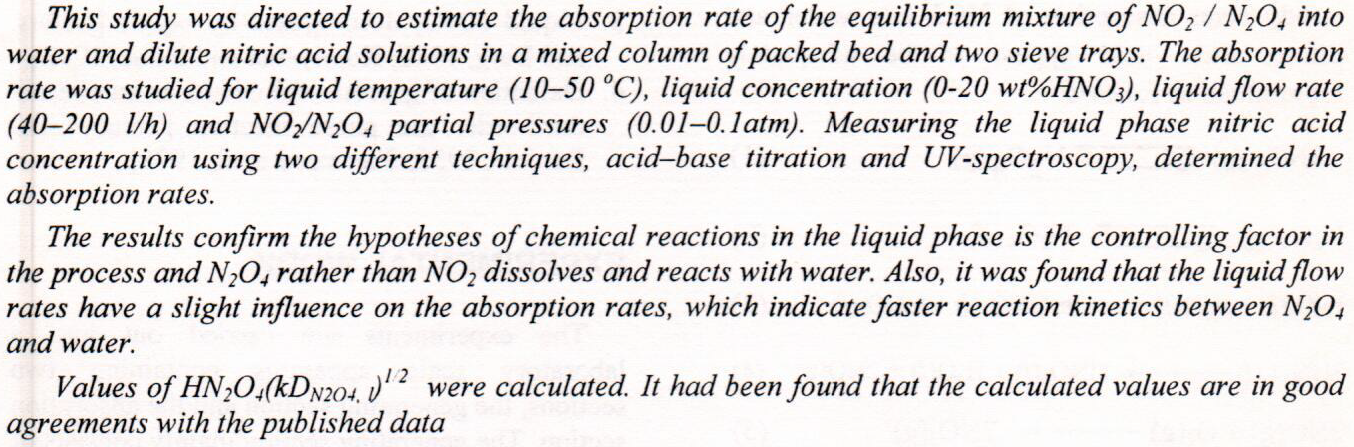
Absorption of NO2 into Water and Nitric Acid Solutions in a Fixed Column

 (8)
(8)
 (6)
(6)


 (14)
(11)
(21)
(12)
(2)
(3)
(63)
(50)
(14)
(11)
(21)
(12)
(2)
(3)
(63)
(50)
Background: Salivary tumors are uncommon, being of low incidence worldwide. This study aimed to assess cases collected in this series of salivary gland tumors in regard to histopathological typing, in relation to age, site and gender. Materials and methods: This is a retrospective study; cases were collected from public and private laboratories. A total number of 171 cases were collected. The slides were reviewed and reclassified for histopathological typing according to WHO classification 2005. Results: Benign tumors were more common than malignant tumors. The most common histological type was benign mixed tumor, followed by Warthin’s tumor. The most common malignant tumor was adenoid cystic carcinoma. One hundred twenty three cases ou
... Show MoreA new method for construction ion-selective electrode (ISE) by heating reaction of methyl orange with ammonium reineckate using PVC as plasticizer for determination methyl orange and determination Amitriptyline Hydrochloried drug by formation ion-pair on electrode surface . The characteristics of the electrode and it response as following : internal solution 10-4M , pH (2.5-5) ,temperature (20-30) and response time 2 sec. Calibration response for methyl orange over the concentrationrange 10-3 -10-9 M with R=0.9989 , RSD%=0.1052, D.O.L=0.315X10⁻⁹ MEre%=(-0.877- -2.76) , Rec%.=(97.230 -101.711) .
The aim of the work is synthesis and characterization of bidentate ligand [3-(3-acetylphenylamino)-5,5-dimethylcyclohex-3-enone][HL], from the reaction of dimedone with 3-amino acetophenone to produce the ligand [HL], the reaction was carried out in dry benzene as a solvent under reflux. The prepared ligand [HL] was characterized by FT-IR, UV-Vis spectroscopy, 'H, 8C-NMR spectra, Mass spectra, (C.H.N) and melting point. The mixed ligand complexes were prepared from ligand [HL] was used as a primary ligand while 8-hydroxy quinoline [HQ] was used as a secondary ligand with metal ion M(IT).Where M(IT) = (Mn ,Co ,Ni ,Cu ,Zn ,Cd and Pd) at reflux ,using ethanol as a solvent, KOH as a
... Show More
Background: Dyslipidemia is defined as an abnormally high level of various lipids in the blood. It is considered a major risk for atherosclerosis and coronary artery disease. Genetic susceptibility can have a significant influence on the development and progression of dyslipidemia. ApoB-100 R3500Q mutation and ApoE variants are among those genetic risks for dyslipidemia. This study aims to assess the possible contribution of ApoB and ApoE variants on lipid profile among a group of early-onset ischemic heart disease (IHD) patients in comparison to a group of controls. Methods: Forty patients with dyslipidemia and early-onset IHD without chronic conditions likely to cause derangement of lipid levels were recruited to this case-control study
... Show More