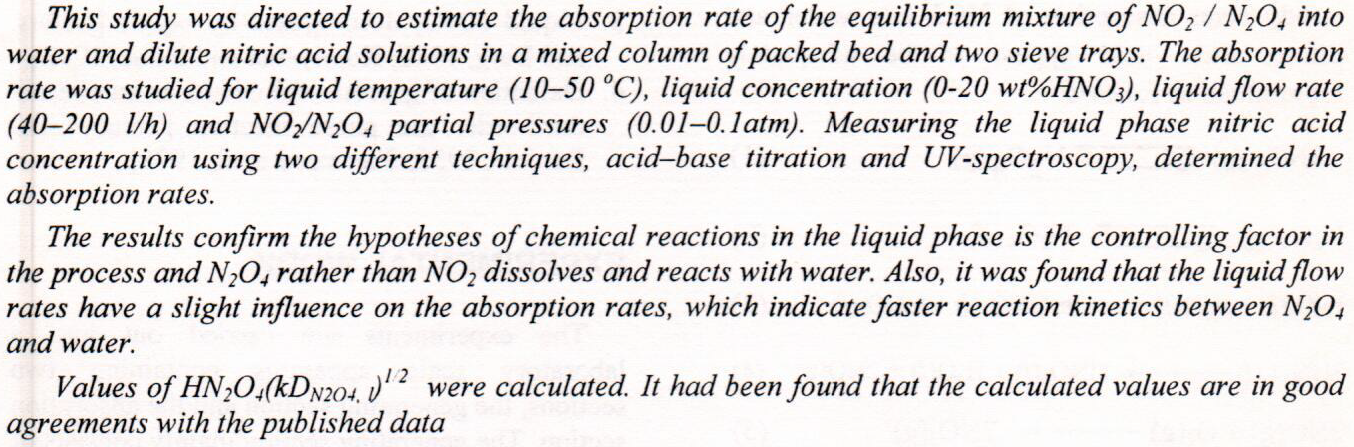
Absorption of NO2 into Water and Nitric Acid Solutions in a Fixed Column

Linear motor offers several features in many applications that require linear motion. Nevertheless, the presence of cogging force can deteriorate the thrust of a permanent magnet linear motor. Using several methodologies, a design of synchronous single sided linear iron-core motor was proposed. According to exact formulas with surface-mounted magnets and concentrated winding specification, which are relying on geometrical parameters. Two-dimensional performance analysis of the designed model and its multi-objective optimization were accomplished as a method to reduce the motor cogging force using MAXWELL ANSYS. The optimum model design results showed that the maximum force ripple was approximatrly reduced by 81.24%compared to the origina
... Show More (4)
(4)

Generally fossil based fuels are used in internal combustion engines as an energy source.
Excessive use of fossil based fuels diminishes present reserves and increases the air pollution in
urban areas. This enhances the importance of the effective use of present reserves and/or to develop
new alternative fuels, which are environment friendly. Use of alternative fuel is a way of emission
control. The term “Alternative Gaseous Fuels” relates to a wide range of fuels that are in the
gaseous state at ambient conditions, whether when used on their own or as components of mixtures
with other fuels.
In this study, a single cylinder diesel engine was modified to use LPG in dual fuel mode to study
the performance, emis
(9)
 (3)
(4)
(3)
(4)

The need for renewable energy sources is higher than ever due to rising global warming, climate change, and ozone depletion. For refrigeration and air conditioning applications, adsorption refrigeration systems are viable alternatives cooling techniques. This study is a topic and part of the M.Sc. thesis. A field solar-powered ice maker unit was created, studied, tested, and evaluated on the 13th and 30th of May, 2022. Activated carbon and methanol pair was used to set up a refrigeration system in Baghdad (Al Dora). Experimental tests were carried out outdoors to determine the coefficient of performance COP and specific cooling power SCP of the system. The results showed that the lowest temperature
... Show More
(7)
(17)
(7)

The necessary optimality conditions with Lagrange multipliers are studied and derived for a new class that includes the system of Caputo–Katugampola fractional derivatives to the optimal control problems with considering the end time free. The formula for the integral by parts has been proven for the left Caputo–Katugampola fractional derivative that contributes to the finding and deriving the necessary optimality conditions. Also, three special cases are obtained, including the study of the necessary optimality conditions when both the final time and the final state are fixed. According to convexity assumptions prove that necessary optimality conditions are sufficient optimality conditions.
... Show More
(11)
(2)
In this paper, variable gain nonlinear PD and PI fuzzy logic controllers are designed and the effect of the variable gain characteristic of these controllers is analyzed to show its contribution in enhancing the performance of the closed loop system over a conventional linear PID controller. Simulation results and time domain performance characteristics show how these fuzzy controllers outperform the conventional PID controller when used to control a nonlinear plant and a plant that has time delay.
(4)
(3)
(25)
(23)